
Rezi builds AI resumes at $234,596 a month — a very large business, cooling very slowly
Rezi is the veteran of this batch: an AI resume builder founded in 2015 that has verified $10,593,245 of all-time revenue. Today it runs at $234,596 MRR across 9,756 subscriptions — and the interesting story is the direction: revenue peaked in April 2026 at $275,551 and has eased down almost every month since, even as website traffic hit its best month of the period.
Product at a glance
Summary
What this business is
Rezi has sold AI resume building since 2015 — long before “AI” was the pitch — and the verified record shows what a decade of compounding looks like: $10,593,245 all-time, 9,756 subscriptions, and a monthly band between $216K and $276K across the last year. The current chapter is a gentle decline: revenue peaked at $275,551 in April 2026 and has eased to $216,471 by October, a −10.5% three-month drift, while SimilarWeb shows traffic rising to its best month of the period. Visits are not the constraint; conversion or pricing is. For a business whose customers, by design, succeed and leave, holding a $235K MRR line for a decade is the achievement — and the slow leak is the story to watch.
Why these scores? See the reasons in Key takeaways →
Momentum
Steady. The last three complete months total $689,027 against $769,790 for the prior three — −10.5%, inside the Steady band. The longer read is less comfortable: October sits 21% below April’s peak.Derived
Best suited for
Operator (main). A decade-long SEO-and-product compounding asset in a seasonal, churn-by-success category — operations over novelty.
Builder (second). How a consumer tool holds $235K MRR when its customers are supposed to leave — lifetime pricing, free-tier funnel, seasonal demand.
What you need to start. A second act beyond the resume moment (career tools, interview prep) or pricing that captures more of the job-search value spike.
Key findings
Product
Product overview
The resume builder that was AI before AI was the selling point.
Rezi builds resumes engineered for applicant-tracking systems: structured templates, AI-generated content tuned to job descriptions, and scoring that tells the user whether the document will survive the filters. It has sold this since 2015 — the AI in the pitch predates the current wave by most of a decade.[1]
The product’s engagement signature shows in the traffic data: visits average 3 minutes 55 seconds across 8.80 pages — people working inside the tool, not bouncing off a landing page. Desktop is 70.78% of traffic, as expected for document work.[2]
The structural fact of the category: the customer’s goal is to stop needing the product. A job seeker subscribes for a search, succeeds, and cancels. Rezi’s answers are the free tier (a wide funnel top), the $29 Pro (priced for a search’s duration) and the $149 lifetime deal (which monetises the churn pattern instead of fighting it).Our read
How it compares
| Business | What it does | MRR or pricing | The difference |
|---|---|---|---|
| Kickresume | Design-led resume and cover-letter builder | $24/mo · $8/mo yearly | Design-first positioning; Rezi leads on ATS/AI scoring |
| Enhancv | Visual resume builder with content checks | Pro from $16.50/mo | Template aesthetics first; 7-day free plan, no lasting free tier |
| Rezi | AI resume builder with ATS focus | MRR $234,596 | The verified scale of the category — $10.59M all-time |
Kickresume and Enhancv prices are from their public pricing pages as reported in Nov 2026 reviews; neither publishes verified revenue, so the MRR column is Rezi’s alone — which is itself the finding.[1][3][4]
What the site looks like
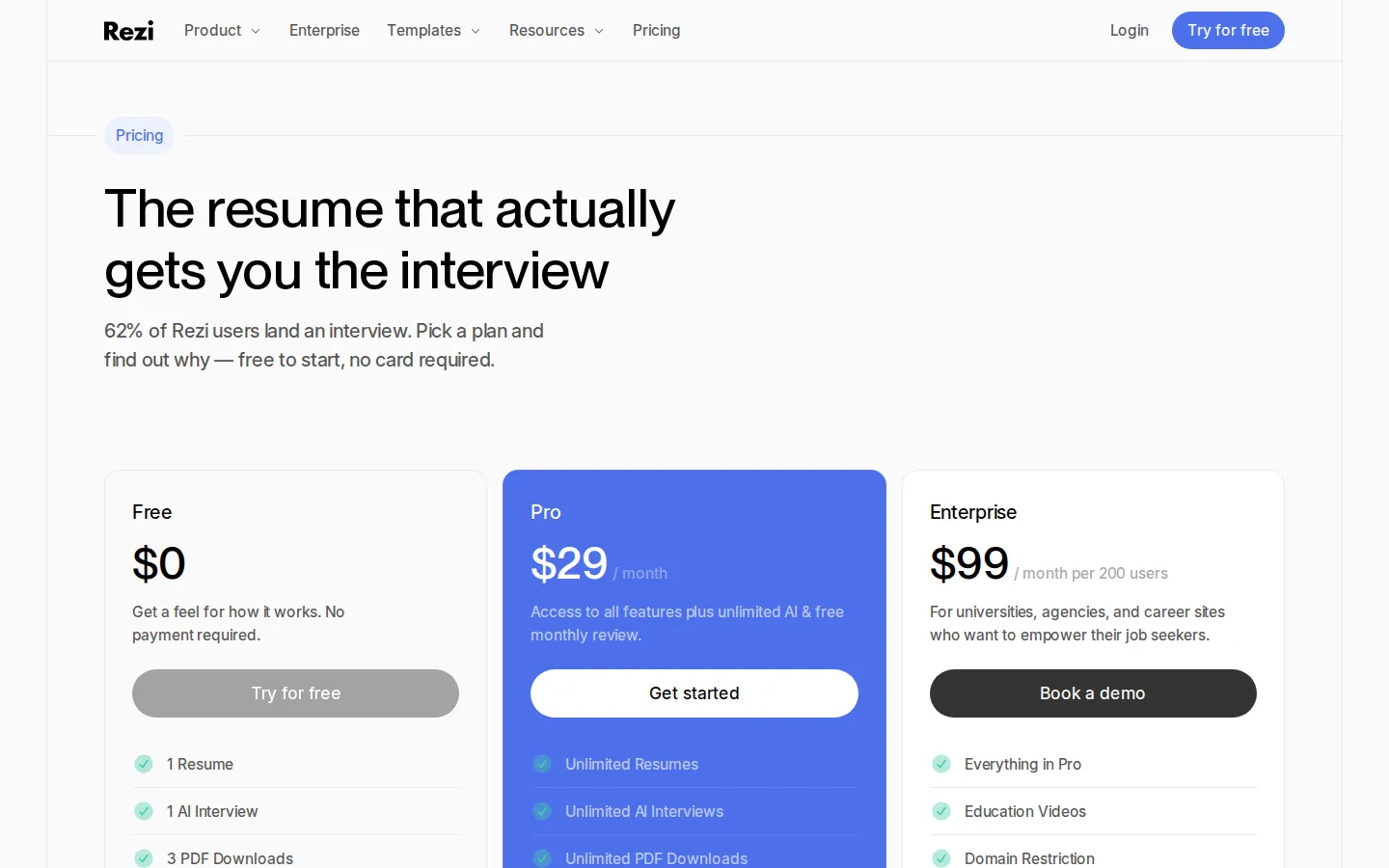
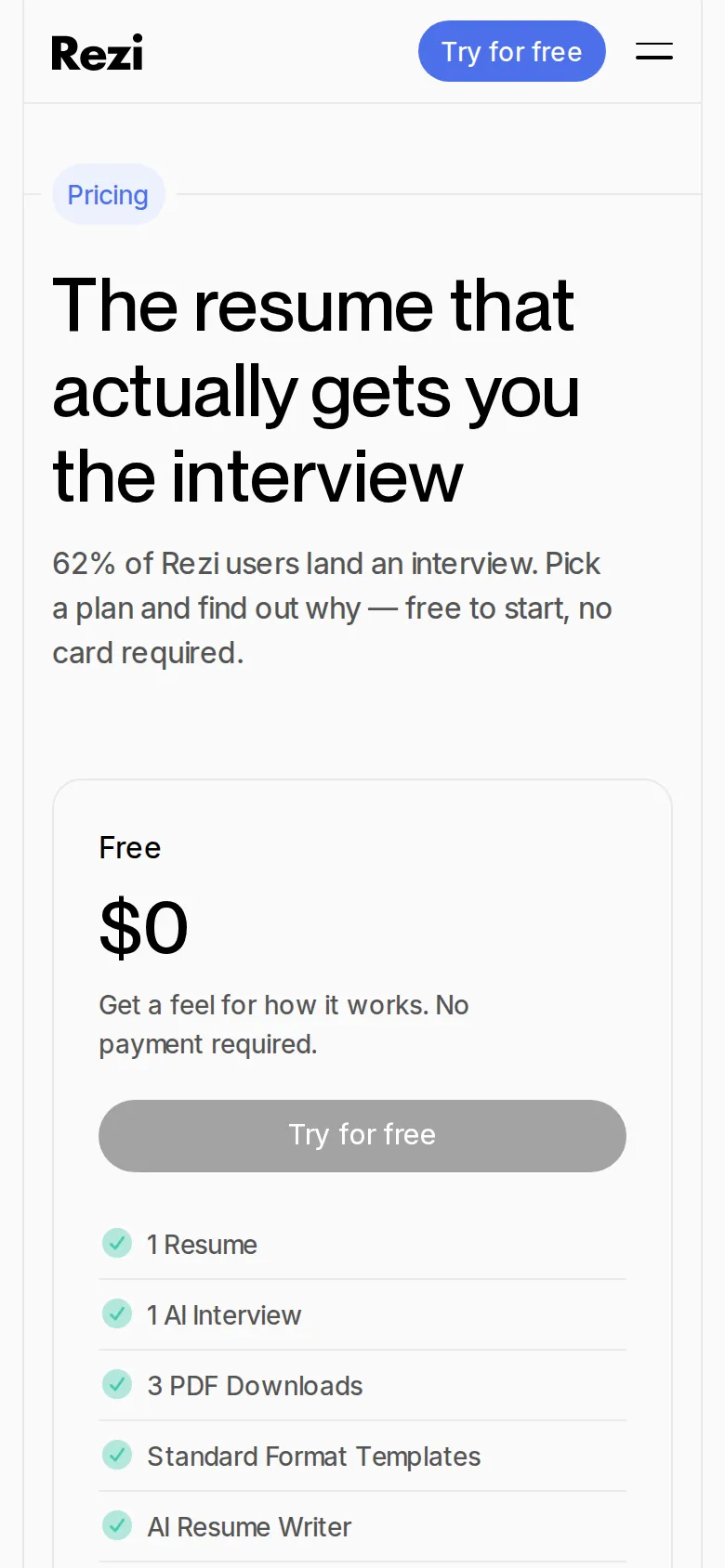
What to look for
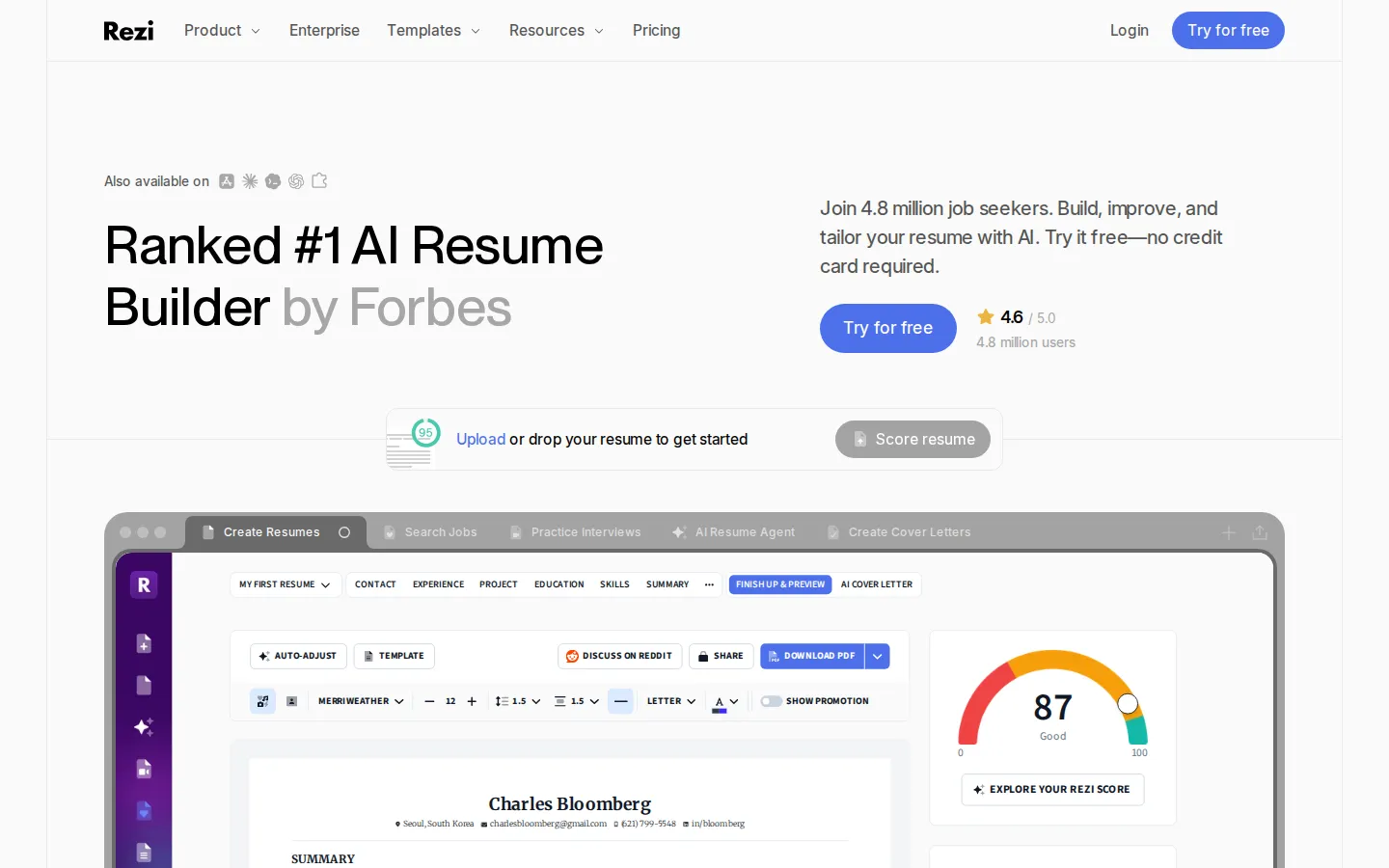
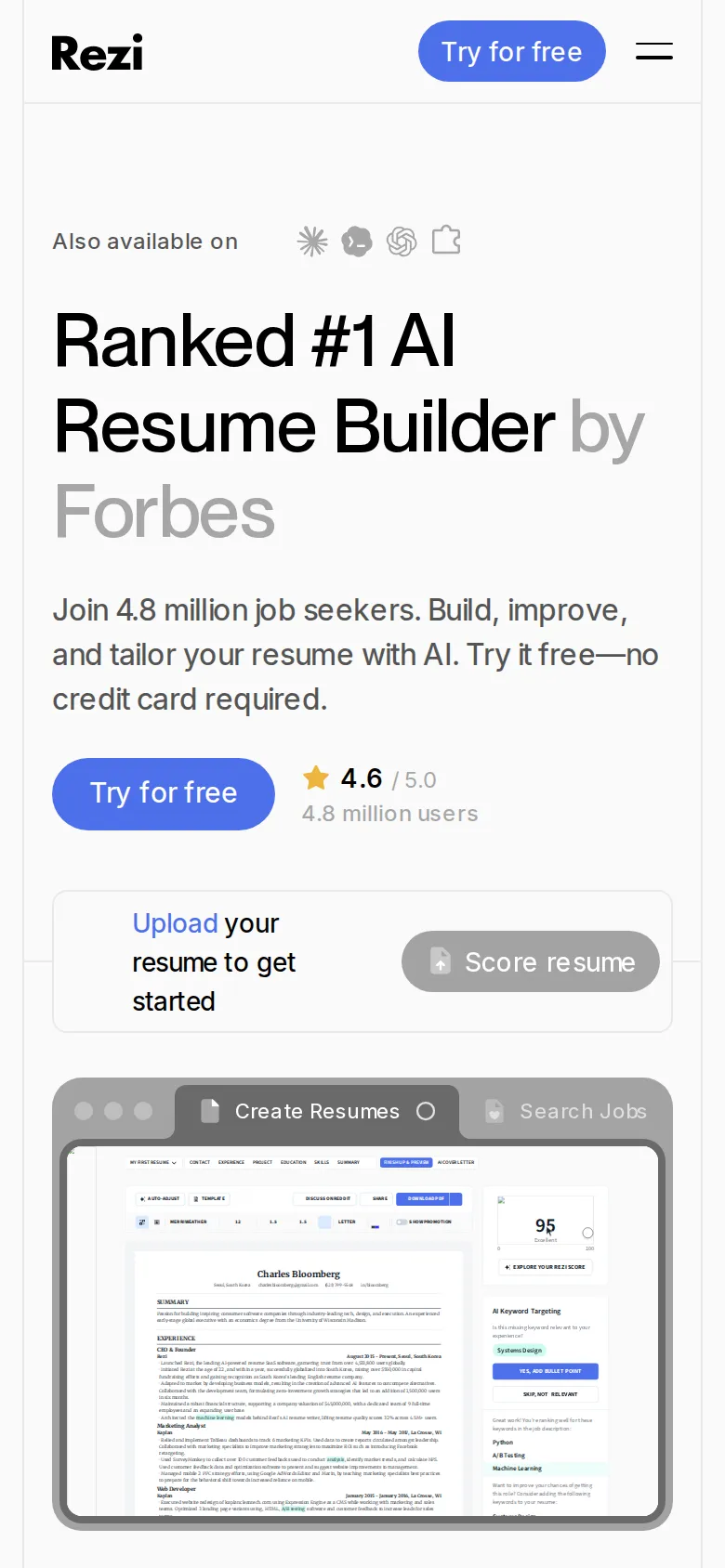
- 1The pitch is outcome-first — get past the ATS, get the interview — with the builder shown immediately.Fact
- 2Social proof is carried high on the page; a decade-old brand sells trust before features.Fact
What to look for
- 1The page shows Free, Pro at $29 and Enterprise at $99/month per 200 users; the $149 lifetime deal (per TrustMRR’s listing) is the churn-by-success answer.Fact
- 2The lifetime deal is the tell: this company would rather have $149 once than gamble on a job seeker renewing.Fact
Pricing
Free, $29 a month, or $149 forever — three answers to a customer who plans to leave.
| Plan | Price | What it covers |
|---|---|---|
| Free | $0 | Entry tier — the funnel top |
| Pro | $29/mo | Full AI builder for an active search |
| Enterprise | $99/mo per 200 users | B2B shelf for universities, agencies and career sites |
| Lifetime | $149 once | One payment; monetises churn-by-success upfront |
The pricing page also carries an Enterprise tier — $99/month per 200 users, sold to universities, agencies and career sites. It is a second, B2B business sitting on top of the consumer one, and the 9,756-subscription count barely reflects it.Fact
Against the category — Kickresume Premium at $24/month ($8/month billed yearly), Enhancv Pro from $16.50/month on six-month billing — Rezi’s $29 is at the confident end, and the derived $24.05 average subscription says discounting and plan mix pull the realised price below sticker. The lifetime deal at roughly five months of Pro is priced for exactly the user who expects to be done by then.Derived
Revenue
Revenue analysis
Eleven months in a high band — with the top of the band behind it.
Daily revenue for the last 30 days (the partial sync day is excluded). Weekends are marked in blue; the best day in the window is dark navy.
| Reading | MRR | Active subscriptions | MRR per subscription |
|---|---|---|---|
| Nov 19, 2026 | $234,596 | 9,756 | $24.05 |
Daily revenue
Oct 22, 2026
Nov 1–19, partial month
daily rows summed, to Nov 19
verified, since 2015
The shape of the record
The year’s shape is a spring peak and a long exhale: $275,551 in April (graduation and hiring season), then $269,975, $250,274, $249,541, $247,272, $225,184, $216,471. Some of this is the category’s seasonality — job-search demand is not flat across a year — and some is drift: September and October are below every month of the prior winter, which seasonality alone does not explain.Derived
MRR tells the same story one notch louder: $234,596, down 4.5% over 30 days on TrustMRR’s snapshot. The subscription base (9,756) is large enough that this is erosion, not noise. The next two quarters — the January job-search surge — are when we learn whether the line resets higher or the peak stays in April.Our read
A note on the numbers
TrustMRR’s header snapshot reports $207,563 for the last 30 days; its daily rows sum to $198,506, a 4.4% gap (the snapshot window and the daily table close on different days). We use the daily sum throughout this report; the monthly timeline is canonical for every other figure.[1]
Market
Resume building is a mature, seasonal consumer category where the free tier is the marketing and the paid moment is brief and urgent. The strategic threat is platform absorption: ChatGPT already writes resumes, and 2.74% of Rezi’s traffic now arrives from generative-AI referrals — the same channel that could eat the category. Rezi’s defences are its ATS specialisation, its templates and eleven years of search presence on terms like “ai resume builder” (its #1 keyword).[2]
Timeline
- May 222015ProductFounded (TrustMRR founding date); founder Jacob Jacquet, United States.[1]
- Dec2025RevenuePublic monthly record for this report opens at $217,472; all-time verified revenue reaches $10.59M by Nov 2026.[1]
- Apr2026RevenueBest month of the record: $275,551 — spring hiring season.[1]
- Oct2026
- Nov 192026RevenueMRR $234,596 on 9,756 subscriptions; November at $132,243 with 11 days left.[1]
Customers
Where customers come from
A mature funnel: brand first, search second, everything else behind.
Direct is 51.51% of 2.30M quarterly visits — a known name typed into the browser. Organic search adds 24.76%, led by “ai resume builder” (6.37%) and “resume builder” (2.78%): category terms, not just brand.[2]
Fact8.80 pages per visit and 3:55 average duration — the highest engagement in this batch. The site is a workplace, not a billboard: traffic arrives to build documents.[2]
FactGenerative-AI referrals are 2.74% of traffic and organic social 6.81%. Small today — but the AI share is the channel to watch for a product whose core task AI assistants increasingly offer free.[2]
FactTraffic figures are SimilarWeb estimates for Aug–Oct 2026, read Nov 19, 2026 — modelled data, not the company’s analytics.[2]
Growth strategies
Two moves from eleven years of compounding.
Takeaways
Rezi is the batch’s proof that boring compounding beats novelty — and a live question about whether even a decade of brand can hold a category that AI assistants are absorbing.
Why we scored it this way
Copy
- Price for success-churn, don’t fight it. The $149 lifetime deal monetises the customer who was always going to leave happy.
- Own the category term. “Ai resume builder” has fed this business for years; brand plus category search is 76% of its funnel.
- Build engagement, not just traffic. 8.8 pages per visit is a product people work in — that depth is a retention asset no landing page creates.
Avoid
- Do not mistake traffic growth for health. Visits hit a quarterly high while revenue slid for six months; watch conversion, not sessions.
- Do not ignore the absorption risk. When 2.7% of your traffic already arrives from AI assistants, the assistant is both channel and competitor.
Predictions
Our predictions
Three dated calls, all checkable on TrustMRR.
Track record: the predictions in our earlier reports are still open; the first checks land Dec 1, 2026. We mark each prediction right or wrong on its date and keep the result on the page.
What could prove us wrong
Things that would change our read, and how to check them.
- The decline is pure seasonality. If the April peak and autumn slide are simply the job-search calendar, January–April 2027 should retrace to $260K+ months.Check: Q1 2027 monthly revenue back above $260,000 would prove the seasonal read.
- The lifetime deal is quietly eating MRR. If lifetime sales are a growing share of billings, cash can hold while the subscription base hollows out.Check: subscriptions falling below 9,000 by Jan 31 while revenue holds above $200K/month.
Appendix
Frequently asked
How much does Rezi make?
$198,506 in the 30 days to Nov 19, 2026, summed from TrustMRR’s daily rows (its header snapshot reads $207,563). MRR is $234,596 from 9,756 subscriptions; all-time verified revenue is $10,593,245.
What does Rezi do?
Rezi is an AI resume builder: ATS-optimised templates, AI writing and resume scoring that help job seekers get past applicant-tracking filters and into interviews.
How much does Rezi cost?
There is a free tier, Pro at $29/month, and a lifetime deal at $149 one-time. The average subscription pays a derived $24.05 a month.
Who founded Rezi?
Jacob Jacquet, in the United States. Rezi’s founding date on TrustMRR is May 2015, making it one of the longest-running AI resume tools with verified revenue.
Sources
- [1]TrustMRR: Rezi — revenue, MRR, subscriptions, daily and monthly data. Verified through a Stripe API key. Synced 2026-11-19.
- [2]SimilarWeb: rezi.ai — traffic estimates for Aug–Oct 2026 (2.30M visits, channels, countries, keywords), read Nov 19, 2026. Modelled estimates, not measured analytics.
- [3]Kickresume pricing — competitor pricing: Premium $24/month, $8/month billed yearly, as reported Nov 2026.
- [4]Enhancv pricing — competitor pricing: Pro from $16.50/month on six-month billing, $39 monthly, as published by the vendor, Oct–Nov 2026.
- [5]Rezi — product description, tiers and positioning as shown on the site, Nov 2026.
What we could not include: no customer-voice section this round — Rezi has review pools on several platforms, but we did not collect them with the two-source standard this report series requires, so the section is omitted rather than padded; it is first on the list for a future update. Plan-level revenue splits (Pro vs lifetime) are not public.
Screenshots © Rezi, used for commentary. Oddig has no business relationship with Rezi. Numbers change daily; check the sources for the latest.
More reports to read
 Chart Scanner AIConsumer app · SubscriptionTwo months of revenue, one verdict per chart — Chart Scanner AI is already at $3,033 MRRRevenue · 30 days$3,493MRR$3,033 Rising fastFor sale
 CoralflavorConsumer app · SubscriptionOne search term carries the whole business: Coralflavor's $4,381 MRR hangs on a single queryRevenue · 30 days$4,086MRR$4,381 Steady
 SilqConsumer app · SubscriptionSilq collected $23,634 in 30 days with $16,609 MRR teaching languages the big apps often skipRevenue · 30 days$23,634MRR$16,609 RisingFor sale
 CalyraConsumer app · SubscriptionCalyra: $119,781 at the August peak — what remains after it?Revenue · 30 days$65,733MRR$47,227 Rising fastFor sale

 Photo AI StudioConsumer app · SubscriptionPhoto AI Studio earned $169,946 before its last 12 months — now it makes about $4,194 a month and is for saleRevenue · 30 days$4,194MRR$3,550 Rising fastFor sale
 AbMaxxConsumer app · Mostly yearlyAbMaxx made $53,086 in September from an AI abs scan — then lost 19% in October, with a $1M price tag onRevenue · 30 days$39,929MRR$22,480


Comments are closed for this article.