
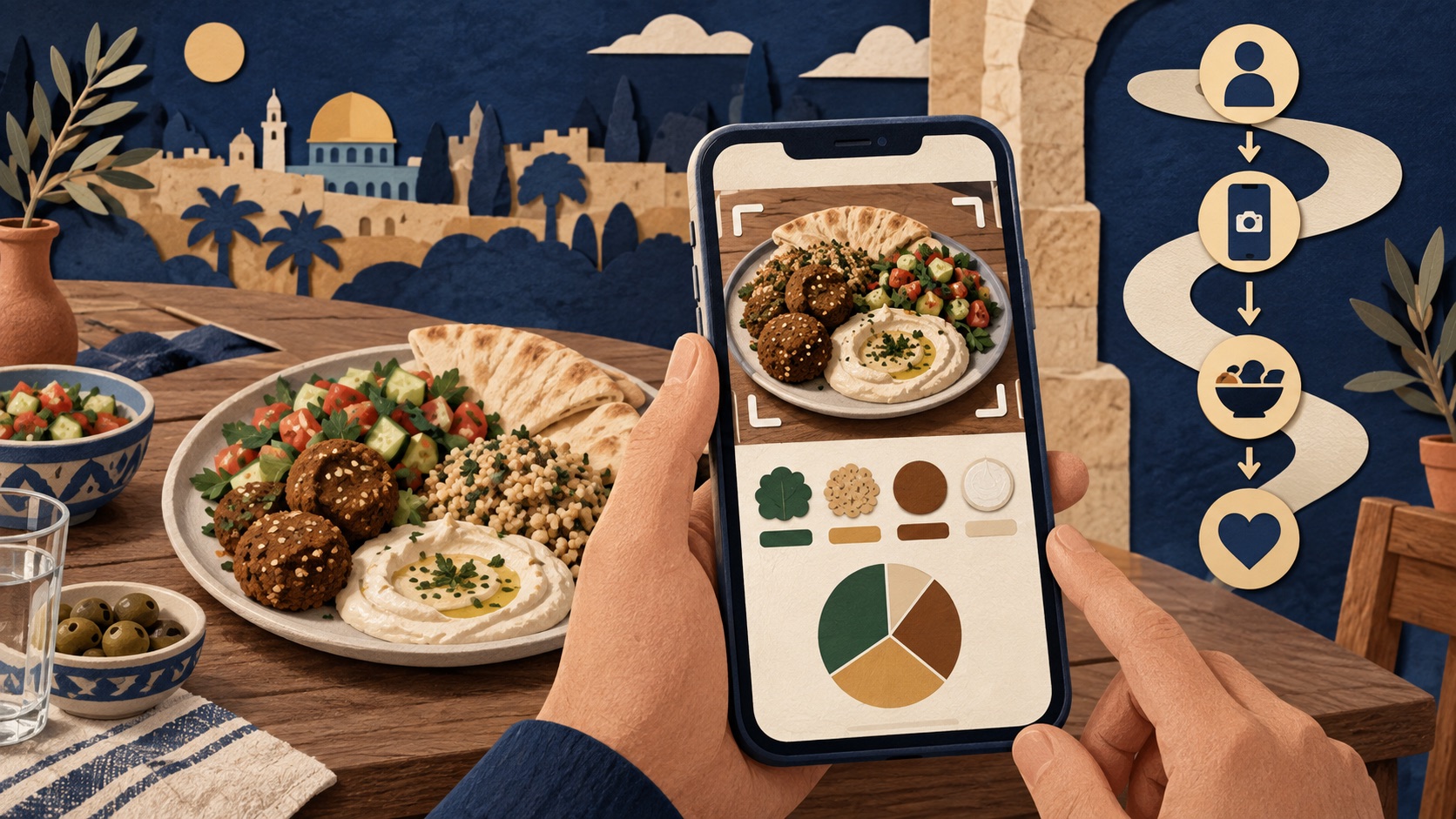
Oddig editorial note: Revenue, cost and partnership terms below are statements by the founder in a Starter Story interview, not audited accounts. Confirm the precise period and the 50/50 deal before publication. The image described above still needs to be produced.
An app idea can be old in one market and still feel newly useful in another. Tomer, the founder of CalBuddy, saw a US photo-based calorie tracker and built a Hebrew-first version for Israel. In a Starter Story interview, he says the app went from roughly $1,000 in its first month after a June 2025 launch to more than $81,000 in April 2026. The interview was published in August. That means the $81,000 is a historical month claimed in the interview, not a verified current run rate or profit figure.
The interesting question is not whether a copy can make money. It is what the founder actually copied, what he changed, and which part of the business is hard to reproduce. CalBuddy's core interaction—photograph food, receive an estimate of calories and macronutrients—is familiar. Its commercial system is not simply a translated screen. The founder combined local food language, relatively cheap local paid media, and a revenue-sharing influencer partnership. If another founder takes only the camera feature, the transferable lesson is lost.
Watch especially 05:32–09:54: the product differences, paid-media approach, and structure of the influencer arrangement. The analysis below separates the founder's statements from our interpretation.
The customer job was familiar; the local workflow was not
n
n
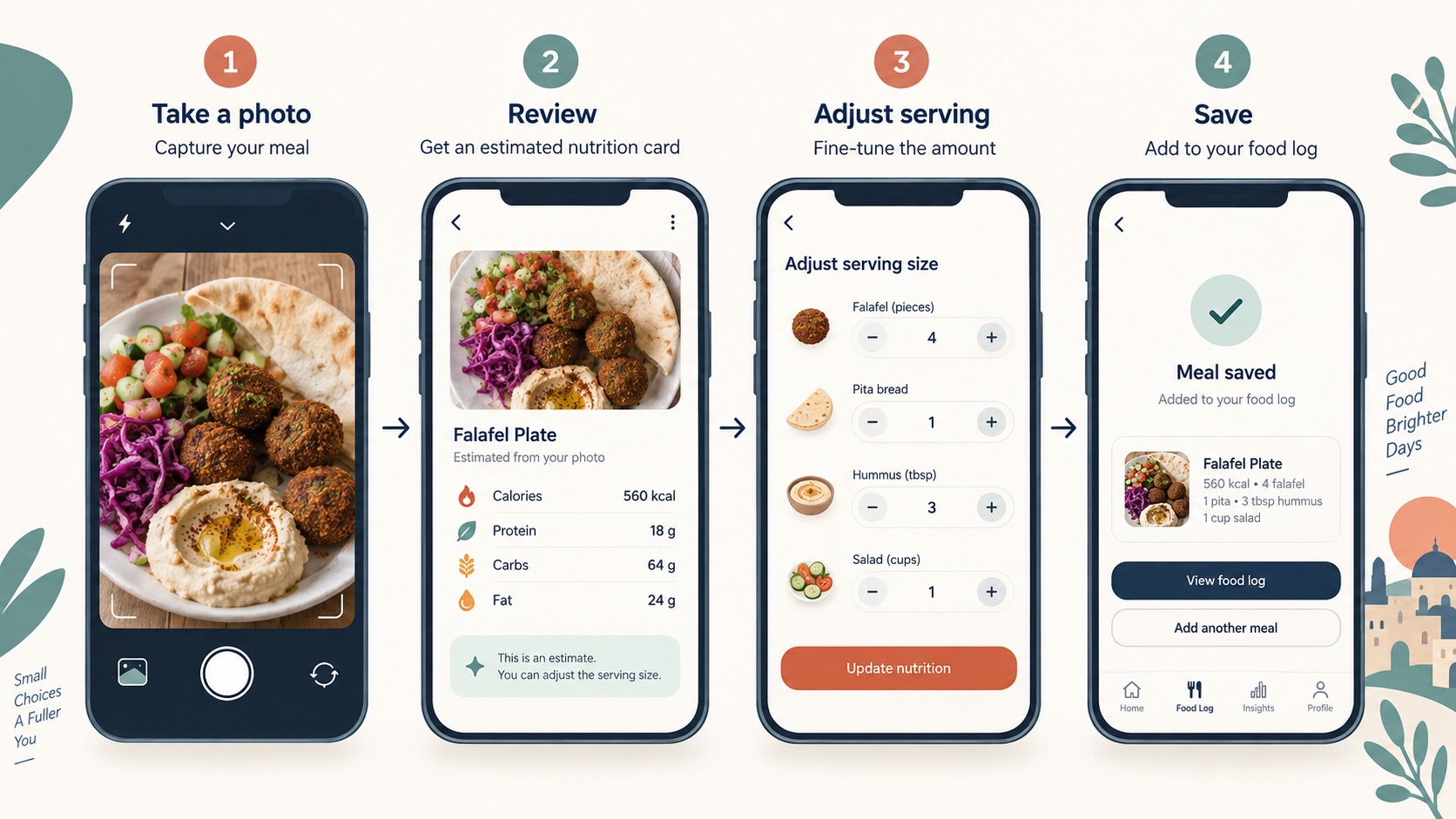
Calorie tracking is a recurring job. People want to understand a meal's nutritional content without weighing ingredients, searching a giant database, and entering each item by hand. A photo-based estimate reduces those steps. CalBuddy's public site presents exactly that proposition in Hebrew: snap a meal, receive calorie and nutrient information, and follow progress toward a goal. The site is useful corroboration that the product and its positioning exist; it does not independently verify the revenue shown in the interview.
The distinction matters. Demand for tracking food does not prove demand for this particular app. Users can choose established alternatives, manual logging, or no tracker at all. Tomer's bet was narrower: the existing photo-led interaction could be packaged for an Israeli audience that recognizes the meals, terms, marketing references, and personalities around it. He says he changed language and several details of how Israelis eat and talk about food, rather than inventing a new calorie-estimation model. That is localization as product work, not merely localization as copywriting.
Consider a lunch with mixed salads, bread, and a cooked dish. The user's problem is not that a global interface lacks a Hebrew translation of “lunch.” The difficult part is identifying servings and ingredients accurately enough to make a useful estimate, then presenting the uncertainty honestly. A localized product can reduce search friction and make the experience feel native, while still needing to solve the underlying measurement problem. The public site makes strong accuracy and time-saving claims; we did not find an independent evaluation of CalBuddy's estimates. Readers should treat nutrition values as estimates, especially for mixed dishes and portion sizes.
| Observed case element | What it may solve | What it does not prove |
|---|---|---|
| Hebrew-first interface and marketing | Recognition and trust for local users | Better food-recognition accuracy |
| Photo-to-calories workflow | Lower logging effort | Medical-grade nutrition measurement |
| Local creative and influencers | More efficient attention and credibility | Durable retention or high margins |
| Revenue screenshot discussed in interview | A founder-reported sales signal | Audited revenue or net income |
This separation helps a builder decide where to spend effort. A localized nutrition app cannot succeed by changing words while leaving its food coverage poor. Equally, a technically excellent model can lose if people never encounter or trust the app. The valuable unit is the entire route from a recognizable meal to a believable estimate to a habit the user is willing to pay to maintain.
The reported revenue path, with the missing denominators
Tomer describes a June 2025 launch, approximately $1,000 in first-month sales, roughly $20,000 per month after four months of paid acquisition, and more than $81,000 for April 2026. Those are interview claims, not a monthly ledger. The recording does not establish whether the figures are gross customer payments, store proceeds after platform fees, recognized subscription revenue, or another revenue definition. It also does not provide a subscriber count, conversion funnel, churn curve, refund rate, model cost, or full ad spend for those periods. A revenue chart, even if genuine, does not answer those questions.
The growth sequence does reveal two distinct stages. First, paid ads reportedly moved the product to about $20,000 monthly revenue. Tomer says local advertising costs were materially lower than in the US and that he studied both successful American calorie-app creative and high-performing Israeli fitness content. Second, he added two well-known local faces as revenue-share partners and attributes the move from around $20,000 to $80,000 monthly revenue to that arrangement. It is plausible that the partners contributed reach and trust, but the interview does not isolate their effect from seasonality, improved ads, pricing changes, word of mouth, or existing growth momentum.
To evaluate a similar story, ask for the denominators in this order: paid customers, gross sales, net sales after app-store fees, acquisition spend, gross margin after image-processing costs, refunds, and cohort retention. If a campaign brought $20,000 of new sales but required $18,000 of advertising and a large ongoing revenue share, the attractive headline could hide a fragile business. Conversely, a lower gross number with strong retention might be a better asset. The interview does not contain enough to choose between those scenarios.
There is a second denominator: market size. Tomer explicitly notes that a smaller country requires a broad enough category. Nutrition and fitness are broad, repeated needs. Localizing a narrow professional tool for a small language market might run out of reachable buyers before acquisition economics improve. “An app succeeds in another country” is a starting hypothesis. It is not market-size evidence.
Why the “two-week build” was not the business
Tomer says he had only limited prior coding experience and used Cursor to get a working version with core features in about two weeks. From first code to an App Store launch took roughly two months, partly because enrollment and review took longer than building. The speed claim is about an early software version, not the time required to reach $81,000 in a month. The latter involved about a year after launch, paid-media iteration, and partnership development.
The build sequence also carries practical product lessons. A photo-based nutrition app needs a camera or image-upload flow, an image-analysis step, a food database or model output, a way for the user to correct estimates, progress tracking, payments, and support for bad outputs. A quick prototype can validate whether people want the interaction. It cannot prove that estimates are reliable, that users return after the novelty wears off, or that the app can handle payment disputes. Those are separate tests. The interview lists Claude for coding and agents, PostHog for analytics, RevenueCat for subscriptions, Supabase for data/storage, and Expo for in-app updates. These tools reduce setup cost, but none creates a defensible food dataset or distribution advantage by itself.
What did Tomer retain from the original US app? The core job and the photo-first mechanic. What did he add? Hebrew presentation, locally legible food and fitness positioning, paid creative adapted to local media, and local promoters. A founder should therefore ask a more useful question than “Can I clone this app?”: “Which portion of the customer's buying journey is underserved in the market I understand?” That can be language, examples, payments, customer service, compliance, community, or a distinctly local distribution channel.
The rights boundary is part of the plan
Reverse-engineering a user problem is different from copying code, branding, artwork, screenshots, or proprietary data. A category can have multiple products. A logo, trade dress, app name, exact visual language, or protected assets should not be copied. A founder testing a localized concept should document what was independently built and obtain permission for any third-party material used in the product or marketing. This is not just a legal footnote. A takedown or rejected store listing can erase the claimed speed advantage.
The actual growth engine: cheap tests, then a costly partner
Tomer's account begins with performance creative. He says he studied viral posts from US calorie apps and Israeli fitness creators, made his own ads, and benefited from comparatively low Israeli CPMs. Cheap impressions can improve testing speed, but CPM is only the top of a funnel. A campaign is economically useful when its paid-customer acquisition cost is below the value a retained customer contributes after platform fees, delivery costs, support, refunds, and partner payments. Lower CPM does not guarantee lower CAC if conversion is weak.
His later influencer arrangement is more unusual than paying a creator for a single Reel. He says he waited until the app had traction and social proof before approaching large influencers. He then negotiated a share of Israeli revenue rather than a flat post fee. The interview refers to a “50/50” arrangement, but it does not specify every term, which partners share which revenue, whether the split applies before or after platform fees, or how existing and new customers are treated. We should not portray “50/50” as a standard or recommend that a reader offer it blindly.
The economic attraction is clear: a creator who shares upside has a reason to mention the product more than once. The cost is also clear: a share of all local revenue could become far more expensive than a campaign fee as the brand grows. Attribution disputes may arise if sales come from a paid ad, a creator mention, and an existing user's referral. A sensible agreement must specify deliverables, filming days, approval rights, attribution rules, reporting access, cancellation, refund treatment, ownership of creative, and an end date or buyout mechanism. Tomer says the actual deal included content deliverables and filming commitments. That is a critical operational detail, not an optional line in a template.
There is a selection effect here. He knew the fitness market and says he personally knew the person he signed. A new builder with no track record or local relationships cannot assume the same access or terms. The repeatable move is to prove a small distribution loop first, then use that data to negotiate. The celebrity itself is not the process.
| Stage | Evidence to collect before moving on | A stop signal |
|---|---|---|
| Problem discovery | Repeated complaints about tracking friction in a specific locale | People already like current tools and will not switch |
| Product prototype | Users recognize their food and correct estimates easily | Frequent unusable estimates or confusing logs |
| Paid tests | Cohort-level CAC and net customer value | Sales depend on unsustainable discounts |
| Influencer test | Incremental paying customers and usable content | Partner fee exceeds incremental contribution |
A practical localization test that does not require a full clone
Start with a job, not a feature list. Interview 15–20 people in the target market who already attempt the job. Ask them to show how they currently log or estimate food, where they abandon the process, and whether local dishes or wording cause trouble. Do not ask, “Would you use an AI calorie app?” That question measures politeness more than demand. Record actual tasks and errors.
Next, test the experience without making a universal accuracy claim. A narrow demo can cover ten common local meals and openly show that its result is an estimate. Observe whether users can correct a portion in one or two steps. If correction is painful, the app may merely replace manual entry with manual error cleanup. Track time to first useful log, repeat use after a week, and willingness to pay for continued use. A trial payment or small paid pilot is stronger evidence than signups alone.
Then test two or three original local ad angles with a capped budget. Each creative should show an actual use case, such as logging a mixed local meal, rather than imply a health outcome the product cannot support. Measure creative-level spend, install, activation, paywall view, payment, refund, and repeat use. Do not scale on cost per install alone. Finally, test a modest creator partnership with a defined audience and limited period before negotiating a broad revenue share. Compare incremental paid customers against a baseline and document what changed in the funnel.
This sequence may take weeks or months; there is no universal seven-day timetable. The gates are behavioral evidence and economics, not a calendar. The right endpoint for a first test is a clear answer to whether the localized workflow is meaningfully easier and whether buyers cover the cost of reaching them.
What this case does—and does not—teach
CalBuddy demonstrates a credible product pattern: take a proven repeated job, adapt it to a market you understand, and build distribution in that market. The founder's reported numbers suggest this combination can be commercially meaningful. They do not prove that every local market is open, that AI coding eliminates the hard work, or that a 50/50 influencer deal produces profit. We have no independent financial statements or customer-cohort data for CalBuddy. Its public website corroborates the product and Hebrew positioning, not the interview's revenue.
The useful closing question for a builder is not “Which popular app should I copy?” It is “Which customer task remains awkward where I live, and what local advantage can I prove before spending heavily?” If the answer is only translation, keep researching. If local data, language, trusted distribution, and a measurable retention advantage come together, the opportunity may be real.
Field checklist
- Identify the repeated user job and its local sources of friction.
- Verify that the target market has enough reachable buyers at a plausible price.
- Test task completion and estimate correction, not just a polished demo.
- Separate founder-reported gross revenue from profit and cash flow.
- Calculate net customer value after store fees, media, inference, refunds, and partner shares.
- Negotiate creator deliverables and end terms before sharing a broad revenue pool.
- Build original software and creative; do not reuse protected assets from the inspiration.
Sources & further reading
- Starter Story interview with Tomer, published August 9, 2026 — primary source for the founder's revenue, build, acquisition, and partnership claims.
- Original Starter Story video — video demonstration and founder statements.
- CalBuddy product website — primary source for the current public product positioning and Hebrew-language workflow; not independent verification of revenue.