

Oddig editorial note: The $32K headline is a founder-reported portfolio MRR figure at interview time. The three disclosed product amounts sum to about $32,060, a rounding difference. Website operation and marketed features can be checked, but we do not have audited finance or data-quality records. Produce the original cover before publication.
“Three simple websites” sounds like a portfolio of easy wins. Rashid Khasanov's Starter Story interview tells a more specific story. He reports approximately $32,000 in monthly recurring revenue across three database products. AngelMatch, the main product, reportedly accounts for $29,000. InvestorHunt contributes about $2,800, and JournalistHunt about $260. Roughly nine-tenths of the reported portfolio comes from one site. That concentration, not the count of websites, is the first fact a prospective builder should notice.
The common product pattern is useful: a buyer has a consequential outreach task, potential contacts are scattered across sources, and a database packages them into a searchable workflow. But the database alone is not the value. The value is a relevant, current, usable shortlist that saves time on a task with a clear business outcome. This case examines how Rashid found the demand, what each product seems to sell, how SEO supports acquisition, and why “boring” is not the same as defensible or easy to operate.
Watch 01:33–03:23 for the three products and founder-reported revenue, 05:48–08:15 for origin and growth, and 08:57–10:57 for the founder's proposed process. The interview is the source of the figures; it is not an audit.
An expensive task created the original customer insight
Rashid studied finance and worked on a fintech investment app with a college friend. In the interview, he says they raised about $100,000 from friends and family but needed more capital. Searching manually for relevant angel investors and venture firms was slow. They made their own list and used it to secure conversations. That internal tool suggested a product: other early-stage teams might pay to avoid the same search and qualification work.
The team assembled an early investor list of about 40,000 entries and launched on Product Hunt. Rashid says the launch month produced about $4,000. That payment signal is more meaningful than a waitlist, but it is not evidence that a broad database business would automatically follow. Product Hunt attracts early adopters who may never renew. A founder must distinguish launch sales from an ongoing reason to pay, and whether the database remains useful when the first fundraising campaign ends.
Today, AngelMatch publicly markets a searchable collection of 125,000-plus investors along with filters, contact details, outreach, and fundraising workflow tools. The product site corroborates those claimed features and the general customer job. It does not prove that every record is active, that emails are deliverable, or that the product causes funding outcomes. InvestorHunt sells another investor-search product. JournalistHunt markets a searchable journalist database for businesses seeking media coverage. The three sites share an operating idea, but their target jobs and willingness to pay differ.
| Product | Customer job | Founder-reported MRR | Important uncertainty |
|---|---|---|---|
| AngelMatch | Find and contact investors for a fundraise | ~$29,000 | Data freshness, subscription retention, outreach results |
| InvestorHunt | Search an investor database | ~$2,800 | Overlap with AngelMatch and differentiation |
| JournalistHunt | Find journalists for relevant pitches | ~$260 | Active demand, contact accuracy, small revenue base |
The table changes the lesson. A reusable database architecture may make new sites faster to launch, but the third product's small revenue shows that repackaging the software does not automatically reproduce demand. The same interface can solve a painful, funded task for one buyer and a weakly monetized task for another. Product-market fit is about the customer's urgency and the quality of the data, not the number of landing pages built.
Reported economics: useful signals, incomplete accounts
Rashid reports roughly $29,000 MRR for AngelMatch, 360 active subscribers, and a 33% trial conversion rate. He says the site receives about 800–1,000 clicks a day from a mix of organic, referral, direct, and some paid traffic. He describes a starting price around $59 a month with more expensive levels depending on outreach volume. If $29,000 were divided by 360, the average would be about $81 per active subscriber per month. That is our rough arithmetic, not a disclosed realized ARPU; discounts, plans, timing, and revenue recognition may change the real figure.
InvestorHunt reportedly brings in about $2,800 monthly without dedicated marketing beyond SEO, with tiers that Rashid mentions as roughly $57, $97, and $297. JournalistHunt reportedly generates about $260 monthly, with customers buying tiers in the $49–$99 range. These figures are founder-reported snapshots, not bank-verified performance. We do not know margins, refunds, churn, paid-ad contribution, data procurement costs, or what portion of subscriptions are annual rather than monthly. The interview also mentions AngelMatch once reaching a $43,000 MRR peak before the current $29,000 level. A peak is not a steady state. The decline or variation deserves investigation before using this as a compounding-growth case.
The revenue concentration can be expressed plainly. Using the rounded figures, AngelMatch represents approximately 90% of the portfolio. InvestorHunt is under 9%, and JournalistHunt is below 1%. The headline's “three websites” invites a replication story; the numbers suggest one successful core business with two much smaller extensions. That does not diminish the achievement. It points builders toward improving a validated workflow before assuming a second and third adjacent audience will buy the same template.
Why a database can command a subscription
n
n
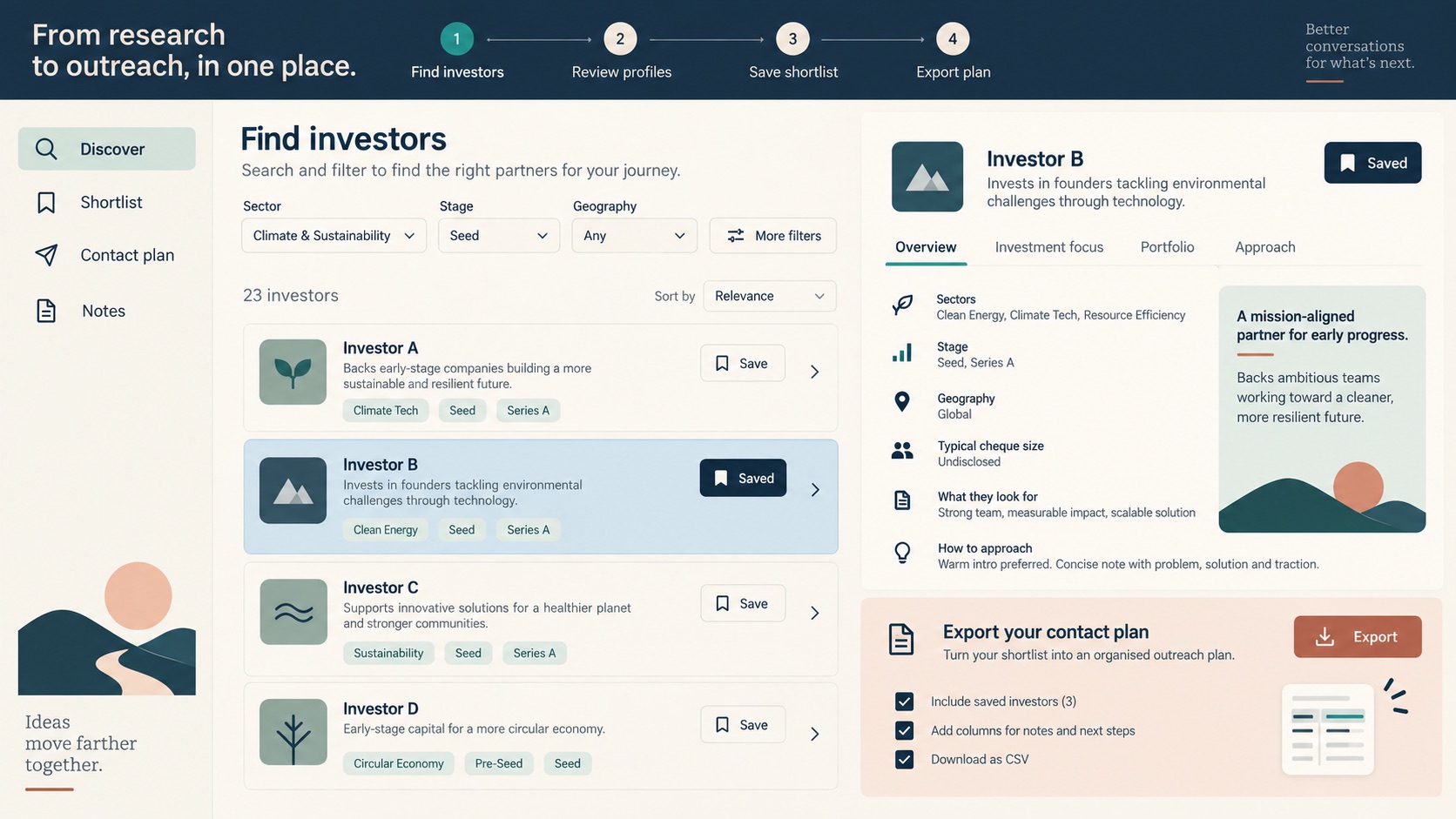
A list of names is easy to imitate and often free to gather in fragments. A useful database saves research time, keeps records current, narrows a relevant subset, and fits into the customer's next action. AngelMatch's own site presents investor profiles, stage and industry filters, contact details, engagement tracking, and outreach-related tools. That combination is closer to a workflow product than a CSV. The buyer's desired progress is not “view 125,000 records.” It is “identify a short list of likely investors and run a responsible, targeted fundraising process.”
The number of records can even be misleading. More entries increase apparent coverage but can lower trust if they are stale, duplicated, out of scope, or missing context. A founder should examine the fraction of relevant contacts that are actually reachable, the rate of bounced messages, the recency of funding interests, and how users judge the match quality. A 10,000-record database with excellent relevance may be worth more than a 200,000-record database with weak metadata. Rashid says he allocates resources to update data; the interview does not quantify accuracy or update frequency.
There is also an ethical and compliance burden. Contact data may be personal information, and collection, use, and outreach are subject to platform terms and applicable privacy and marketing laws. A builder should not assume that because data is visible online, it can be scraped, resold, or used for mass unsolicited messaging. Record provenance, honor deletion and opt-out requests, review local legal requirements, and design outreach volume limits. Bad outreach can harm founders and contacts, eroding the very trust a database is supposed to create. This is operational work, not a checkbox after the product has grown.
For JournalistHunt, the problem is different. A media professional's public beat and preferred pitch channel change. A searchable journalist directory can help a small business discover a relevant person, but generic bulk pitching is unlikely to deliver valuable coverage. Again, the outcome depends on relevance, recency, and workflow quality. The current $260 MRR figure suggests the product is much smaller than AngelMatch; it does not tell us whether the issue is weak demand, poor distribution, newer launch timing, or competition.
SEO is a distribution system, not the product itself
Rashid says he noticed roughly 60 daily clicks to AngelMatch, wondered what more search traffic could do, hired six writers, and built free tools and useful content. Over six to eight months, traffic reportedly grew. He attributes an increase from around $3,000 to $20,000 MRR to SEO, with Meta ads added. He also says programmatic SEO brings about half of revenue for the business. These are plausible causal accounts from a founder; the interview does not include channel-level attribution data that would prove SEO alone produced each dollar.
What makes SEO fit this product? People search for investors by location, industry, stage, or type. A structured database can answer those long-tail questions with specific, genuinely useful pages. AngelMatch's site exposes directories and filters along these dimensions and adds free fundraising tools such as calculators and templates. The page can satisfy a searcher's immediate research need and lead to a paid workflow. That is a reasonable product-to-distribution link.
Programmatic publishing has a failure mode: thousands of near-duplicate pages with thin or stale content. The search engine may not value them, and users may bounce or lose trust. A useful page should tell a reader why the listed investors match the query, when the information was reviewed, what eligibility conditions apply, and what the next responsible action is. It should not simply repeat names and cities with a “start free” button. Six writers and multiple tools represent a real investment. A new founder should not infer that one script creating thousands of pages recreates the outcome.
The site's reported 800–1,000 daily clicks are from several channels, not solely organic search. Clicks also say little about signups or paying customers. If half of revenue does come from SEO, then changes in rankings are a material business risk. Diversifying through referrals, partnerships, direct visits, and product-led word of mouth would reduce that dependence. Likewise, if Meta ads are material, blended acquisition cost should be tracked separately from organic conversion. An attractive MRR chart can hide rising customer-acquisition expense.
A focused way to test a database business
Start from a real, consequential research job. Identify ten people who perform it and ask to watch them build a shortlist. What sources do they open? Which fields do they verify? Where do they lose time? What information makes a candidate disqualifying? For fundraising, those fields might include stage, geography, check size, investment history, and whether the firm is actively investing. Do not start by scraping a giant generic contact list. A smaller manually curated sample will reveal whether relevance can be delivered.
Build a narrow dataset—perhaps one geography and one buyer type—with documented provenance and refresh rules. Give target customers access to a limited search and observe whether they can complete a task faster than their current method. Ask them to judge false positives and missing candidates. Sell the outcome with a paid pilot, not a hypothetical willingness-to-pay survey. If no one pays to save a few hours in a high-stakes task, adding 100,000 more records probably will not fix the offer.
Then attach the next action. A useful investor list may need saved shortlists, notes, and careful outreach; a journalist list may need beat validation and a pitching workflow. The next action should make the data more valuable, not encourage spam. Track time saved, shortlisted contacts used, user-reported relevance, payment conversion, support tickets about bad records, and renewals. Retention in a campaign-based job can be difficult: a founder may stop paying after finishing a fundraise. Consider whether subscription access is justified by ongoing use or whether a project-based purchase better matches the job.
Finally, publish only pages that answer real search intents. An industry-specific investor page should include qualifying criteria, a current sample, and useful context. Measure whether search visitors complete relevant tasks, not only whether pages get impressions. Review stale pages, remove low-value duplicates, and keep source/update metadata. Organic discovery takes time; the founder's own account describes months, a team of writers, and free tools. Budget accordingly.
| Test gate | Evidence to require | Reason to stop or revise |
|---|---|---|
| Problem | Buyers repeatedly build a costly shortlist | The task is rare or easily solved with free tools |
| Data quality | Relevant, current contacts with provenance | High bounce rate or unfixable rights issues |
| Value | Paid pilots complete the task faster | Usage is curiosity, not workflow adoption |
| Distribution | Search or other channels bring qualified buyers | Traffic is high but paid conversion is weak |
| Retention | Buyers return or expand usage | Most cancel after one project and pricing ignores it |
What to take away from the “boring websites” headline
The case does not show that any directory can reach $32,000 a month. It shows that one founder's self-reported portfolio is dominated by a database tied to a painful, high-value task: finding appropriate investors while a startup needs funding. The initial insight came from experiencing that task, early buyers paid after a Product Hunt launch, and the team later invested in SEO content and free tools. The two much smaller adjacent sites are evidence against the idea that a shared template alone creates commercial value.
There is no independent verification of the monthly revenue, margins, contact accuracy, or attributed SEO contribution in the public interview. The product sites verify that these services exist and describe their features. For a builder, the useful thesis is conditional: a database can become a business when it turns scattered information into a trustworthy decision and saves enough time or risk for the buyer to pay. The complexity is in data quality, rights, refresh, and acquisition—not in the visible web page.
Builder checklist
- Observe a buyer assembling a shortlist before designing a database.
- Choose a narrow segment with a repeated, valuable decision.
- Curate a small legally sourced dataset and measure relevance and freshness.
- Charge for a real pilot rather than treating signups as proof.
- Build the workflow around the next responsible action, not merely a giant list.
- Separate one-product revenue from portfolio totals and peaks.
- Track channel-level customer value, not only pageviews or daily clicks.
- Review privacy, outreach, deletion, and licensing obligations early.
Sources & further reading
- Starter Story interview with Rashid, published August 23, 2026 — primary source for the founder's product history, monthly revenue, traffic, pricing, and SEO claims.
- Original Starter Story video — demonstration and interview context.
- AngelMatch, InvestorHunt, and JournalistHunt — primary product sites for current public features and positioning, not independent verification of revenue or data accuracy.