
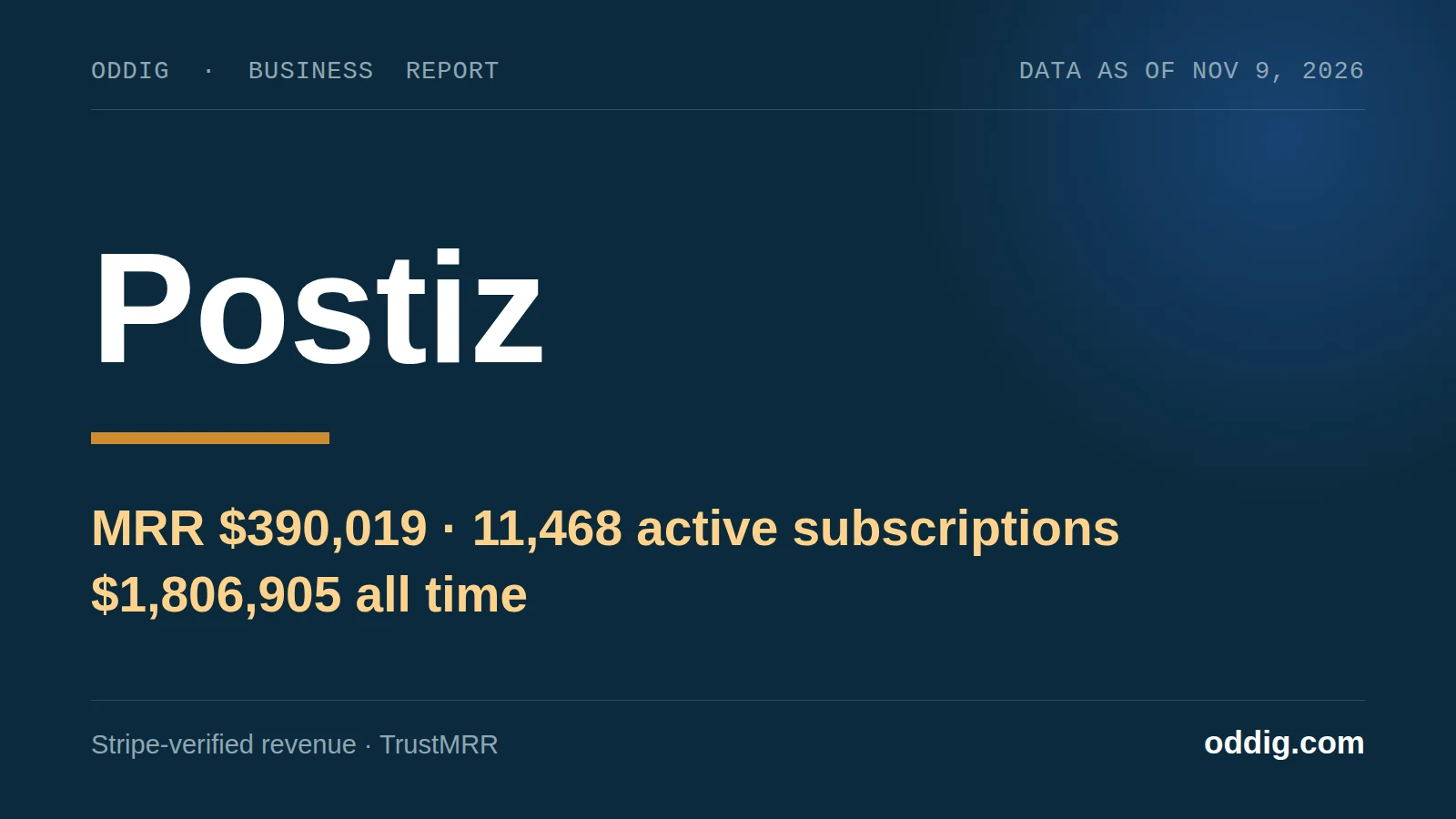

Postiz makes $390K a month from software it gives away free
An open-source scheduler for 30+ social platforms. Stripe-verified revenue grew 56% in October, prices have not moved since January 2025, and no single day made up more than 5% of the month. The funnel is the free repo.

Product at a glance
Summary
What this business is
Postiz is an open-source social media scheduler built by solo founder Nevo David (Gitroom; previously Novu). The same product exists twice: a free, self-hosted app whose code sits in a 41,170-star GitHub repo, and a hosted cloud version that charges $29–$99 a month. The repo is the marketing; the cloud is where the money is taken. Revenue is Stripe-verified: $390,019 MRR from 11,468 subscriptions as of Nov 9, 2026, after a +56.3% month in October — growth that comes from more subscribers at a flat $34 each, not from higher prices, which have not moved since at least January 2025.
Why these scores? See the reasons in Key takeaways →
Momentum
Rising fast. Revenue: last three complete months +85% on the three before; +274% on the same months half a year earlier.Derived
Best suited for
Builder (main). The engine is an open-source repo that has been maintained in public since 2023.
Marketer (second). A shelf of free font and bio tools brings search traffic, and verified revenue is published as a channel.
What you need to start. No ad budget. A product that can honestly run self-hosted, and years of patience: the repo started a year before the company.Our read
Key findings
Product overview
A scheduler is a commodity — unless it is also a repo. Postiz leads with AI agents and open source, not with another calendar.
Postiz schedules posts to more than 30 platforms — Instagram, YouTube, X, LinkedIn, TikTok, Facebook, Pinterest, Threads, Reddit, Discord, Mastodon, Bluesky and more — from one visual calendar, with AI agents that can plan and generate posts for review[2]. It exists in two forms that share one codebase: a hosted cloud app, and a free self-hosted version anyone can run from the public GitHub repo, licensed AGPL-3.0[3]. The company was founded on Jul 24, 2024, a full year after the repo was created in July 2023 — the open-source project came first, the business second[1][3]. Founder Nevo David builds it solo; his previous work (Novu, Gitroom) is developer tooling, and it shows in the surface area: every cloud tier includes the MCP server, CLI, public API and webhooks[2].

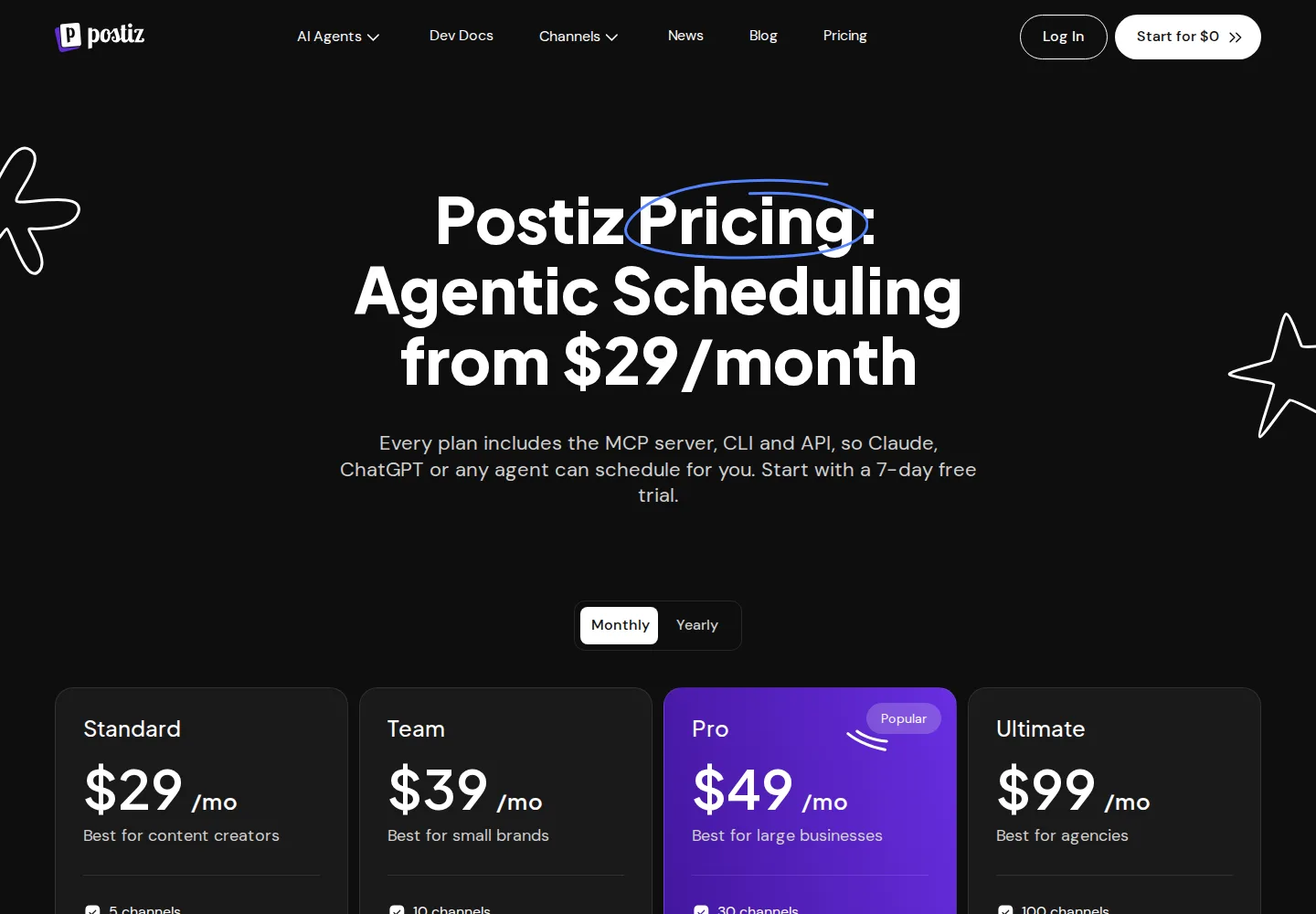

Captured 2026-11-09 · Screenshots: Postiz
What to look for
- 1The headline sells agents, not scheduling: “Run your social media on autopilot with AI agents.”Fact
- 2Three Product Hunt badges above the headline — #1 product of the day, week and month — reused as social proof.Fact
- 3The offer is honest about the funnel: “Start a 7-day trial for $0.” There is no free cloud tier, and the page does not pretend otherwise.Fact
- 4Thirty-plus platform icons answer “does it post where I post?” in one glance.Fact
- 5A “Discord Support” button floats on the marketing page. Support is the community — a strength and, per §05, a complaint.Fact
What to look for
- 1“Every plan includes the MCP server, CLI and API” — the agent surfaces are the headline, not an enterprise upsell.Fact
- 2Tiers are named by buyer, not by features: content creators → small brands → large businesses → agencies.Fact
- 3Pro ($49) carries the “Popular” badge — the middle of four is where the page pushes.Fact
- 4A Monthly/Yearly toggle with yearly at $23–$79/mo explains the receipts pattern in §02: money collected ahead of the month it covers.Fact
Revenue analysis
TrustMRR’s banner says MRR grew 51.4% in 30 days. The daily view is calmer and more impressive: a rising floor, no spike day — and the week a hosting platform many Postiz users rely on was breached contains the month’s then-highest day.
As of the Nov 9, 2026 sync, Postiz shows $390,019 MRR from 11,468 active subscriptions and $1,806,905 in cumulative verified revenue[1]. The 29 complete days on the chart (Oct 11 – Nov 8, UTC) add up to $416,451, an average of $14,360 a day, ranging from $9,892 (Oct 11) to $19,086 (Nov 3). No single day accounts for more than 4.6% of the window — there is no launch spike to explain away.Derived
Hover or tap a bar, or pick a window. Verified daily revenue, Oct 11 – Nov 8, 2026 (UTC), from TrustMRR[1]. Oct 21–22, the days around the Railway breach disclosure, are labelled in the readout. Full days ranged from $9,892 to $19,086; no single day accounts for more than 4.6% of the window.
The base month for October’s jump.Fact
Closed month, +56.3% on September ($387,214 ÷ $247,809).Derived
Receipts rose through the two days around Railway’s breach disclosure; Oct 22 was the highest day of the month to that point.Fact
Paces to roughly $502K for November. An extrapolation, not a result — prediction #1 tests it.Derived
Which 30-day total? TrustMRR shows several, and they disagree. The Nov 8 read carried a page title of $420,694 against a body figure of $414,476; the Nov 9 read shows a table total of $428,240 against a snapshot figure of $428,617. The windows differ by a day and the totals are computed differently. Wherever a total matters in this report we use the daily series — $416,451 across the 29 complete days — and say so.Derived
Monthly revenue, verified
Hover or tap a bar for the month. Monthly verified revenue, Dec 2025 – Nov 2026, from TrustMRR[1]. November ($139,124) is partial — Nov 1–9 including a half-day — and is not comparable yet; every other month shown is closed.
Our arithmetic on the verified data in this report. Revenue ÷ MRR uses the last 30 days; the share of all-time revenue counts the months in the chart above; the swing is the median change between complete months.
The monthly shape matters more than any single month. Postiz took nine months to go from $15,785 (Dec 2025) to $247,809 (Sep 2026), then added $139K in a single month. The August step lines up with the event the founder credits: a post about Postiz by Oliver Henry — an account with roughly 200 followers — was read 7.2 million times and, by the retelling, drove about 700 trials a day; the founder announced $2M ARR crossed on Aug 10, and by Aug 30 MRR stood at $191,954 from 5,645 subscriptions[4]. We grade that chain B−: the revenue points are verified, the causal story is a third-party retelling of the founder’s account.Founder
Two regimes are visible in the increments. Through July the business compounded in monthly steps of $11K–$36K — real growth, small base. The viral post’s effect does not show in August’s increment (+$13,950, smaller than July’s) but in the steps after it: September +$55,210, October +$139,405. Trials converting and word spreading take weeks. Virality here was an accelerant poured on a compounding base, not the base itself — which is also why the floor has kept rising since, instead of falling back the way a pure spike does.Derived
The founder’s own numbers, checked
| Date | Founder said | TrustMRR read | Gap |
|---|---|---|---|
| Oct 24, 2026 | MRR $316,840 | $315,693 (Oct 26 read) | 0.4% |
| Nov 2, 2026 | “$4M ARR” | $352,049 MRR × 12 ≈ $4.22M annualised | claim sits ≈5% under the verified figure |
Founder posts against Stripe-verified reads[5]. His numbers survive checking — which is why this report uses his event claims at all, each with its grade attached.
Market and competitors
See all numbers
| Product | MRR | Revenue, last 30 days | Active subscriptions | Per subscription | Entry price | Started |
|---|---|---|---|---|---|---|
| Postiz | $390,019 | $416,451 (29 days) | 11,468 | $34.01 | $29/mo | Jul 2024 |
| Post Bridge | $49,530 | $44,741 | 1,634 | $30.31 | $39/mo | Sep 2024 |
| Marky | $22,113 | $16,153 | 474 | $46.65 | not listed | Jul 2023 · for sale |
| Followr | $5,091 | $3,275 | 283 | $17.99 | $12/mo | Mar 2023 · for sale |
Social media schedulers with Stripe-verified revenue on TrustMRR[18]. Postiz as of Nov 9, the others read Nov 10, 2026, so Post Bridge differs slightly from the Nov 7 figures used above. Per subscription is MRR ÷ active subscriptions. Entry prices for the other three are as listed on their TrustMRR profiles.
Crowded, with one clear leader. Of the four schedulers with verified revenue, Postiz holds about 84% of the combined MRR ($390,019 of $466,753), and two of the three smaller ones are listed for sale. The opening is not another calendar: Post Bridge, started two months after Postiz, reached about $50K MRR through a different channel. The category’s largest names, such as Buffer and Hootsuite, are not on TrustMRR and are not in this table.Our read
The risk in this chapter is not concentration — there is none — but the rate. MRR grew 10.8% in the single week from Nov 2 ($352,049) to Nov 9 ($390,019)[1][5]. No business compounds at that rate for long; our December predictions (§09) are written to test the pace, not to admire it.Our read
Pricing: flat since January 2025
Four archived reads across two years, and the prices never move. Postiz changed everything about its pricing except the prices.
| Archived read | Monthly | Yearly (per-mo) | What changed |
|---|---|---|---|
| Jan 23, 2025 | $29 / $39 / $49 / $99 | $23 / $31 / $39 / $79 | Channels 5/10/30/100; posts capped at 400 on the two lower tiers |
| Jul 5, 2025 | unchanged | unchanged | Team tier’s post cap lifted to unlimited |
| Jan 14, 2026 | unchanged | unchanged | No price change in any tier |
| Oct 31, 2026 | unchanged | not verifiable in the archived replay | Posts unlimited on all tiers; MCP/CLI/API in every tier; Enterprise card removed from the page (still linked in the footer) |
Wayback Machine snapshots of postiz.com/pricing[7]. One honest gap: the Oct 2026 snapshot’s yearly toggle did not run in the replay, so the yearly row is verified through Jan 2026 plus the current live page[2] — not for Oct 2026 itself.
The fingerprint of that policy is in §02’s arithmetic. Revenue per subscriber has read $34.10 (Nov 2), $34.04 (Nov 8) and $34.01 (Nov 9) — three readings, one conclusion: the +56.3% October and the +10.8% MRR week were bought with volume, not with price[1][5].Derived
The door is also cheaper than its closest comparator in this series: $29 against Post Bridge’s $39 entry, while each Postiz subscriber is worth ≈12% more per month ($34.01 vs $30.32)[6]. A cheaper door and a slightly richer subscriber is a volume strategy, and the subscriber count — 5,645 on Aug 30 to 11,468 on Nov 9[4][1] — says it is working.Derived
Where customers come from
Start with the repo. Referrals, social, even the revenue leaderboard are downstream of a free product that developers pass around. Search is a second front — a shelf of free font and bio tools ranking for terms that have nothing to do with scheduling — and the two sources that measure search disagree about which engine is bigger.
The funnel’s head. github.com sends 23.47% of all referral visits, and the repo has been compounding since Jul 2023 — a year longer than the company.[3][8]
Factgitroom.com — the founder’s developer-tools home — is the single largest referrer. An audience built on earlier open-source work routes straight into Postiz.[8]
Facttrustmrr.com is the second-largest referrer. Publishing verified revenue is itself a channel: founders browse the leaderboard and arrive pre-sold.[8]
FactOf social traffic: YouTube 61.94%, X 23.43%, LinkedIn 9.30%. Tutorials and demos, not ads.[8]
FactOliver Henry, roughly 200 followers, Aug 2026; about 700 trials a day by the retelling. The event in front of the $2M ARR announcement.[4]
FounderBookmarks, the app itself, word of mouth — the residue of a tool people open every day.[8]
FactMCP server, CLI and API are bundled, not gated. “postiz api” is already 3.29% of search terms — agents and their builders are a discovery channel.[2][8]
FactAI assistants already send a measurable slice — more than paid search and display combined.[8]
FactEffectively zero. Display adds 0.65%. Whatever Postiz is doing, it is earned, not bought.[8]
Fact| Top US keywords, by traffic | Position | Volume | Share |
|---|---|---|---|
| postiz | #1 | 3,600 | 13.54% |
| instagram fonts | #8 | 60,500 | 6.26% |
| fonts for instagram | #1 | 4,400 | 5.13% |
| postitz | #1 | 880 | 3.31% |
| italic font generator | #4 | 9,900 | 3.02% |
| discord fonts | #9 | 33,100 | 2.95% |
| facebook fonts | #4 | 8,100 | 2.47% |
| discord font | #7 | 18,100 | 1.87% |
| instagram bio generator | #2 | 2,900 | 1.79% |
| the best bio for telegram | #1 | 2,400 | 1.48% |
Semrush, US database, Nov 7 2026[9]. Below the brand itself (and its misspelling, “postitz”), the traffic belongs to free tools: font generators for Instagram, Discord and Facebook, a bio generator, a telegram-bio page. None of these terms is about scheduling. This is a second discovery engine, independent of the repo.
Search and traffic data
+14.71% on September (458,949); August was 413,683. SimilarWeb estimate.Fact
$387,214 verified revenue ÷ 526,445 estimated visits. A yardstick, not a funnel measurement.Derived
Average visit duration and pages per visit; bounce 36.82%. SimilarWeb estimate.Fact
Then India 8.85%, Indonesia 4.98%, France 4.78%, UK 4.23%.Fact
| Top search terms | Share of search traffic |
|---|---|
| postiz | 30.55% |
| postiz pricing | 7.81% |
| postiz api | 3.29% |
| social media scheduler | 2.81% |
| postiz github | 2.37% |
SimilarWeb, Aug–Oct 2026[8]. Four of the top five terms carry the brand. The only generic term — the category itself — is 2.81%. Read that as a statement about clicks, not about discovery: SimilarWeb’s panel records the terms people actually clicked, where a known brand naturally dominates, while Semrush’s position-based estimate (block above) puts ≈80% of organic traffic on non-brand terms, most of them free font and bio tools. The two sources measure different things, so this report shows both and picks neither.
Customer voice
A pilot layer for this series: what buyers and self-hosters actually say — sampled, counted, and marked for how thin the sample is.
Read this chapter with its calibration first. G2 holds 51 reviews (4.8/5) for a product with 11,468 paying subscriptions; Capterra has exactly one review; Trustpilot is sparse and polarised[10]. The review layer is severely under-sampled for a business this size, so everything below is directional, not statistical: themes worth naming, never ratios worth quoting.Our read
Cloud buyers, on G2
| Complaint theme | Reviews mentioning |
|---|---|
| Price “too high” — the open-source version is free | 8 |
| AI features limited | 4 |
| Learning curve | 3 |
| Instagram connection and verification friction | 2 |
| Analytics too shallow | 2 |
G2, 51 reviews, sampled Nov 9, 2026[10]. The praise side is led by ease of use and smooth scheduling — the product’s core job is not the problem. The top complaint is structural: against a free self-hosted twin, any cloud price reads as expensive to a slice of buyers.
The structural gaps
Across review sites, the same four gaps recur — none of them is a bug, all of them are choices: no native mobile app (the product is web-only); no free cloud tier, only a 7-day trial; analytics shallower than dedicated reporting tools; and support that runs through a Discord community rather than a staffed desk — the homepage’s own support button says “Discord Support” (§01). Lower AI credit limits on cheap tiers are a fifth, smaller theme.[10]Fact
Trustpilot adds a rougher edge — trial-cancellation and billing friction, no self-serve way to remove a card or delete an account, support that is hard to reach — alongside outright raves on the same page. The sample is small and the grade is low; we name the theme and stop there.[11]Our read
Self-hosted users, on GitHub — a different crowd
These are not cloud buyers and must not be read as them. In a sample of the 43 most-discussed open issues, the loudest thread is “Could not add provider” (56 comments) — connecting channels is the self-hoster’s core friction, followed by OAuth, cookie and custom-domain sign-in problems, self-hosting documentation that lags the product, and requests for more platforms (Pixelfed, Snapchat, S3 storage, webhooks, custom OpenAI endpoints)[12]. What this crowd praises is the mirror image of the cloud complaints: control, and the code being open at all.Fact
Growth strategies
Four moves explain most of the curve. None of them is an ad.
Timeline
- Jul 82023ProductGitHub repo created: gitroomhq/postiz-app, AGPL-3.0. The open-source project starts a year before the company.[3]
- Jul 242024ProductPostiz founded (TrustMRR profile). Solo founder Nevo David.[1]
- Jan 232025PricingEarliest archived pricing read: $29 / $39 / $49 / $99; posts capped at 400 on the lower tiers.[7]
- Jul 52025PricingSecond archived read: prices unchanged; Team tier’s post cap lifted to unlimited.[7]
- Dec2025Revenue$15,785 for the month — the start of the verified monthly series used in §02.[1]
- Jan 142026PricingThird archived read: monthly and yearly prices unchanged again.[7]
- Apr 182026SecurityCVE-2026-40487, CVSS 9.0 — file-upload MIME spoofing to stored XSS. Fixed in 2.21.6.[13]
- Jun 162026SecurityCVE-2026-48781, CVSS 9.9 — any signed-in user could forge a superadmin session through an integration callback. Fixed in 2.21.8.[16]
- Aug 72026SecurityCritical advisory: unauthenticated /uploads path traversal leading to instance takeover (self-hosted).[13]
- Aug2026MarketingA post about Postiz by Oliver Henry (~200 followers) is read 7.2M times; roughly 700 trials a day by the retelling.[4]
- Aug 102026RevenueFounder announces $2M ARR crossed.[4]
- Aug 302026RevenueMRR $191,954 from 5,645 subscriptions.[4]
- Sep 222026SecurityCritical advisory: OAuth state built on Math.random() is recoverable — tokens, authorization codes and org API keys at risk (self-hosted).[13]
- Sep2026Revenue$247,809 for the month.[1]
- Oct 212026
- Oct 23–242026SecurityThree critical vulnerabilities published — CVE-2026-115931 (9.9), -115932 (9.6), -115933 (9.9, token forgery to sign in as any user) — fixed in 2.25.2 / 2.25.3 within a day. Scope: self-hosted instances; no exploitation in the wild reported.[14]
- Oct2026Revenue$387,214 closed month, +56.3% on September.[1]
- Oct 312026PricingFourth archived read: prices still unchanged; posts unlimited on all tiers, MCP/CLI/API everywhere, Enterprise card gone from the page.[7]
- Nov 92026RevenueMRR $390,019; 11,468 subscriptions; $1,806,905 cumulative.[1]
Key takeaways
Verdict: Postiz is a distribution business wearing a product’s clothes — and the distribution is a public good it maintains.
The applicability boundary matters more than the admiration. Who can copy this: founders whose product can honestly run self-hosted, in categories where developers or technical buyers are the audience, with the stamina to maintain a public repo for years before it pays. Who cannot: anyone whose economics need paid acquisition, whose product cannot stand alone on a user’s server, or who needs the funnel this quarter. And keep two growths separate: the founder’s pre-built asset (Gitroom and Novu credibility — gitroom.com is still the #1 referrer) explains the repo’s first audience, not the slope since August. The slope is product-side: trials, search and subscriptions compounding on a flat $34.Our read
Why we scored it this way
Copy
- Open the product, sell the hosting. The repo is the funnel; the cloud is the till. P1
- Publish receipts where skeptics can check them. A leaderboard you don’t control is a channel. P2
- Give agents the keys at the entry tier. MCP, CLI and API from $29, not as an enterprise gate. P3
- Treat price as a constant and limits as the dial while the funnel is filling. P4
Avoid
- Reading a +56% month as a run-rate. It is a surge to be tested (see predictions), not a slope to project.
- Reading the October Railway breach as “Postiz was hacked.” A hosting platform was breached; nothing public says Postiz’s own cloud was. Keep the two apart.
- Mixing two crowds. Self-hosters’ GitHub issues are deployment pain; cloud buyers’ reviews are product pain. A roadmap built from the wrong crowd serves neither.
- Raising prices before the funnel earns it. Postiz loosened limits for two years instead — and volume did the rest.
Our predictions
Three claims with dates. We mark each one right or wrong on its date and keep the result on the page.
Track record: this series’ bytemail and Post Bridge predictions are still open; the first checks land Dec 1, 2026. We mark each prediction right or wrong on its date and keep the result on the page.
What could prove us wrong
Things that would change our read, and how to check them.
- The growth rate is the risk, not the product. October rose +56.3% and MRR rose +10.8% in one week. Rates like that end. If November lands below our $460K floor, the “engine” story becomes a “viral quarter” story.Check: predictions #1 and #2, Dec 1 and Dec 6, on TrustMRR.
- Security is a recurring cost line, not one bad week. At least seven critical advisories in 2026 (April, June, August, September, three in October — one a 9.9 token-forgery). So far every one hit self-hosted installs and was fixed within a day. A critical that reaches the cloud, or is exploited before the patch, changes the verdict and the defensibility score.Check: the repo’s advisory feed; any critical with reported in-the-wild exploitation.
- The moat is forkable. The product is AGPL code with 7,845 forks. A funded rival can start from Postiz’s own codebase tomorrow; the defences are brand, community and hosted convenience — none of them locked.Check: watch for a funded fork’s launch and whether it takes repo or search share within two quarters.
- The quiet crowd may be unhappier than the loud one. 51 G2 reviews against 11,468 subscriptions is a 0.4% sample. Billing and support friction on Trustpilot could be the visible tip of churn the revenue line hasn’t shown yet — at +56% growth, churn is easy to hide.Check: review velocity and themes across Q1 2027; whether MRR growth survives the surge fading.
Appendix
FAQ
How much does Postiz make?
$390,019 in MRR and $1,806,905 cumulative as of Nov 9, 2026, verified through Stripe on TrustMRR. Across the 29 complete days to Nov 8 it collected $416,451; October, its best closed month, was $387,214.
Is Postiz open source?
Yes — AGPL-3.0, and self-hosting is free. The hosted cloud version costs $29–$99 a month after a 7-day trial; there is no free cloud tier.
How much does Postiz cost?
Standard $29/mo (5 channels), Team $39 (10), Pro $49 (30), Ultimate $99 (100). Yearly billing works out at $23/$31/$39/$79 a month. Prices have not changed since at least January 2025; what changed is the limits — posts are now unlimited on every tier, and every tier includes the MCP server, CLI and API.
Was Postiz hacked in October 2026?
Nothing public says so. Two separate events are easy to conflate. On Oct 21, hosting platform Railway disclosed a breach of customer environment variables; Railway is widely used to deploy Postiz, but whether Postiz’s own cloud was affected is not public. Separately, three critical vulnerabilities in Postiz were published on Oct 23–24 and fixed in versions 2.25.2 and 2.25.3.
Why don’t TrustMRR’s own totals agree?
The page computes its 30-day figure several ways over slightly different windows: the Nov 8 read showed $420,694 in its title and $414,476 in its body; the Nov 9 read shows $428,240 in its table and $428,617 in its snapshot. This report uses the daily series wherever a total matters — $416,451 for the 29 complete days to Nov 8 — and flags the alternatives where they appear.
Sources
- [1]TrustMRR: Postiz— revenue, MRR, subscriptions, daily and monthly series, founder, founded date. Synced 2026-11-09 08:24 UTC.
- [2]postiz.com and /pricing— positioning, tiers, agent surfaces, badges. Captured 2026-11-09.
- [3]GitHub API: gitroomhq/postiz-app— 41,170 stars, 7,845 forks, 214 open issues, AGPL-3.0, created 2023-07-08. Read 2026-11-09.
- [4]aiolum: Postiz story— Oliver Henry post and trial surge, $2M ARR (Aug 10), Aug 30 MRR and subscriptions. Third-party retelling; graded B−.
- [5]theaireceipts and proofofincomeai— TrustMRR reads of Nov 1–2, 2026; founder self-report checks (Oct 24 claim vs Oct 26 read).
- [6]Oddig: Post Bridge revenue teardown— comparison figures: MRR $49,944, 1,647 subscriptions, $30.32 per subscriber, receipts ≈90% of MRR. Published 2026-11-08.
- [7]Wayback Machine snapshots of postiz.com/pricing — 2025-01-23, 2025-07-05, 2026-01-14, 2026-10-31. Prices, yearly rates, limits and bundling.
- [8]SimilarWeb: Website Performance for postiz.com, Aug–Oct 2026 — visits, channel mix, referral sources, social split, search terms, geography. Estimates; read 2026-11-09.
- [9]Semrush: postiz.com domain overview and organic research — US database dated Nov 7, 2026; pulled Nov 9, 2026 via mirror. Authority Score, keyword counts, organic traffic estimates, backlink profile, top keywords, branded vs. non-branded split.
- [10]G2: Postiz reviews — 51 reviews, 4.8/5; complaint and praise themes with mention counts. Sampled 2026-11-09.
- [11]Trustpilot: Postiz — billing and support friction themes; sparse, polarised sample. Sampled 2026-11-09. Low grade.
- [12]GitHub issues: gitroomhq/postiz-app— 43 most-commented open issues sampled 2026-11-09. Self-hosted users, not cloud buyers.
- [13]GitHub Security Advisories: gitroomhq/postiz-app— Apr 18 (CVE-2026-40487), Aug 7 and Sep 22 criticals. Read 2026-11-08.
- [14]Ostorlab and GAdvisory — the three October CVEs (115931 / 115932 / 115933), scope, and fix versions 2.25.2 / 2.25.3.
- [15]Railway: preliminary report on the October security incident and initial disclosure, Oct 21 — Oct 20–22, 2026 platform breach; at most 1.85% of workspaces potentially exposed; providers asked to revoke keys.
- [16]OSV: CVE-2026-48781 (GHSA-j77w-h625-56q2)— critical, CVSS 9.9, published 2026-06-16, fixed in 2.21.8. Read 2026-11-10.
- [17]Nevo David on DEV: “as a single developer”— the founder’s own description of the team, published 2025-11-21. Current team size not independently verified.
- [18]TrustMRR: social media category and the profiles of Post Bridge, Marky and Followr— MRR, 30-day revenue, subscriptions, founding dates, listed prices. Synced and read 2026-11-10.
Screenshots and logo © Postiz, used for commentary. Oddig has no business relationship with Postiz. Numbers change daily; check the sources for the latest.



Comments are closed for this article.