
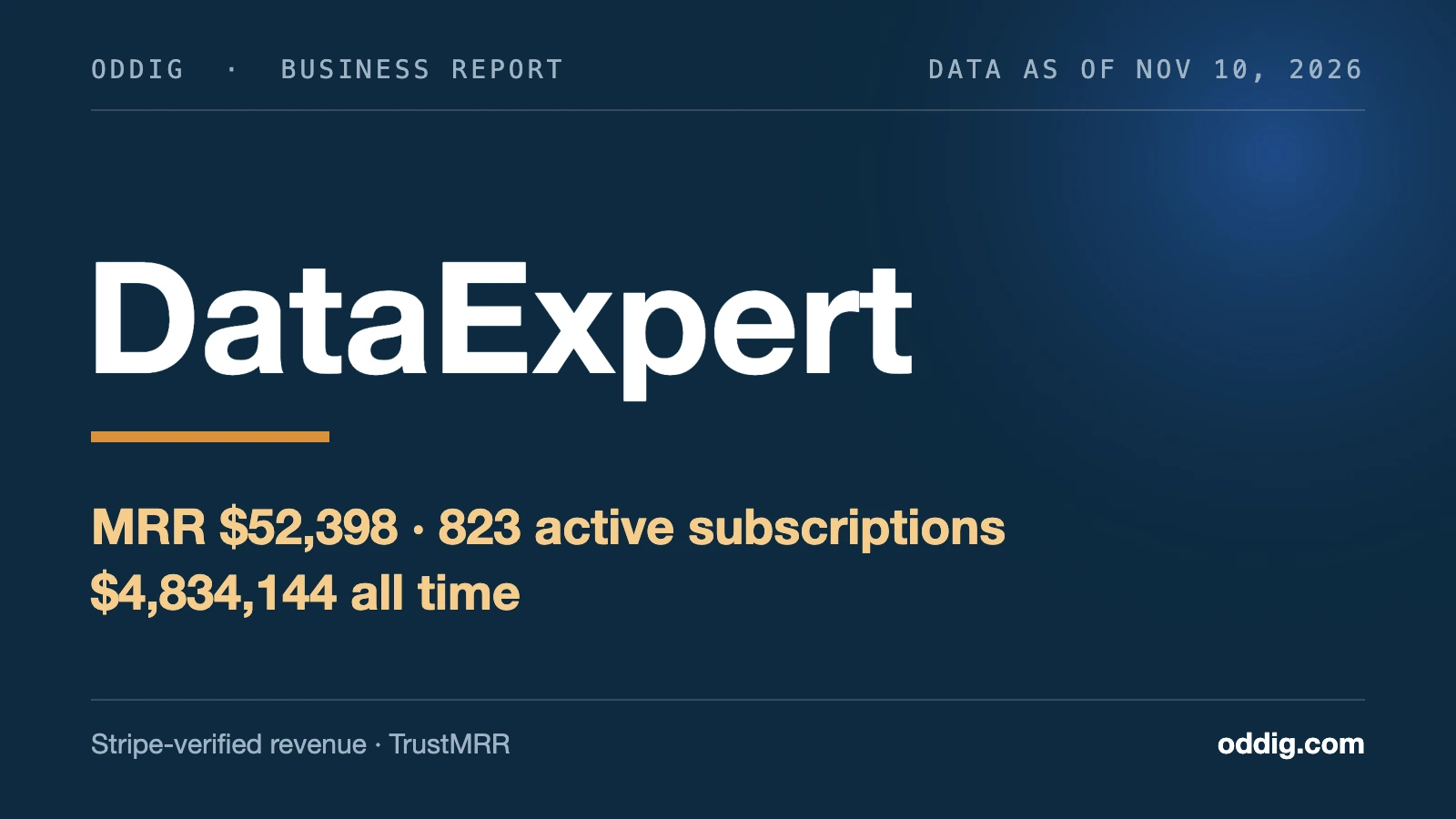
DataExpert made $1.4M in a year while its subscriptions shrank by a fifth
A data engineering school run by a creator with a large following: Stripe-verified revenue that arrives in waves around each live boot camp, and a subscription line that is slowly falling underneath.
Product at a glance
Summary
What this business is
DataExpert.io is an online school for data engineering and AI, founded by Zach Wilson, who says he led data teams at Airbnb, Facebook and Netflix. It gives a great deal away: an open course handbook on GitHub, a free six-week program and a newsletter. It earns from live boot camps at $3,000 each and from a subscription to its recorded library. Revenue is large and uneven, because most of the big months are the ones in which a cohort is enrolling. The method is easy to describe. The scale rests on an audience of several hundred thousand people that took years to build.
Why these scores? See the reasons in Key takeaways →
Momentum
Mixed. Revenue: last three complete months +25% on the three before; −17% on the same months half a year earlier; MRR −14% since Apr 3, 2026.Derived
Best suited for
Creator (main). The business runs on an audience built by years of public teaching.
Marketer (second). Each cohort is a launch with a date, a price and a deadline.
What you need to start. Real expertise in a field people pay to enter, the willingness to give most of it away, and time. The audience came first.Our read
Key findings
Product overview
A school with three doors: a free one, a monthly one and a $3,000 one with a start date.
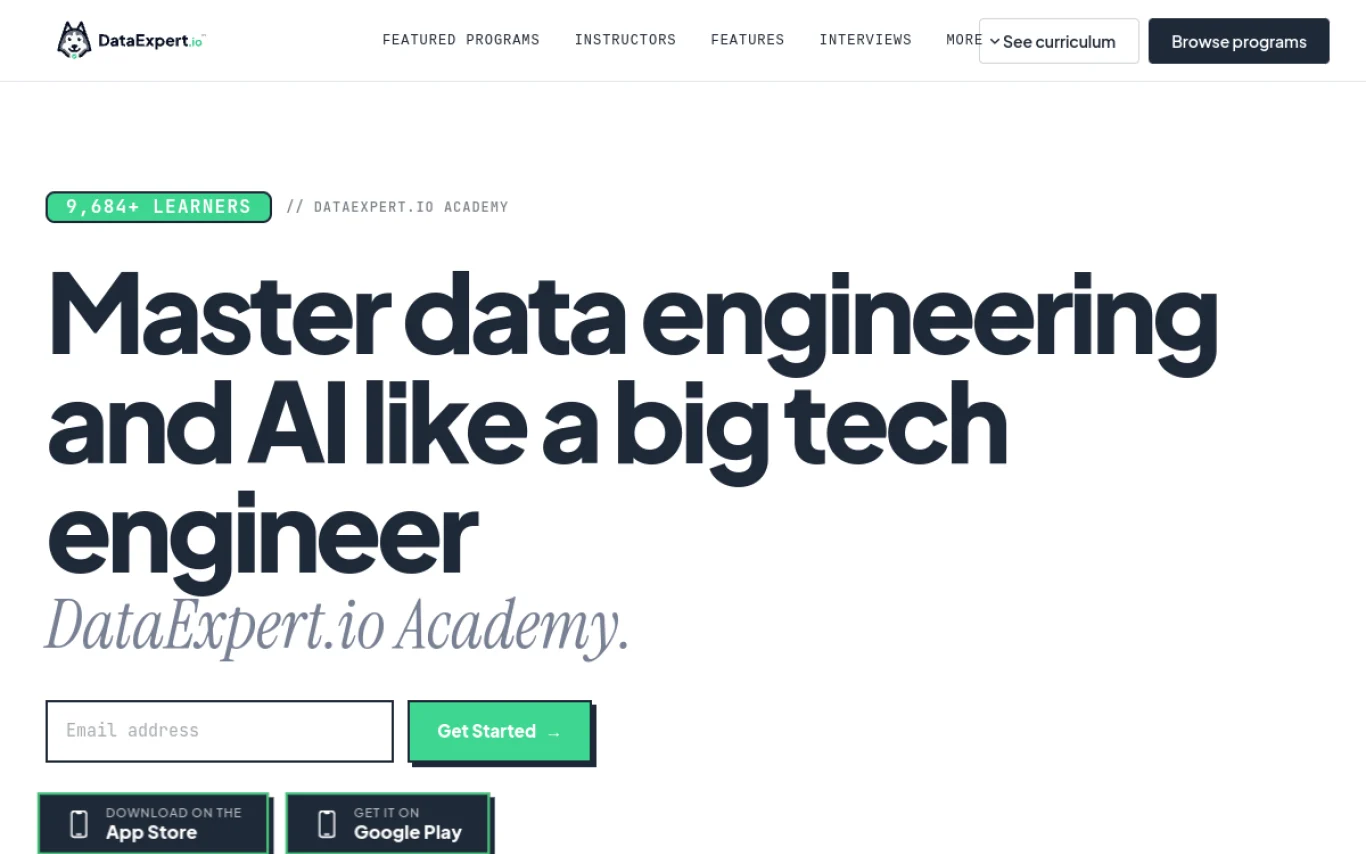
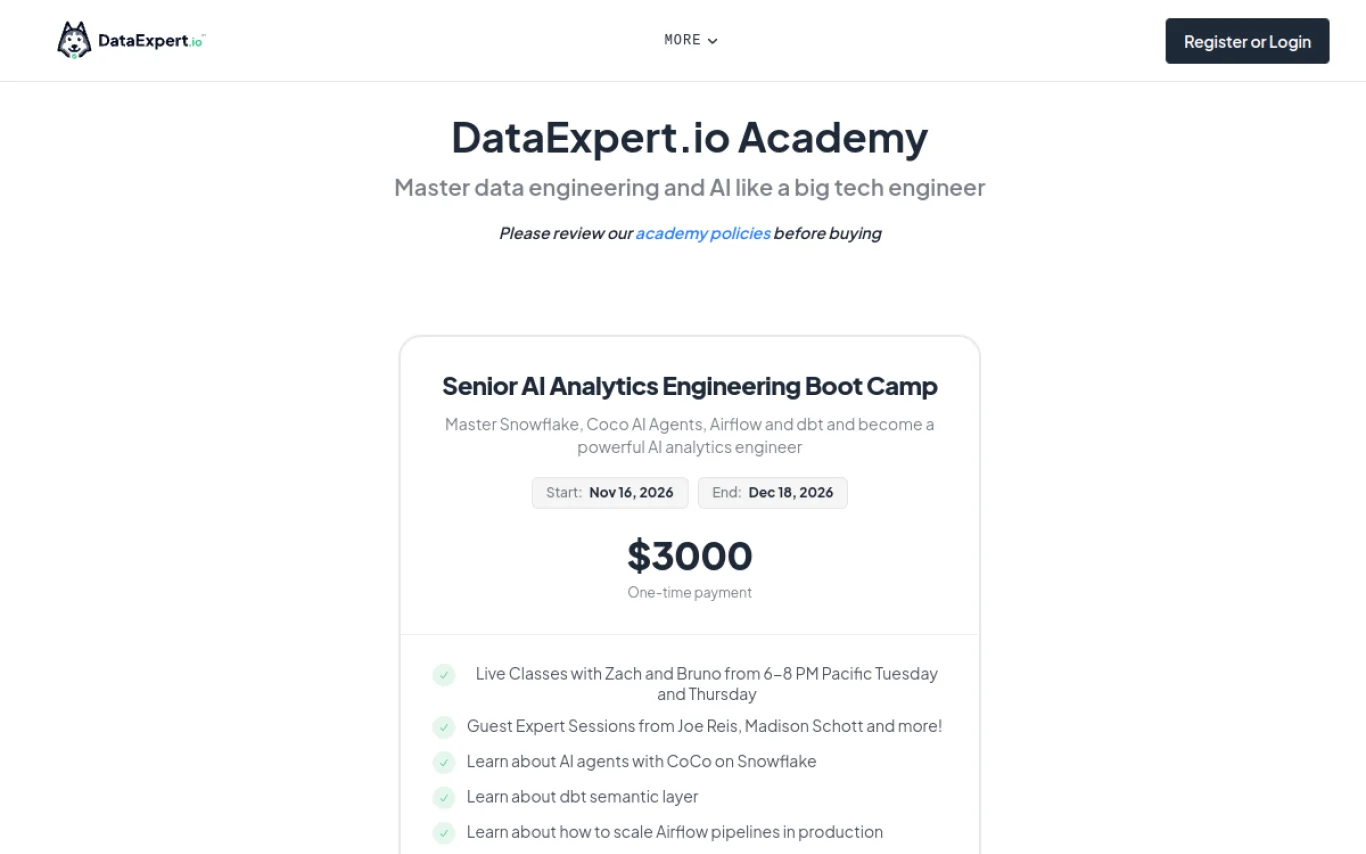
The site sells three things. Live boot camps run for about five weeks with classes two evenings a week; the one now enrolling is the Senior AI Analytics Engineering Boot Camp, Nov 16 to Dec 18, 2026, at $3,000. The self-paced subscription opens the recorded library for $96 a month or $1,150 a year. Mock interviews start at $50, and some are free[2].
What the site looks like


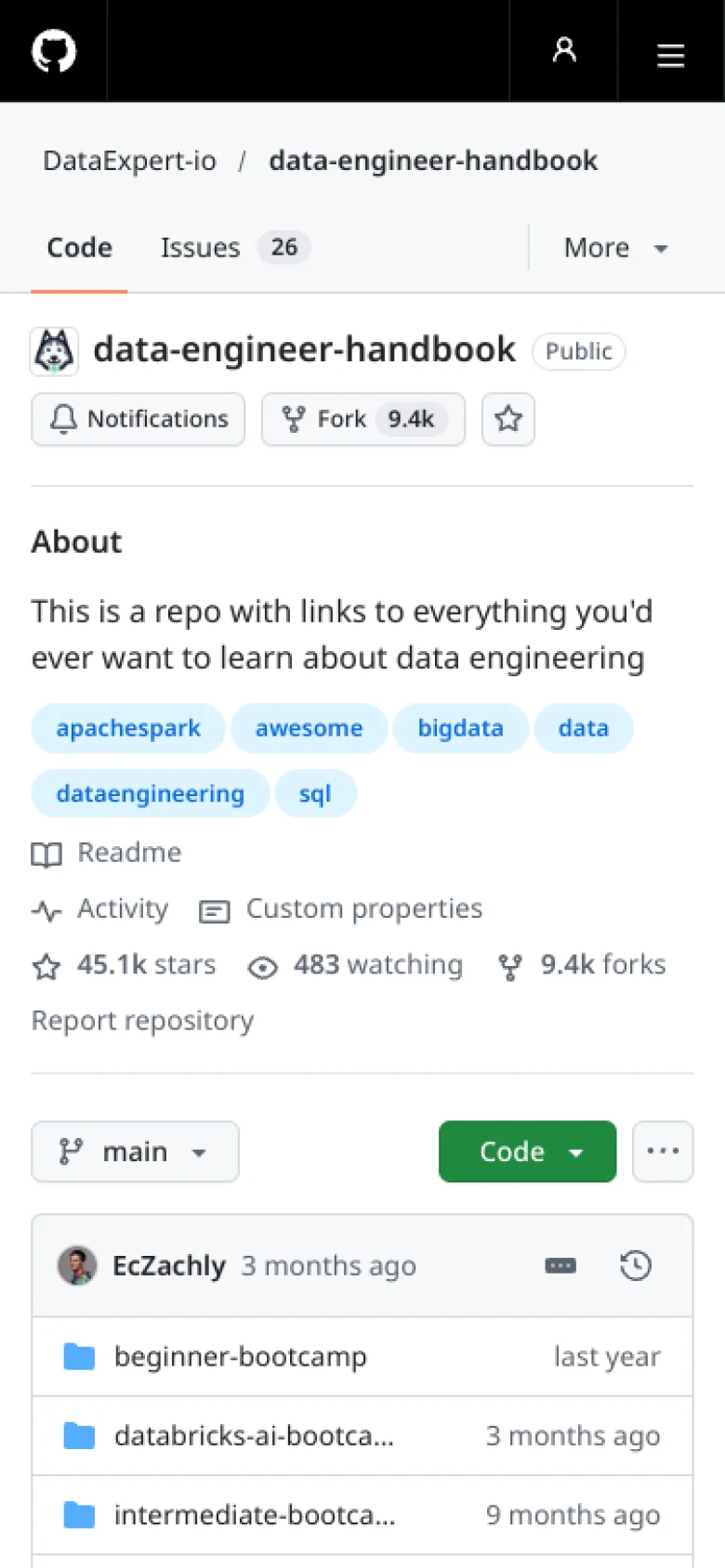
Captured Nov 11, 2026 · Screenshots: dataexpert.io and github.com
What to look for
- 1The promise is a level, not a topic: “Master data engineering and AI like a big tech engineer.”Fact
- 2The next live boot camp sits on the page with its dates and a “Now Enrolling” label.Fact
- 3Employer logos stand in for outcomes: OpenAI, Amazon, Meta, Netflix and others.Fact
What to look for
- 1The pricing page shows one thing: the next boot camp, $3,000, with a start and end date.Fact
- 2A team option offers “Save up to 25%”.Fact
- 3The subscription is not on this page. The page exists to fill the cohort.Our read
What to look for
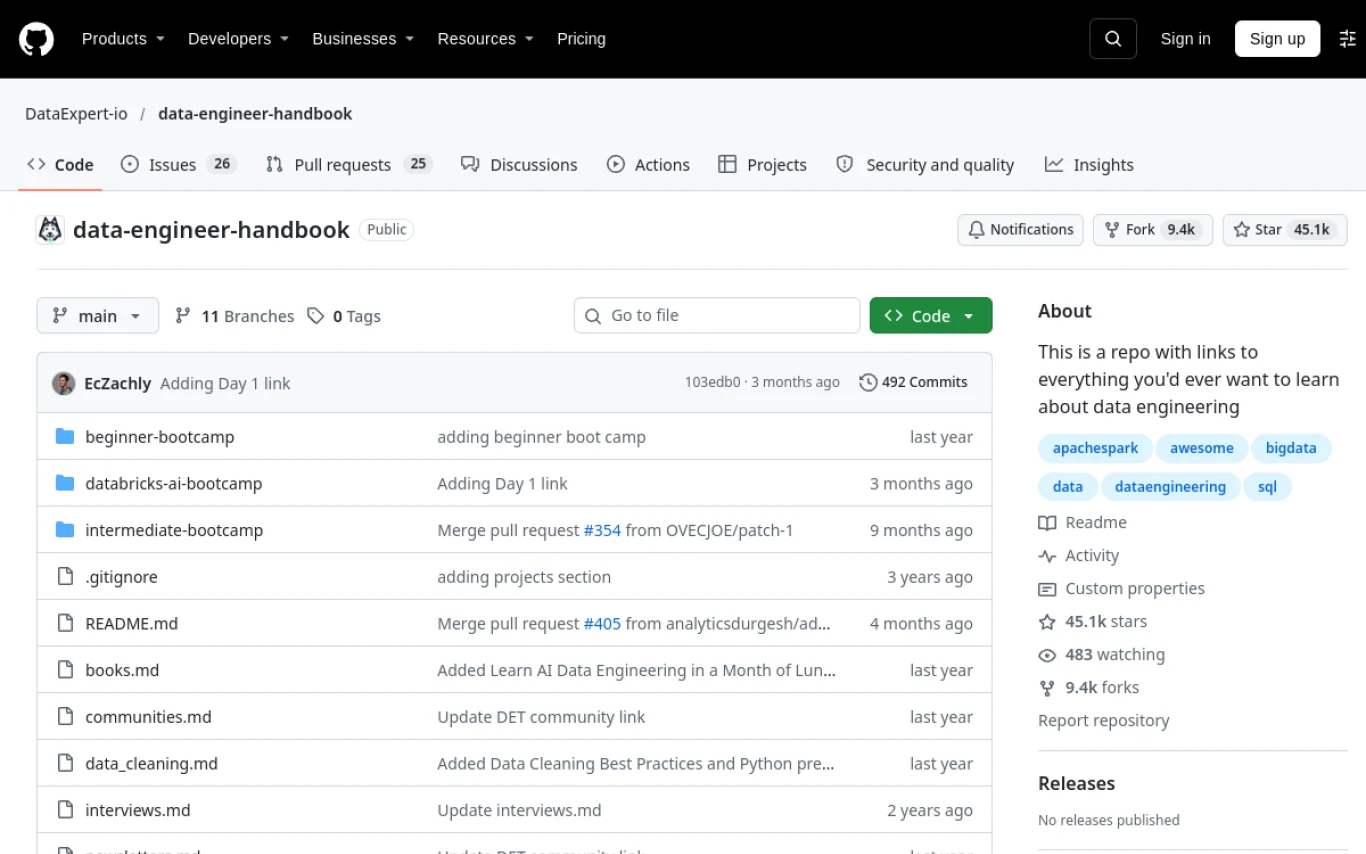
- 1The star and fork counts sit at the top of the page, where every visitor sees them.Fact
- 2The repository is a reading list and course materials, not software.Fact
- 3It carries the school’s name, so each star is also a mention. See §04.Our read
More than one teacher
The homepage lists six instructors, the founder among them, and two guest experts[2]. The founder’s program pages say he led data and software teams at Airbnb, Facebook and Netflix[2]. TrustMRR gives the founding date as Mar 22, 2023; the domain has archived copies going back to December 2021[1][4].
| Free | Subscription | Live boot camp | |
|---|---|---|---|
| Price | $0 | $96 a month or $1,150 a year | $3,000 one time |
| What you get | A six-week program, newsletter, SQL practice, the GitHub handbook | The recorded course library | About five weeks of live classes with instructors |
| When | Any time | Any time | Fixed dates |
From the live site, read Nov 11, 2026[2]; the free program from the newsletter post that announced it in June 2025[6].
Revenue analysis
Two businesses on one Stripe account: a subscription that is slowly shrinking, and a launch business that pays in bursts.
Hover or tap a bar, or pick a window. Verified daily revenue, Oct 12 – Nov 9, 2026 (UTC), from TrustMRR[1]. Blue: the twelve days from Oct 29. The next boot camp starts Nov 16[2]. Nov 10 is left out because the day was not complete at sync.
17 days, $24,328 in total.Derived
12 days, $78,466 in total.Derived
Taken in those 12 days.Derived
$104,582 in 30 days against $52,398 MRR.Derived
Monthly revenue: three peaks and long valleys
Hover or tap a bar. Monthly verified revenue from TrustMRR[1], December 2025 to November 2026. November covers Nov 1–10.
Our arithmetic on the verified data in this report. Revenue ÷ MRR uses the last 30 days; the share of all-time revenue counts the months in the chart above; the swing is the median change between complete months.
December 2025 brought $251,176 and September 2026 brought $49,281, a ratio of 5.1 to 1. The three largest months, December, August and March, hold 47.7% of the eleven complete months[1]. In December 2025 the homepage was selling a 15-week program at $7,497 that started on Jan 2, and two boot camps at $3,000 that started in January and February[4]. The peak and those launches fall in the same weeks; we cannot show which program brought which dollars.Our read
The subscription line
| Date | MRR | Active subscriptions | All-time revenue |
|---|---|---|---|
| Nov 20, 2025 | $57,914 | 1,045 | $3,462,249 |
| Apr 3, 2026 | $60,899 | 920 | $4,214,753 |
| Jun 21, 2026 | $57,694 | 914 | $4,393,277 |
| Sep 4, 2026 | $57,708 | 911 | $4,674,448 |
| Nov 2, 2026 | $53,450 | 834 | $4,782,554 |
| Nov 10, 2026 | $52,398 | 823 | $4,834,144 |
Earlier rows from archived copies of the TrustMRR page[3]; the last row from the live page[1]. The November 2025 MRR was labelled an estimate.
1,045 to 823, a loss of 222.Derived
$57,914 to $52,398.Derived
Added to the all-time total.Derived
MRR × 12 at its lowest and highest, against 12-month revenue.Derived
MRR tells you about one of the two businesses. Multiply today’s MRR by twelve and you get $628,776, or 45% of the last twelve months of revenue; use April’s higher MRR and you get 52%. Either way, roughly half of what DataExpert collected is not subscription money[1][3].Derived
Each subscription is worth about $64 a month, under the $96 list price. Annual plans, older prices and discount codes are mixed into that average and we cannot separate them.Our read
Market
Paid courses for working engineers are a crowded field. We found no comparable school with named, verified revenue, so revenue is not compared.Our read
Pricing: cohorts up, subscription down
Over three years the live boot camp became more expensive and the subscription became cheaper.
| Archived | Live boot camp | Self-paced |
|---|---|---|
| Jan 2024 | $2,000 for both tracks; $1,650 for one | $1,750 one time |
| Jun 2024 | — | $1,750 one time. “Bought by 127 students!” |
| Dec 2024 | “30% off! Less than 15 seats left in Jan 2025 boot camp!” | — |
| Dec 2025 | $3,000 for five weeks; $7,497 for a 15-week program | $200 a month or $1,500 a year; $100 a month without cloud access |
| Nov 2026 | $3,000 for five weeks | $96 a month or $1,150 a year |
From archived copies of the homepage[4] and the live site[2]. A dash means that capture did not show a price for that product.
$2,000 in January 2024 to $3,000 now.Derived
$200 in December 2025 to $96 now.Derived
The self-paced course started as a one-time purchase at $1,750 and became a subscription. The TrustMRR profile still gives the price as $119 a month, which matches neither the December 2025 archive nor today’s site[1][2][4].
Where customers come from
From an audience the founder built by teaching in public, on several platforms at once.
The founder’s personal profile. His headline states a goal of upskilling a million knowledge workers in AI before 2030.[7]
FactOn Substack, under the DataExpert.io name. A list the business can reach without a platform’s feed.[6]
Factdata-engineer-handbook, created November 2023, forked 9,416 times. Course homework and materials are kept here.[5]
FactThe GitHub repository is the unusual one. A list of learning resources and the materials for the free program sit in public, where every star and fork is visible to the next visitor. A second handbook, for AI engineers, was created in February 2026 and has 1,258 stars[5].
A six-week program released free in June 2025, on the school’s own platform and on YouTube. Homework is submitted on the platform.[6]
FactEvery live program has a start and an end, shown on the homepage and the pricing page.[2]
FactWhat we could not read
What the founder posts, and how often, sits behind a login on both LinkedIn and X, so we used only the follower counts. We did not read the YouTube channel. We have no traffic data for the site, whose domain rating is 51[1].
What customers say
669 reviews on Trustpilot, almost all five stars, on a profile that invites them.
Profile claimed in August 2025.Fact
Out of 5.Fact
Four-star 3%, one-star 1%.Fact
As reported by Trustpilot.Fact
| Theme | What reviewers say | Example |
|---|---|---|
| Praise: real-world focus | The course teaches trade-offs such as cost and performance, not only how to use a tool | Sep 5, 2026 |
| Praise: structure | Clear lessons and a capstone project with realistic pipelines | Jul 7 and Aug 10, 2026 |
| Praise: the teacher | The founder’s own teaching is named as the reason it worked | May 9, 2026 |
| Criticism: pace | Hard to follow without more background; wanted a slower start before projects | 3 stars, Mar 3, 2026 |
| Criticism: price | Steep against local salaries in some regions | 4 stars, May 15, 2026 |
| Criticism: community | Wished the community were more active | Sep 6, 2026 |
Themes from reviews on Trustpilot, paraphrased, with the date of one example each[8].
Growth strategies
Five moves. The first two build the audience, the next two turn it into revenue, and the last one keeps the proof visible.
Timeline
- Mar 222023ProductFounding date on TrustMRR.[1]
- Nov 192023MarketingThe data-engineer-handbook repository is created on GitHub.[5]
- Jan 262024PricingHomepage: live boot camp $2,000, self-paced course $1,750.[4]
- Dec 12024PricingBanner: 30% off, fewer than 15 seats left for the January 2025 boot camp.[4]
- Aug2025MarketingTrustpilot profile claimed.[8]
- Nov 202025Revenue1,045 active subscriptions; $3,462,249 all time.[3]
- Dec 32025PricingHomepage: a 15-week program at $7,497 and boot camps at $3,000; subscription $200 a month.[4]
- Dec2025Revenue$251,176 for the month, the highest in the last twelve.[1]
- Feb 162026MarketingA second handbook, for AI engineers, is created on GitHub.[5]
- Aug2026Revenue$171,257 for the month.[1]
- Sep2026Revenue$49,281 for the month, the lowest in the last twelve.[1]
- Nov 102026Revenue823 active subscriptions; $4,834,144 all time.[1]
- Nov 162026ProductNext live boot camp starts, at $3,000.[2]
Key takeaways
DataExpert shows what a teaching business looks like once the audience exists: generous at the front, expensive at the live end, and uneven month to month.
Why we scored it this way
Copy
Avoid
- Reading MRR as the size of a course business. Here it is about half. §02
- Planning on launch months. The best month was 5.1× the worst. §02
- Expecting this scale without the audience. The follower counts came before the revenue. §04
Our predictions
Three claims with dates. We mark each one right or wrong on its date and keep the result on the page.
Track record: the predictions in our earlier reports are still open; the first checks land Dec 1, 2026. We mark each prediction right or wrong on its date and keep the result on the page.
What could prove us wrong
Things that would change our read, and how to check them.
- The falling subscription count may be a choice. The monthly price went from $200 to $96 and the site now leads with boot camps. The business may be steering people to cohorts on purpose.Check: whether the subscription returns to the pricing page or the homepage’s first screen.
- Our split between cohorts and subscriptions is an estimate. We annualise MRR at two points and compare it with twelve months of revenue. Annual plans, refunds and team deals could move it either way.Check: not public. Only the founder has revenue by product.
- The reviews are invited. A 4.9 score from 669 reviews on a profile that asks customers to post is a floor for satisfaction among people who replied, not a sample of everyone who paid.Check: Trustpilot marks invited reviews on each entry.
- The business leans on one person’s reach. If the founder’s accounts lose reach or he steps back, every channel here is affected at once.Check: newsletter and follower counts at the next review.
Appendix
FAQ
How much does DataExpert make?
$104,582 in the 30 days to Nov 10, 2026, $1,397,414 in the last twelve months and $4,834,144 all time, verified through Stripe on TrustMRR. MRR is $52,398 from 823 active subscriptions.
What does DataExpert cost?
The live boot camp starting Nov 16, 2026 is $3,000 as a one-time payment. The self-paced subscription is $96 a month or $1,150 a year. Mock interviews start at $50, and a six-week program is free.
Why is DataExpert’s revenue so much higher than its MRR?
Because about half of it is one-time payments for live boot camps, which MRR does not count. Revenue rises in the weeks before a cohort starts and falls back afterwards.
Who runs DataExpert?
Zach Wilson, the founder, who teaches alongside six instructors listed on the site. He has about 526,000 followers on LinkedIn and a newsletter with more than 173,000 subscribers.
Sources
- [1]TrustMRR: DataExpert / TechCreator — revenue, MRR, subscriptions, daily and monthly data. Verified through a Stripe API key. Synced 2026-11-10 20:02 UTC.
- [2]dataexpert.io — homepage, pricing page and program pages. Read 2026-11-11.
- [3]Wayback Machine captures of the TrustMRR page for DataExpert on Nov 20, 2025 and Apr 3, Jun 21, Sep 4 and Nov 2, 2026 — MRR, subscriptions and all-time revenue on those dates. Read 2026-11-11.
- [4]Wayback Machine captures of dataexpert.io — seven homepage captures from Jan 26, 2024 to Oct 8, 2026: programs and prices. Read 2026-11-11.
- [5]GitHub: DataExpert-io — repositories, stars, forks and creation dates. Read 2026-11-11.
- [6]DataExpert.io Newsletter on Substack — subscriber count as shown on the page. Read 2026-11-11.
- [7]Zach Wilson on LinkedIn — follower count as shown on the public profile. Read 2026-11-11.
- [8]Trustpilot: dataexpert.io — review count, score, star split and review text. The company invites reviews. Read 2026-11-11.
Screenshots © DataExpert.io and GitHub, used for commentary. Oddig has no business relationship with DataExpert.io. Review themes are paraphrased from public reviews. Numbers change daily; check the sources for the latest.


Comments are closed for this article.