
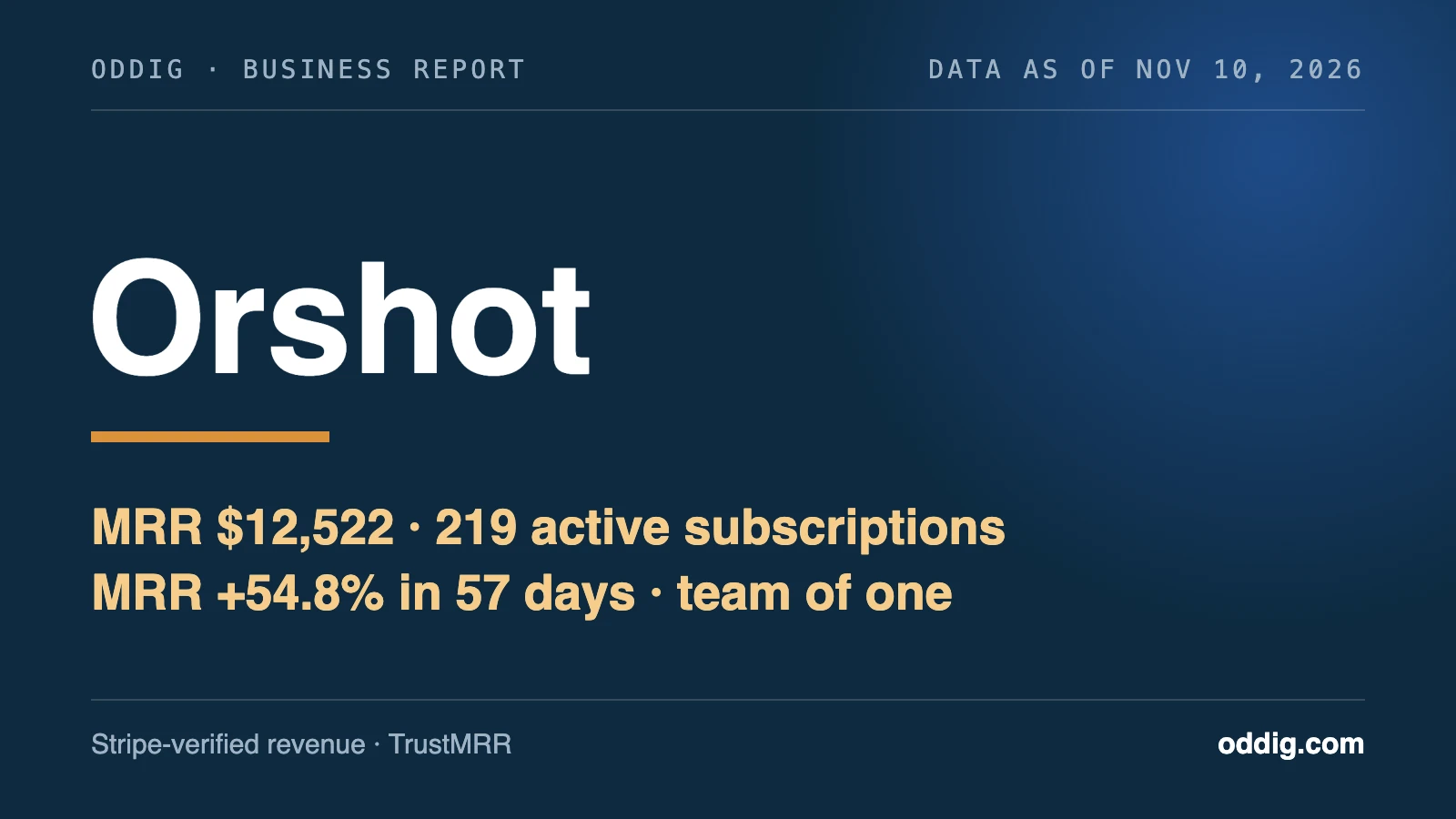
One developer, no team: Orshot’s MRR rose 55% in eight weeks to $12,522
A template-to-image API built by one developer in Berlin. It is his second product; the first customers came from the first. Growth now comes from customers on bigger plans, and he publishes his own metrics every 12 hours.
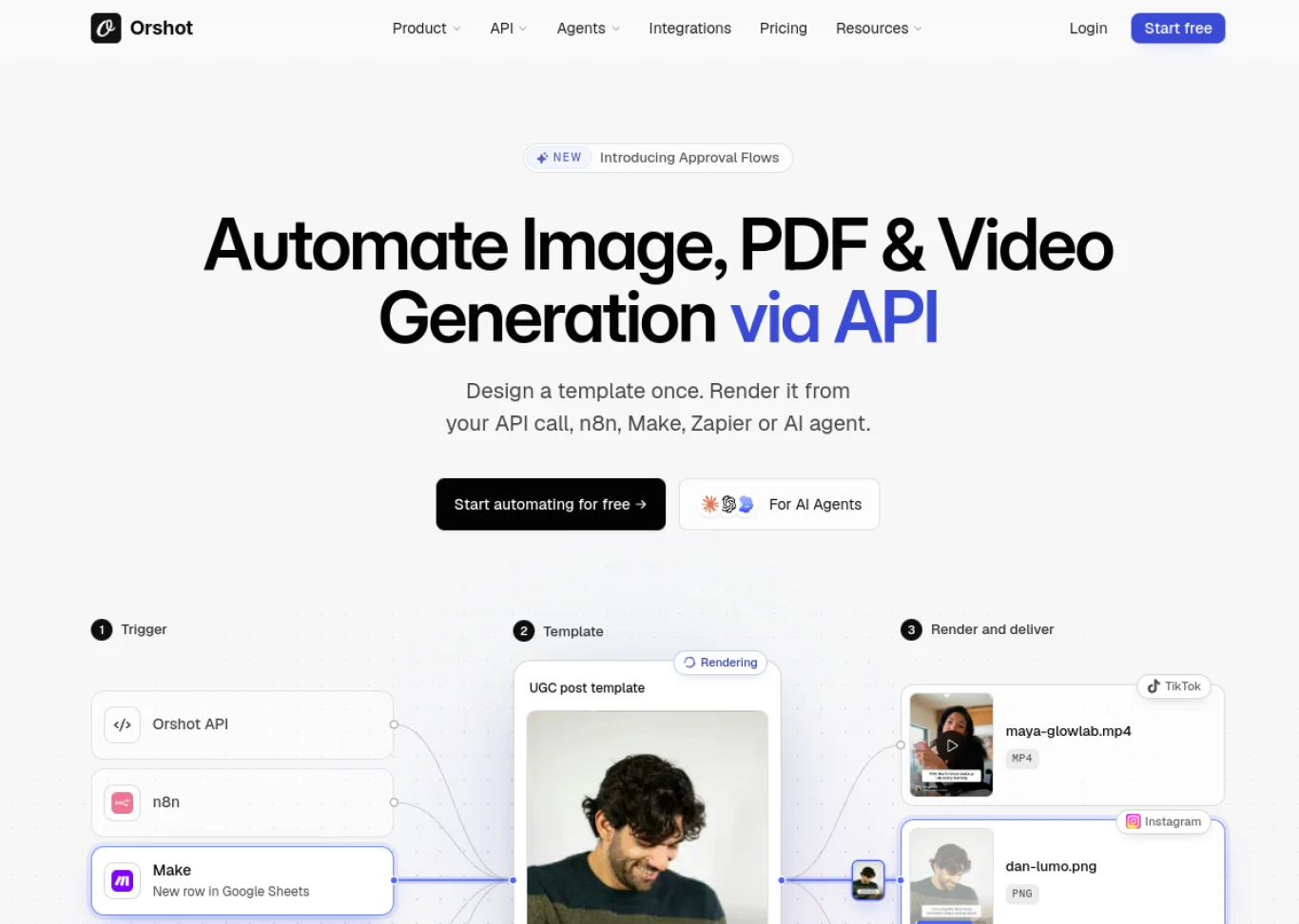
Product at a glance
Summary
What this business is
Orshot turns a design template into an API: a team designs a social post, a certificate or a product banner once, then sends data to Orshot and gets back finished images, PDFs or videos. It was built by Rishi Mohan, a designer and front-end engineer from India living in Berlin, who works alone. It is his second product; his first, the screenshot tool Pika, earned more than $100,000 and supplied many of Orshot’s first customers. Orshot launched in March 2025, passed $5,000 MRR a year later and is now at $12,522. He has published his own metrics on a public page since launch.
Why these scores? See the reasons in Key takeaways →
Momentum
Rising. Revenue: last three complete months +31% on the three before; +90% on the same months half a year earlier; MRR +92% since May 15, 2026.Derived
Best suited for
Builder (main). Shipping fast matters here: the public page shows 801 commits in 30 days from a team of one.
Creator (second). His first customers came from an audience built by sharing his work on X for years.
What you need to start. An audience or an earlier product to start from, and the stamina to keep integrating with every tool customers use.Our read
Key findings
Product overview
Design once, render thousands of times, from whatever tool sends the data.
A team designs a template in Orshot’s editor or imports one from Canva or Figma. Each text, image or colour in it becomes a field. Anything that can send data, from its API to Zapier, Make, n8n, a Google Sheet or an AI assistant, then fills the fields and gets back an image, a PDF or a video[2]. Finished files can also be posted straight to social platforms[2].
The homepage claims 140+ teams, 1,490,000+ renders and a library of 2,000+ templates[2]. Customer logos include Incubeta and Brendi, which serves more than 5,000 restaurants[2][6].
What the site looks like
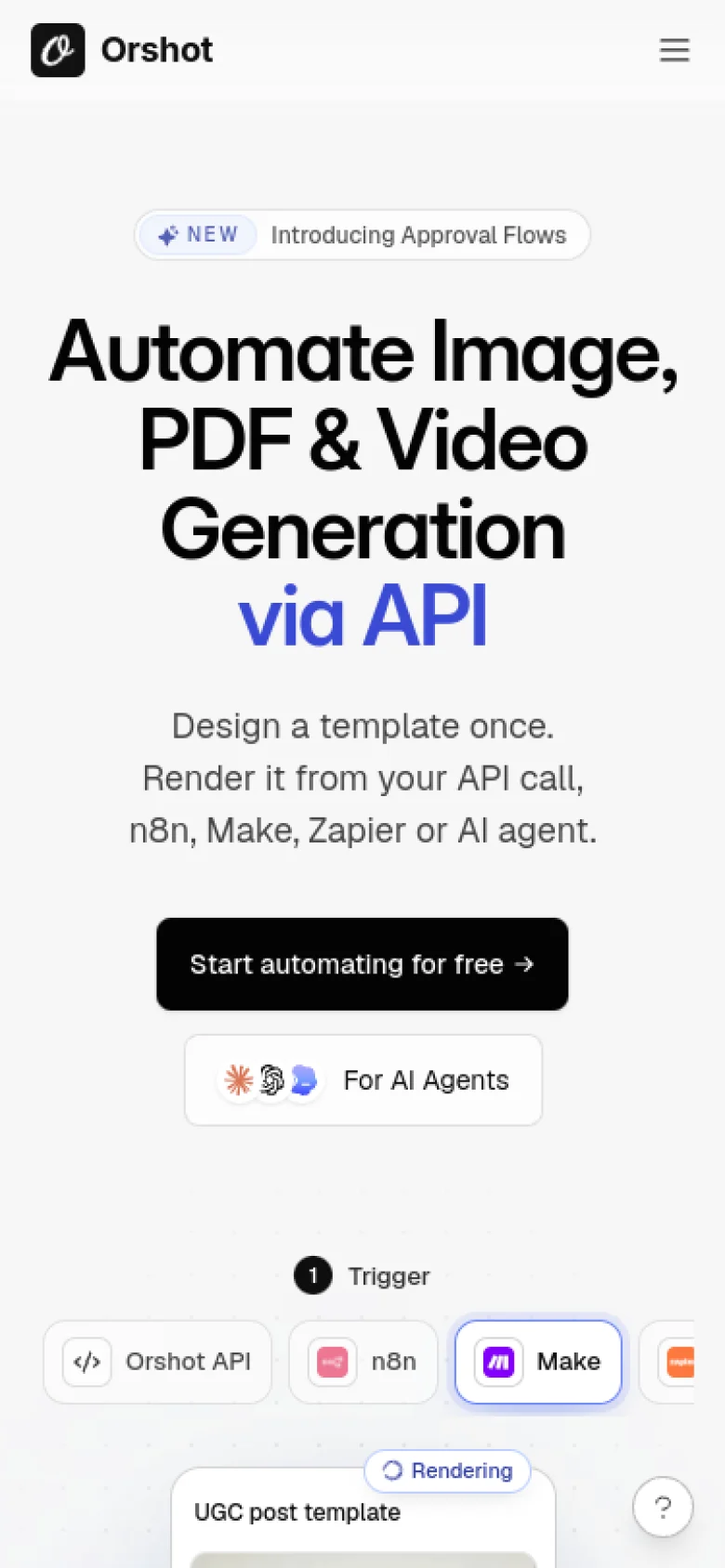
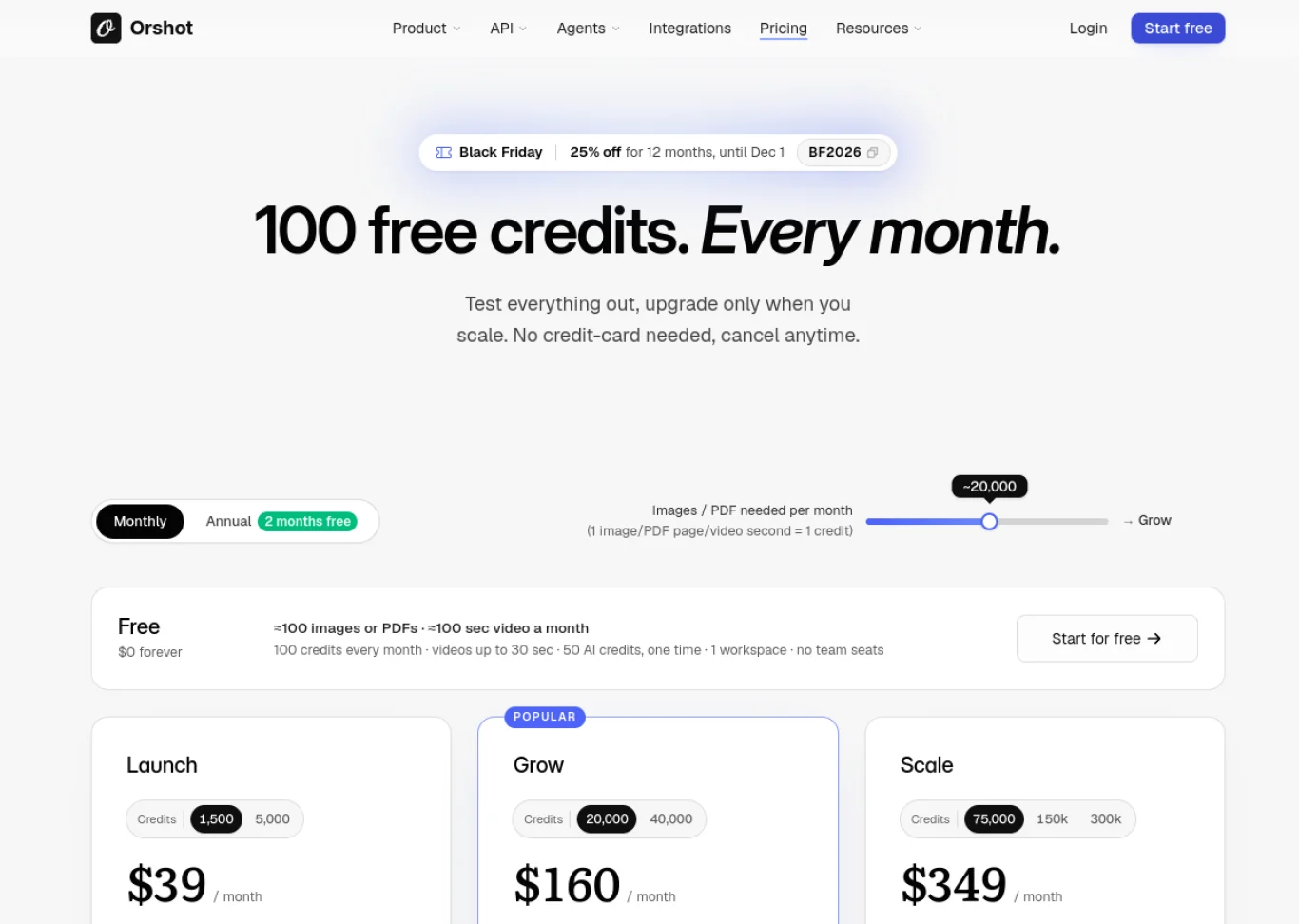
Captured Nov 11, 2026 · Screenshots: orshot.com.
What to look for
- 1“Automate Image, PDF & Video Generation via API”: one line for developers, no-code users and AI agents.Fact
- 2A diagram of triggers: Orshot API, n8n, Make, Zapier. The integrations are the product’s front door.Fact
- 3A separate button “For AI Agents” sits next to the main call to action. See §04.Fact
What to look for
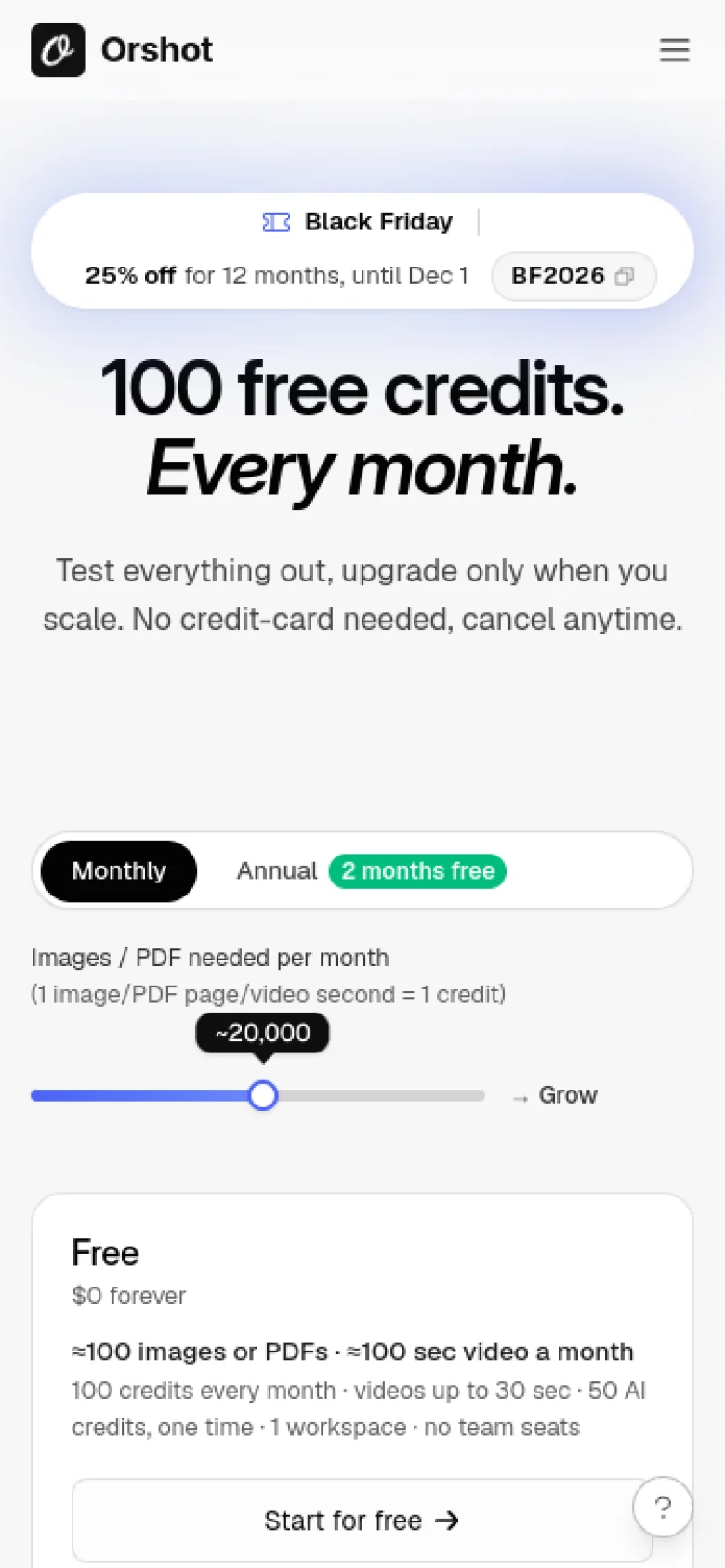
- 1“100 free credits. Every month.” leads the page; the free plan was widened on Sep 21.Fact
- 2A slider picks volume first, then shows Launch $39, Grow $160 and Scale $349.Fact
- 3A Black Friday banner: 25% off for 12 months until Dec 1.Fact
What to look for
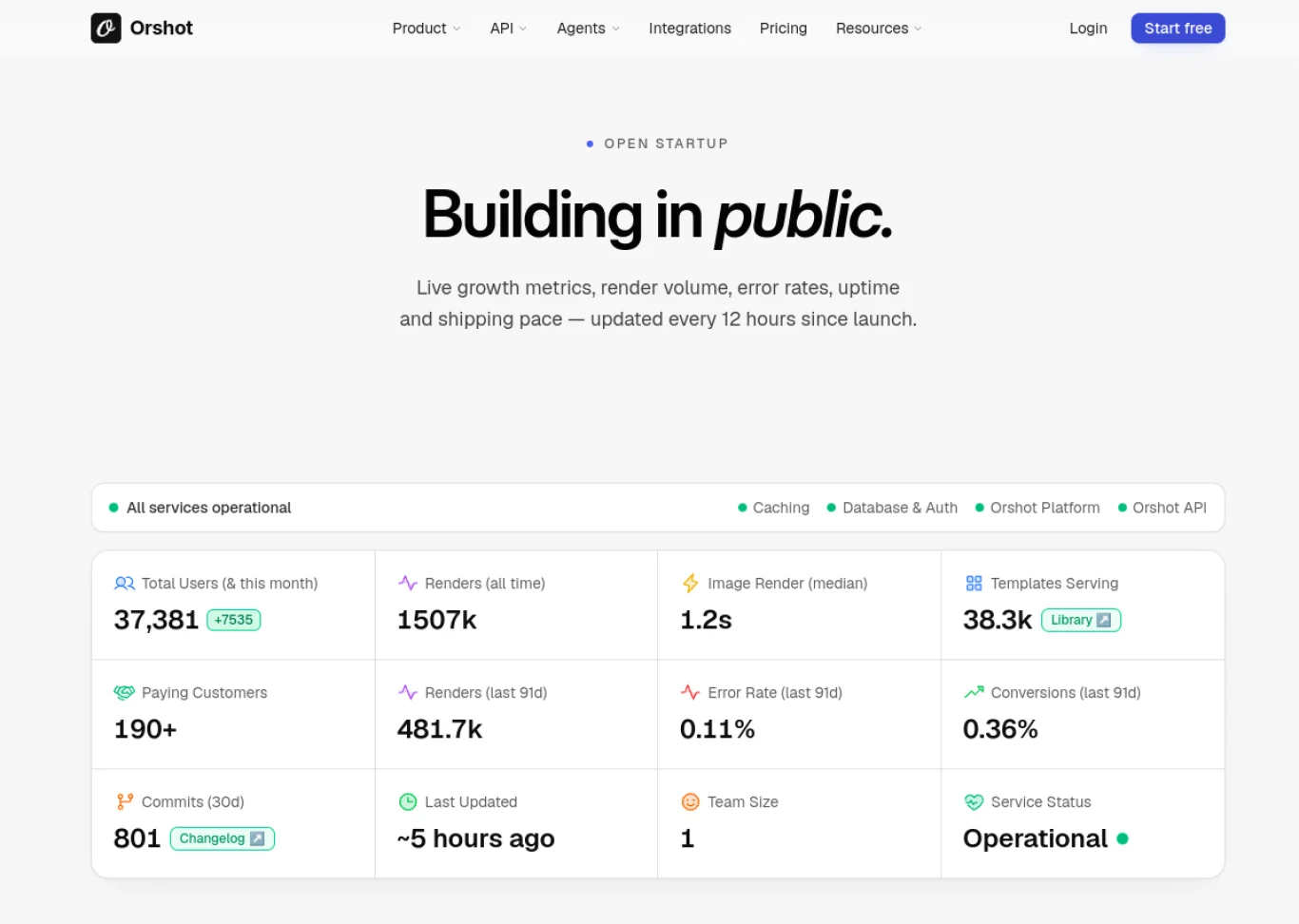
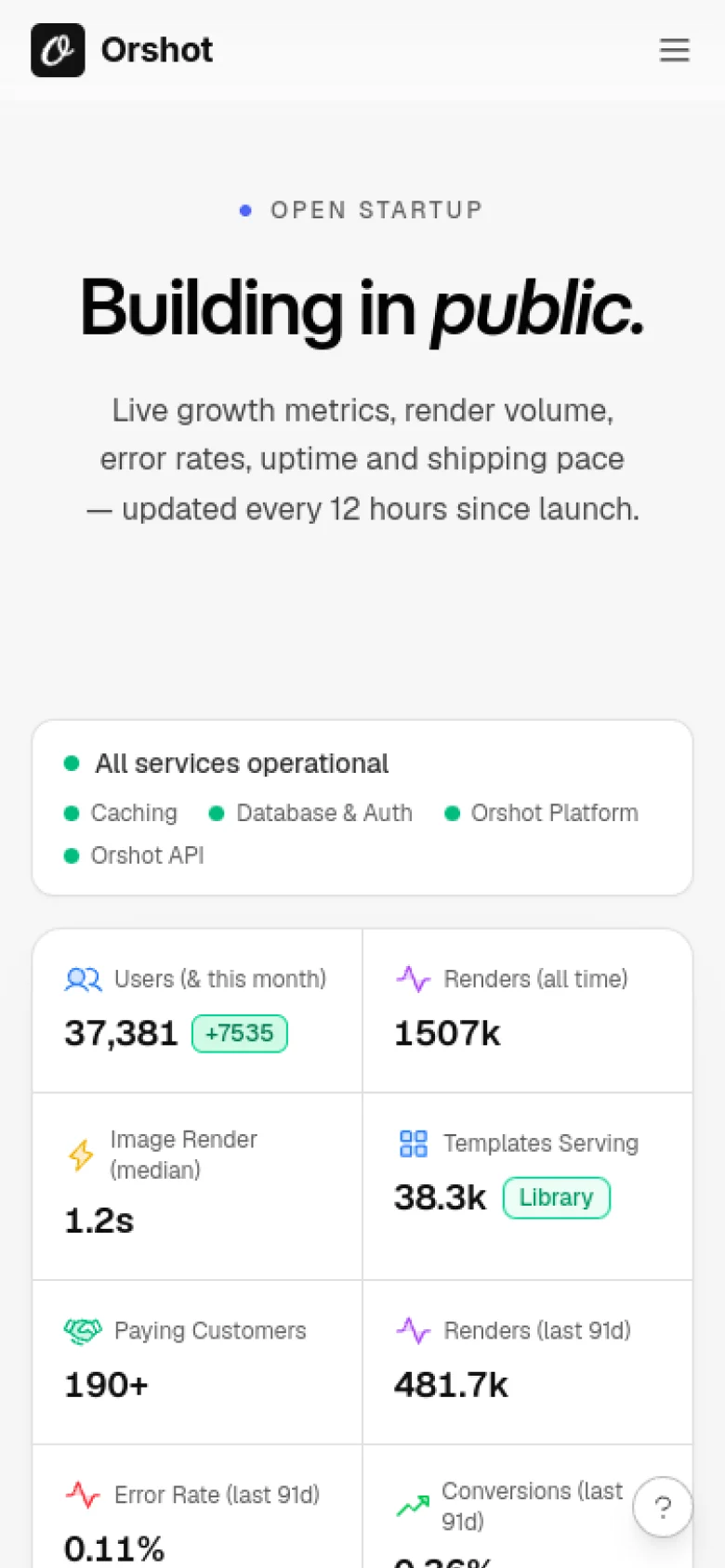
- 1“Building in public”: users, renders, render time, paying customers and conversion, updated every 12 hours.Fact
- 237,381 users, 1507k renders, 190+ paying customers, team size 1.Fact
- 3The page used to show MRR. It no longer does. See §02.Fact
| Plan | Price a month | Credits a month | Team |
|---|---|---|---|
| Free | $0 | 100 | 1 user, 1 workspace |
| Launch | $39 | 1,500 | 2 members |
| Grow | $160 | 20,000 | 6 members |
| Scale | $349 | 75,000 | 14 members, approval flows |
| Enterprise | Custom | Custom | Custom |
From the live pricing page, read Nov 11, 2026[2]. One credit is one image, one PDF page or one second of video. Annual billing gives two months free; social publishing is $12 a month per account.
The founder, Rishi Mohan, spent about ten years as a designer and front-end engineer before working on his own products full time[6]. Before Orshot he built Pika, a screenshot and mockup tool; TrustMRR shows $141K of all-time revenue for it, now mostly past[7]. His public metrics page lists Orshot’s team size as one[4].
Revenue analysis
About $400 a day, every day, from monthly subscriptions that keep getting bigger.
Hover or tap a bar. Verified daily revenue, Oct 13 – Nov 9, 2026 (UTC), from TrustMRR[1]. Blue: Saturdays and Sundays. Nov 10 is left out because the day was not complete at sync.
20 weekdays.Derived
8 weekend days.Derived
Automations run every day.Derived
$11,389 in 30 days against $12,522 MRR.Derived
Monthly revenue: up 5.3× in ten months
Hover or tap a bar. Monthly verified revenue from TrustMRR[1], December 2025 to November 2026. November covers Nov 1–10. Revenue from March to November 2025 totals $7,115.
Our arithmetic on the verified data in this report. Revenue ÷ MRR uses the last 30 days; the share of all-time revenue counts the months in the chart above; the swing is the median change between complete months.
Monthly revenue rose from $2,160 in December 2025 to $11,498 in October 2026[1]. Most of that came in two steps: a rise in March, and a 42.3% jump in October.Derived
| Date | MRR | Active subscriptions | MRR per subscription |
|---|---|---|---|
| May 15, 2026 | $6,523 | 145 | $44.99 |
| Sep 14, 2026 | $8,088 | 169 | $47.86 |
| Oct 30, 2026 | $11,398 | 199 | $57.28 |
| Nov 10, 2026 | $12,522 | 219 | $57.18 |
Earlier rows from archived copies of the TrustMRR page[3]; the May figure was marked as an estimate. The last row from the live page[1]. The last column is our division.
The founder’s own public metrics
| Date | Users | MRR shown | Conversion |
|---|---|---|---|
| Dec 1, 2025 | 2,208 | $1,750 | 4.71% (17 days) |
| Mar 8, 2026 | 3,689 | $3,235 | 5.93% (91 days) |
| Jun 6, 2026 | 4,917 | $5,633 | 10.41% (91 days) |
| Nov 11, 2026 | 37,381 | No longer shown | 0.36% (91 days) |
From orshot.com/open and its archived copies[4]. These are the founder’s own figures; how conversion is counted is not stated.
Users grew 7.6× between June and November, and the page says 7,535 joined this month alone[4]. Over the same months the conversion figure fell from 10.41% to 0.36%[4]. Three changes sit in that window: Orshot apps for ChatGPT and Codex in August, a free plan of 100 credits every month from Sep 21, and an Orshot app for Claude on Sep 30[4]. The timing fits sign-ups from new, lower-intent sources, but we cannot see where users came from or how conversion is defined.Our read
Market
Template-to-image APIs are a crowded category. Orshot itself publishes comparison pages against Bannerbear, Placid, Creatomate, Polotno, Templated.io, APITemplate.io, Abyssale, img.ly, RenderForm, Canva Bulk Create and ContentDrips[2]. We found no rival with named, verified revenue, so revenue is not compared.
Pricing: from flat render counts to credits
The entry price went from $30 to $39, and the plans grew taller.
| Archived | Plans |
|---|---|
| Mar 2025 (launch) | $30 a month for 5,000 renders; $75 a month for 10,000 renders |
| Jan 2026 | Free trial; pay-as-you-go overage at $0.018 a render |
| Jun 2026 | Launch $39 for 3,000 renders; Grow $160; overage $18 per 1,000 |
| Nov 2026 | Free 100 credits; Launch $39 (1,500 credits); Grow $160; Scale $349; video counted per second |
From archived copies of the pricing page[5] and the live page[2].
March 2025 to now.Fact
A Scale tier was added.Fact
Renders keep going past the plan.Fact
Recurring since Sep 21, 2026.Fact
Where customers come from
From an audience he already had, then search, integrations and AI assistants.
“A good chunk of my initial customers came from the Pika crowd,” the founder says.[6]
FounderYears of posting revenue, features and failures, first for Pika, then Orshot.[1][6]
FounderHe calls long comparison posts his highest-traffic, highest-converting content.[2][6]
FounderZapier, Make, n8n, Pipedream, Figma and Canva imports, Sheets, Airtable, Shopify, HubSpot.[2]
FactApps and an MCP server with 100+ tools, launched August and September 2026.[2][4]
FactA tweet screenshot extension, a thread-to-carousel generator and a colour picker.[2]
FactLaunches and viral posts did not create lasting growth, the founder says.[6]
FounderWhat we could not read
TrustMRR has no traffic data for Orshot, and the public metrics page does not split users by source[1][4]. We do not know how many of the 37,381 users came through AI assistants.
Growth strategies
Four moves, each visible from outside.
Timeline
- Mar 252025
- Dec 12025RevenuePublic metrics page: 2,208 users, $1,750 MRR.[4]
- Mar 292026Marketing“1 Year of Orshot” post: 100+ customers, $5,000+ MRR, still solo.[6]
- Jun 52026PricingLaunch $39, Grow $160, overage $18 per 1,000.[5]
- Aug 182026ProductOrshot for ChatGPT and Codex.[4]
- Sep 212026PricingFree plan becomes 100 credits every month.[4]
- Sep 302026ProductOrshot for Claude; approval flows for templates.[4]
- Oct2026Revenue$11,498, up 42.3% on September.[1]
- Nov 102026RevenueMRR $12,522 from 219 subscriptions.[1]
Key takeaways
Orshot shows how a solo founder can turn the audience of one product into the first customers of the next, and grow revenue by letting customers move up to bigger plans.
Why we scored it this way
Copy
- Build your second product for the users of your first. Pika’s users became Orshot’s early customers. P1
- Publish your metrics on a page of your own, updated automatically. P2
- Write comparison pages against every rival. The founder calls them his highest-converting content. P3
- Plug into the tools your buyers already automate with: Zapier, Make, n8n, Figma, AI assistants. P4
Avoid
- Counting on launch spikes. Product Hunt and viral posts lasted a day. §04
- Reading a sign-up surge as demand before checking conversion. §02
- Entering a crowded API category without a starting audience. §09
Our predictions
Three claims with dates. We mark each one right or wrong on its date and keep the result on the page.
Track record: the predictions in our earlier reports are still open; the first checks land Dec 1, 2026. We mark each prediction right or wrong on its date and keep the result on the page.
What could prove us wrong
Things that would change our read, and how to check them.
- The October jump may include one-off upgrades. Two months of strong growth is a short run.Check: MRR on the next review against the $12,522 here.
- The conversion drop may be a change in counting, for example users signing up through AI assistants. We cannot see the definition.Check: not public.
- A crowded market can squeeze prices. Bannerbear, Placid and at least nine others sell similar APIs.Check: Orshot’s prices on the next review.
- One person carries everything. Support, uptime and 800 commits a month depend on the founder.Check: team size on the public metrics page.
Appendix
FAQ
How much does Orshot make?
$11,389 in the 30 days to Nov 10, 2026, verified through Stripe on TrustMRR. MRR is $12,522 from 219 active subscriptions.
What does Orshot do?
It turns a design template into an API. You design an image, PDF or video template once, then send data to Orshot through its API, a no-code tool such as Zapier or Make, or an AI assistant, and get finished files back.
Who built Orshot?
Rishi Mohan, a designer and front-end engineer from India living in Berlin. He runs it alone; his earlier product is the screenshot tool Pika.
What does Orshot cost?
Free for 100 credits a month. Launch is $39, Grow $160 and Scale $349 a month, with two months free on annual billing. Social publishing costs $12 a month per account.
Sources
- [1]TrustMRR: Orshot.com — revenue, MRR, subscriptions, daily and monthly data. Verified through a Stripe API key. Synced 2026-11-10 20:01 UTC.
- [2]orshot.com — homepage, pricing page, integrations and alternative pages. Read 2026-11-11.
- [3]Wayback Machine captures of the TrustMRR page for Orshot on May 15, Sep 14 and Oct 30, 2026 — MRR, subscriptions and all-time revenue on those dates. Read 2026-11-11.
- [4]Orshot Open Startup page and its Wayback captures from Dec 1, 2025, Mar 8 and Jun 6, 2026 — users, MRR, conversion and team size as published by the founder. Read 2026-11-11.
- [5]Wayback Machine captures of orshot.com/pricing — March 2025 to June 2026. Read 2026-11-11.
- [6]Fake Mayo: How Rishi Mohan built Orshot, Jul 17, 2026, and Orshot blog: 1 Year of Orshot, Mar 29, 2026 — the founder’s account of channels and milestones. Read 2026-11-11.
- [7]TrustMRR: rishi — the founder’s products, including Pika, and their verified revenue. Read 2026-11-11.
Screenshots © Orshot, used for commentary. Oddig has no business relationship with Orshot. Numbers change daily; check the sources for the latest.


Comments are closed for this article.