
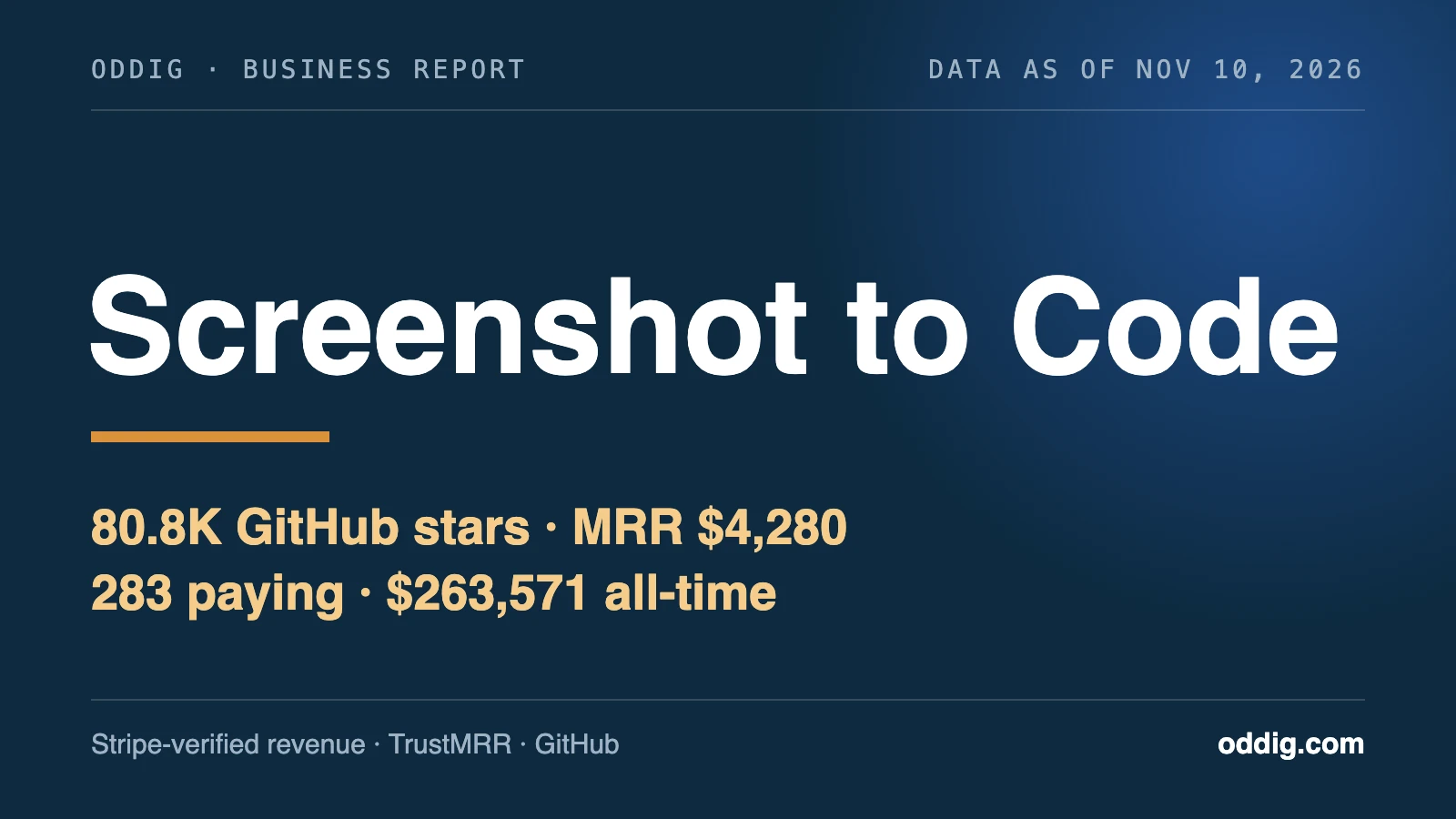
80,800 GitHub stars, $4,280 a month: what an open-source hit earns as a hosted product
One developer’s screenshot-to-code project went viral on GitHub in 2023. The paid hosted version has earned $263,571, but monthly revenue has fallen by about two-fifths while the stars kept climbing.
Product at a glance
Summary
What this business is
Screenshot to Code turns an image of a user interface into working front-end code using AI models. Abi Raja, a developer in New York, released it as an open-source project in November 2023, and it reached about 24,000 GitHub stars within weeks. Anyone can run the code with their own API key; the paid product is a hosted version at screenshottocode.com. It has taken $263,571 in verified revenue. Revenue averaged about $8,400 a month before December 2025 and about $5,100 a month since, while the repository kept gaining stars.
Why these scores? See the reasons in Key takeaways →
Momentum
Declining. Revenue: last three complete months −16% on the three before; −15% on the same months half a year earlier.Derived
Best suited for
Builder (main). The project won attention by shipping fast and adding each new AI model as soon as it came out.
Creator (second). The audience is the repo’s followers, not paid marketing.
What you need to start. A plan for turning open-source attention into a paid product that stays ahead of the free version.Our read
Key findings
Product overview
A free open-source tool, and a paid version you do not have to set up.
Screenshot to Code takes a screenshot, a design mockup, a screen recording or a text prompt and produces front-end code in stacks such as HTML with Tailwind, React or Vue, which can then be refined with plain-English follow-ups[1][3]. The open-source version on GitHub runs on your own machine with your own API keys for the AI models[3]. The hosted version at screenshottocode.com needs no setup and is paid[2].
The founder, Abi Raja, is a developer in New York; a third-party profile says he was previously a technical product manager at ADP and founded a startup called Patio[5]. TrustMRR lists the team as one person and the company as bootstrapped[1].
What the site looks like
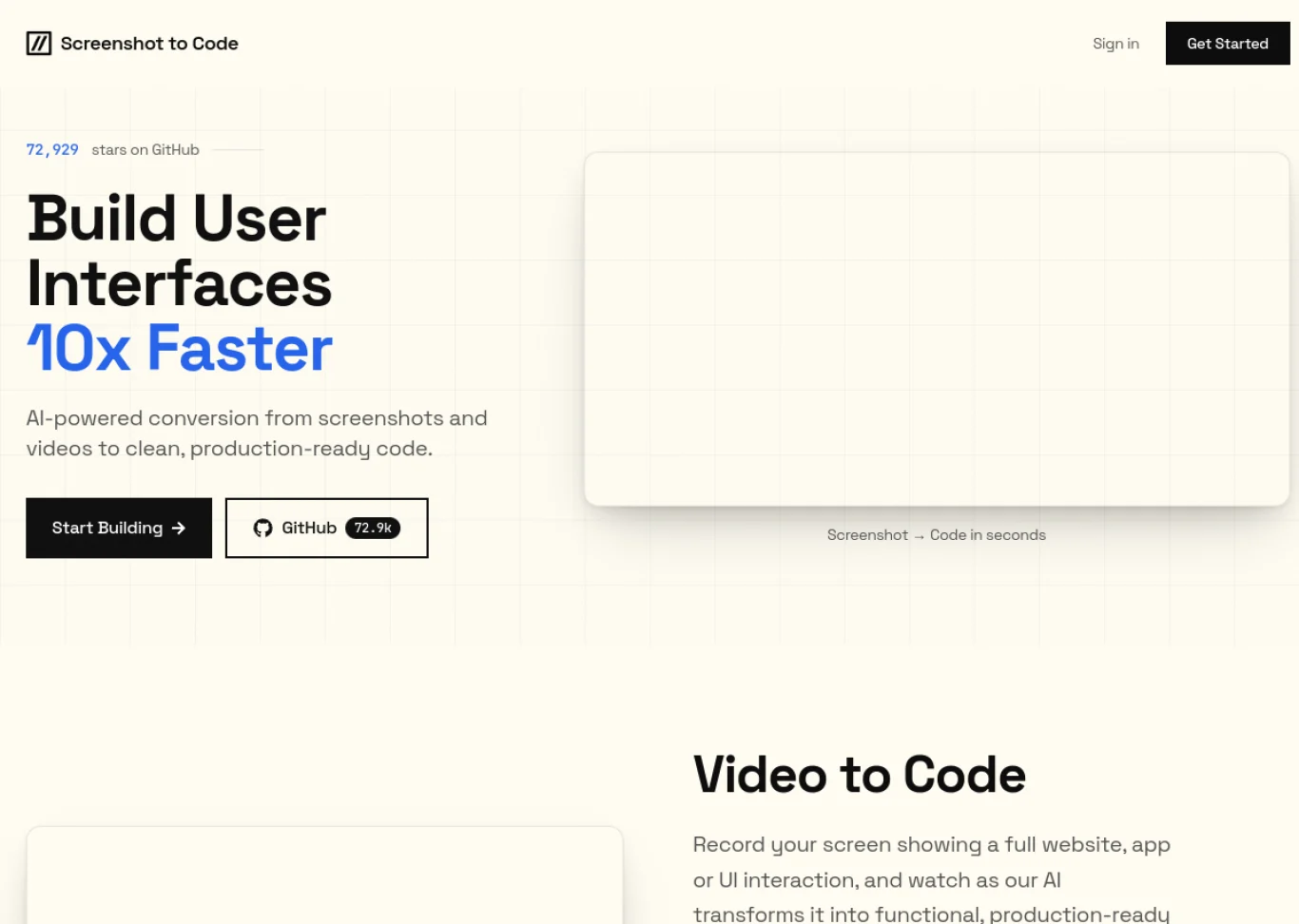
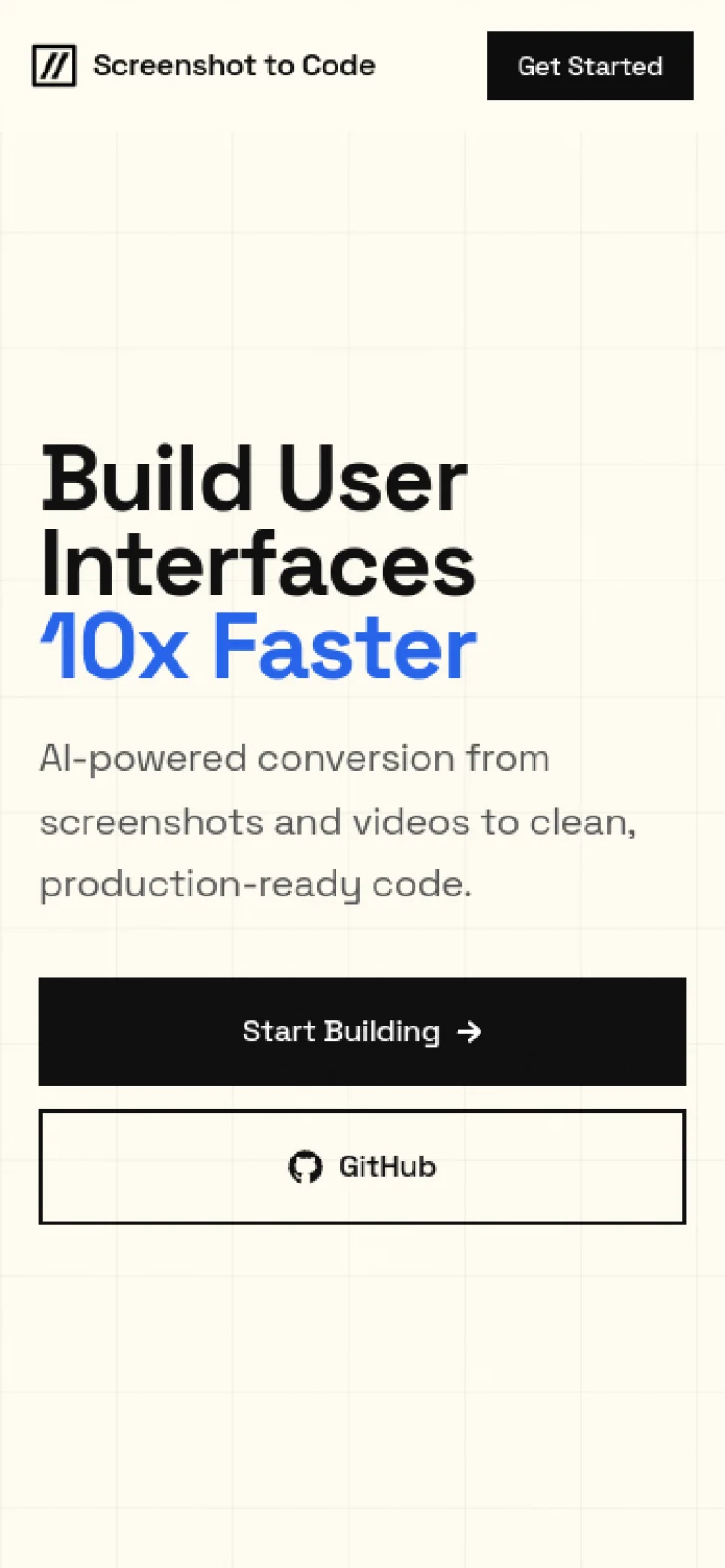
Captured Nov 11, 2026 · Screenshots: screenshottocode.com and github.com.
What to look for
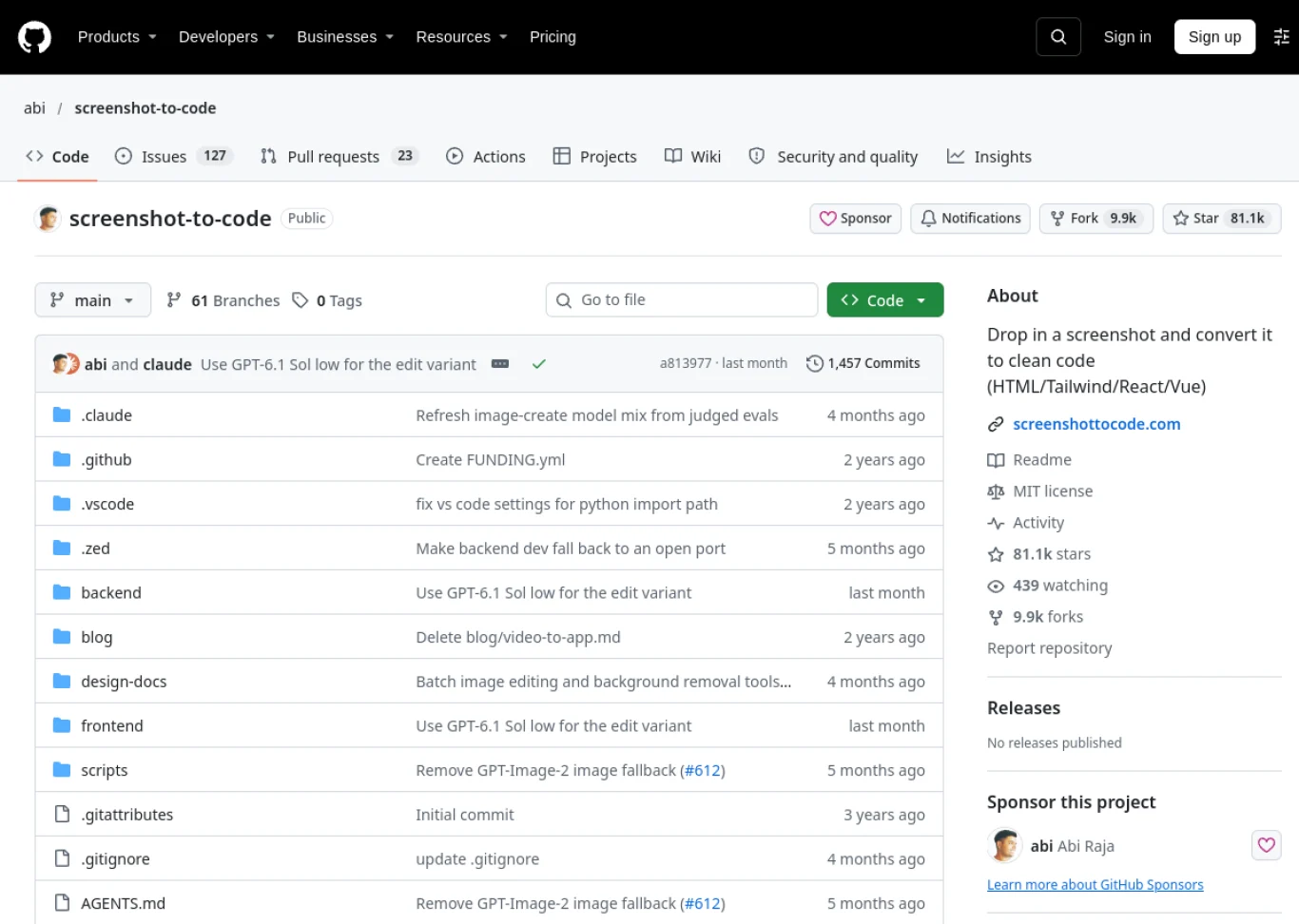
- 1The first line is a GitHub star count, 72,929, older than the 80.8K on GitHub itself.Fact
- 2“Build User Interfaces 10x Faster”: the hosted product sells speed, not the code, which anyone can run.Fact
- 3A GitHub button sits next to “Start Building”: the open-source repo is the credential.Fact
What to look for
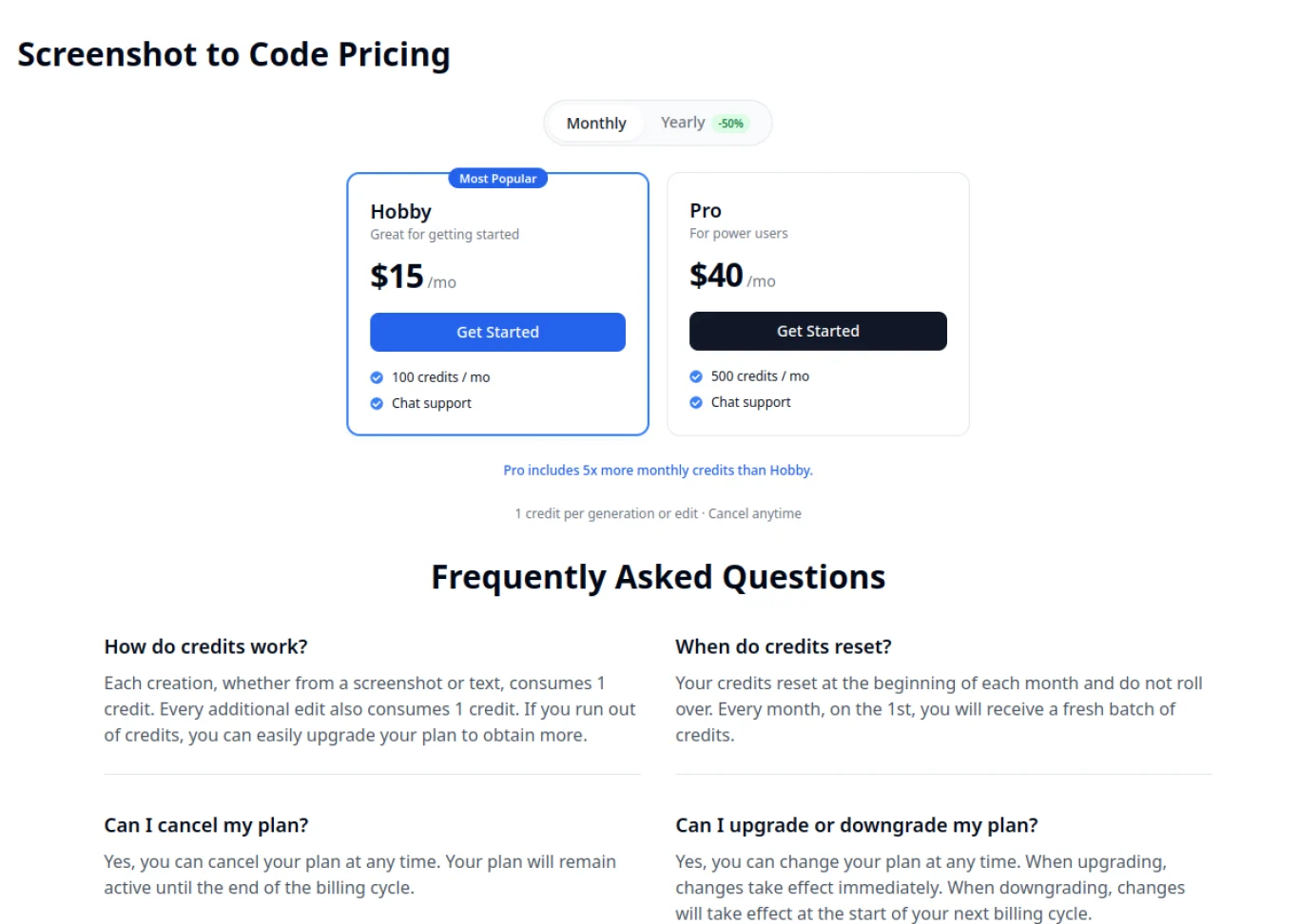
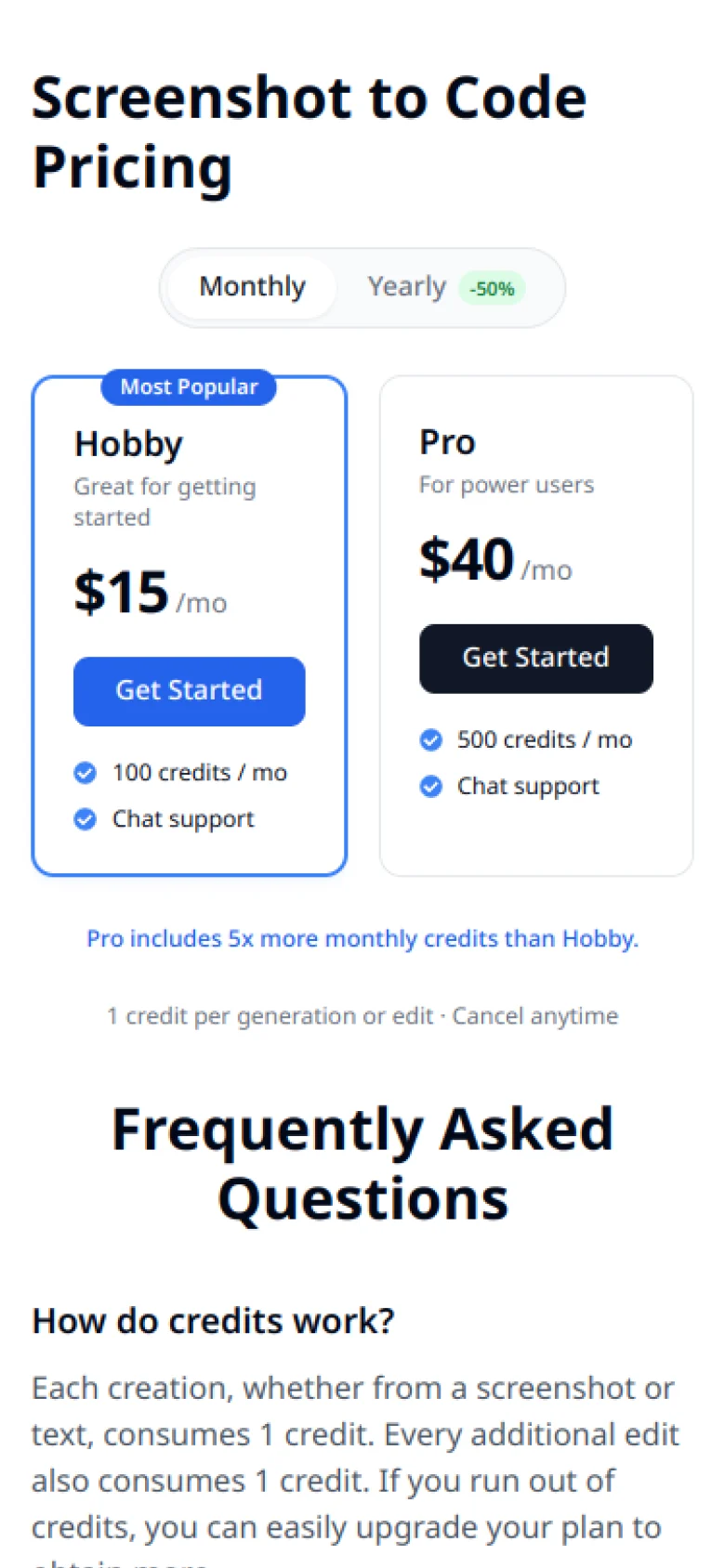
- 1Two plans: Hobby $15 and Pro $40 a month, with yearly billing at half price.Fact
- 2Credits: one per generation or edit, reset monthly, no rollover.Fact
- 3No free plan. The free option is the open-source repo with your own API key. See §03.Our read
What to look for
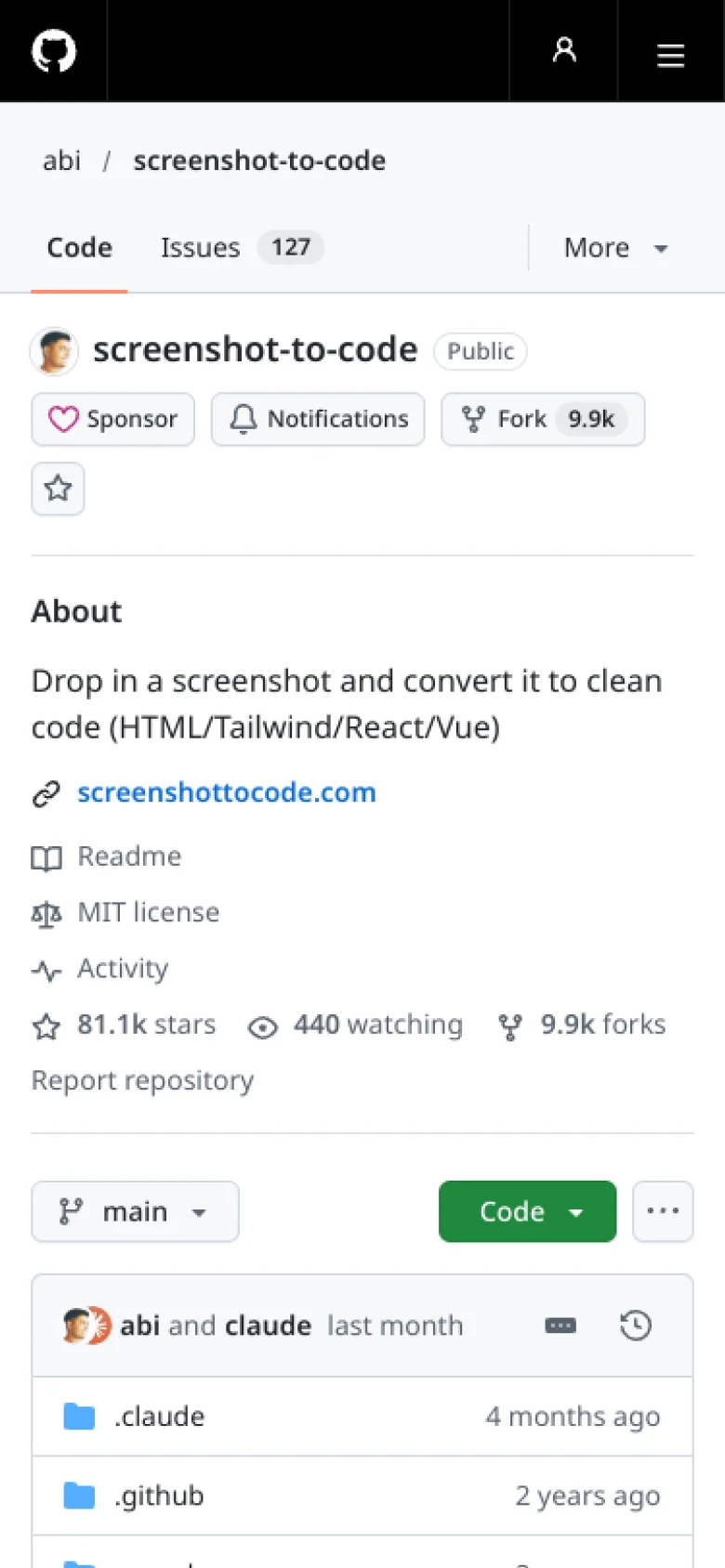
- 1The repository: MIT licensed; TrustMRR lists the team as one person.Fact
- 2The README links to the hosted version, with tracking tags.Fact
- 3This page, not the product site, is where most people meet the project. See §04.Our read
| Plan | Monthly | Yearly | Credits a month |
|---|---|---|---|
| Hobby | $15 | $90 a year | 100 |
| Pro | $40 | $240 a year | 500 |
From the live pricing page, read Nov 11, 2026[2]. One credit per generation or edit; credits reset monthly and do not roll over; no refunds.
Revenue analysis
About $134 a day from 283 subscribers, down from its first two years.
Hover or tap a bar. Verified daily revenue, Oct 13 – Nov 9, 2026 (UTC), from TrustMRR[1]. Blue: Saturdays and Sundays. Nov 10 is left out because the day was not complete at sync.
20 weekdays.Derived
8 weekend days.Derived
$4,008 in 30 days against $4,280 MRR.Derived
As shown on TrustMRR.Fact
Monthly revenue: drifting down since May
Hover or tap a bar. Monthly verified revenue from TrustMRR[1], December 2025 to November 2026. November covers Nov 1–10. Revenue before December 2025 totals $205,193.
Our arithmetic on the verified data in this report. Revenue ÷ MRR uses the last 30 days; the share of all-time revenue counts the months in the chart above; the swing is the median change between complete months.
Monthly revenue peaked in this window at $6,478 in May 2026 and fell to $4,250 in October, down 34.4%[1]. Over the full record the decline is longer: the $205,193 earned before December 2025 averages about $8,400 a month across roughly two years, against about $5,100 a month since[1].Derived
Stars vs revenue
| Captured | GitHub stars |
|---|---|
| Dec 2023 | 23,986 |
| Mar 2024 | 38,831 |
| Jul 2024 | 54,852 |
| Jan 2025 | 67,203 |
| Jun 2025 | 70,078 |
| Jan 2026 | 71,429 |
| Jun 2026 | 72,758 |
| Sep 2026 | 77,255 |
| Nov 2026 | 80.8K |
From archived copies of the GitHub repository page[4] and the live page[3].
Stars in the first eight months after the launch month.Derived
Stars in seventeen months.Derived
283 subscriptions on 80.8K stars.Derived
80,800 ÷ 283.Derived
Stars measure attention on GitHub, mostly from developers who can run the code themselves. They rose every year; revenue did not follow. The product site had 2,073 visitors and 14,888 Google search impressions in the last 30 days on TrustMRR[1].Our read
Market
Since 2023, large AI app builders such as v0, Lovable and Bolt have made generating an interface from an image or a description a common feature. We found no direct rival with verified revenue, so revenue is not compared.Our read
Pricing: credits on top of model costs
Two plans, priced in credits, because every request costs money.
100 credits a month.Fact
500 credits a month.Fact
$90 and $240 a year.Fact
Close to the Hobby monthly price.Derived
MRR per subscription is $15.12, almost exactly the Hobby monthly price, and it was $15.31 in October[1][4]. The mix of plans behind that average is not public.Derived
Where customers come from
GitHub first, and almost only.
Released in November 2023; reached about 24,000 stars within a month.[3][4]
FactThe README sends readers to the hosted version with tracking tags.[3]
FactA third-party timeline lists GPT-4o and Claude 3.5 Sonnet support added right after release.[5]
FactGoogle impressions in the last 30 days, from TrustMRR’s Search Console link.[1]
FactWhat we could not read
We do not know how many paying customers first found the project on GitHub, or how many of the 80.8K stars belong to people who never ran it.
Growth strategies
Four moves, each visible from outside.
Timeline
Key takeaways
Screenshot to Code shows what a viral open-source project can earn on its own: a real business at launch, then a slow decline once the free version and bigger rivals catch up.
Why we scored it this way
Copy
Avoid
- Treating stars as a revenue forecast. 3.5 payers per 1,000 here. §02
- A hosted product with nothing the free version lacks. §09
- Ignoring model costs in your price. The margin here is 40%. §03
Our predictions
Three claims with dates. We mark each one right or wrong on its date and keep the result on the page.
Track record: the predictions in our earlier reports are still open; the first checks land Dec 1, 2026. We mark each prediction right or wrong on its date and keep the result on the page.
What could prove us wrong
Things that would change our read, and how to check them.
- A new model could restart growth. Past model launches gave the project new attention.Check: monthly revenue after the next major model release.
- The 40% margin is a profile figure. We could not see the costs behind it.Check: not public.
- Paid users may come from search, not GitHub. TrustMRR shows 14,888 Google impressions in 30 days.Check: not public; no traffic split.
- A sale may be in progress. The TrustMRR profile mentions what a sale would include, though it is not listed.Check: the TrustMRR listing on the next review.
Appendix
FAQ
How much does Screenshot to Code make?
$4,008 in the 30 days to Nov 10, 2026, verified through Stripe on TrustMRR. MRR is $4,280 from 283 subscriptions; all-time revenue is $263,571.
Is Screenshot to Code free?
The open-source code on GitHub is free under the MIT licence if you bring your own AI API key. The hosted version costs $15 or $40 a month, or half that billed yearly.
How many GitHub stars does Screenshot to Code have?
About 80.8K on Nov 11, 2026. It had about 24,000 in December 2023, a month after release.
Who built Screenshot to Code?
Abi Raja, a developer in New York, under his company WhimsyWorks, Inc. TrustMRR lists the team as one person.
Sources
- [1]TrustMRR: Screenshot to Code — revenue, MRR, subscriptions, daily and monthly data, visitors, search impressions and profit margin. Verified through a Stripe API key. Synced 2026-11-11 00:24 UTC.
- [2]screenshottocode.com — homepage and pricing page. Read 2026-11-11.
- [3]GitHub: abi/screenshot-to-code — stars, licence and README. Read 2026-11-11.
- [4]Wayback Machine captures of the GitHub repository from December 2023 to September 2026, and of the TrustMRR page on Oct 15, 2026 — star counts and MRR on those dates. Read 2026-11-11.
- [5]EveryDev: WhimsyWorks — third-party profile with the founder’s background and product timeline. Read 2026-11-11.
Screenshots © WhimsyWorks, Inc. and GitHub, used for commentary. Oddig has no business relationship with Screenshot to Code. Numbers change daily; check the sources for the latest.


Comments are closed for this article.