
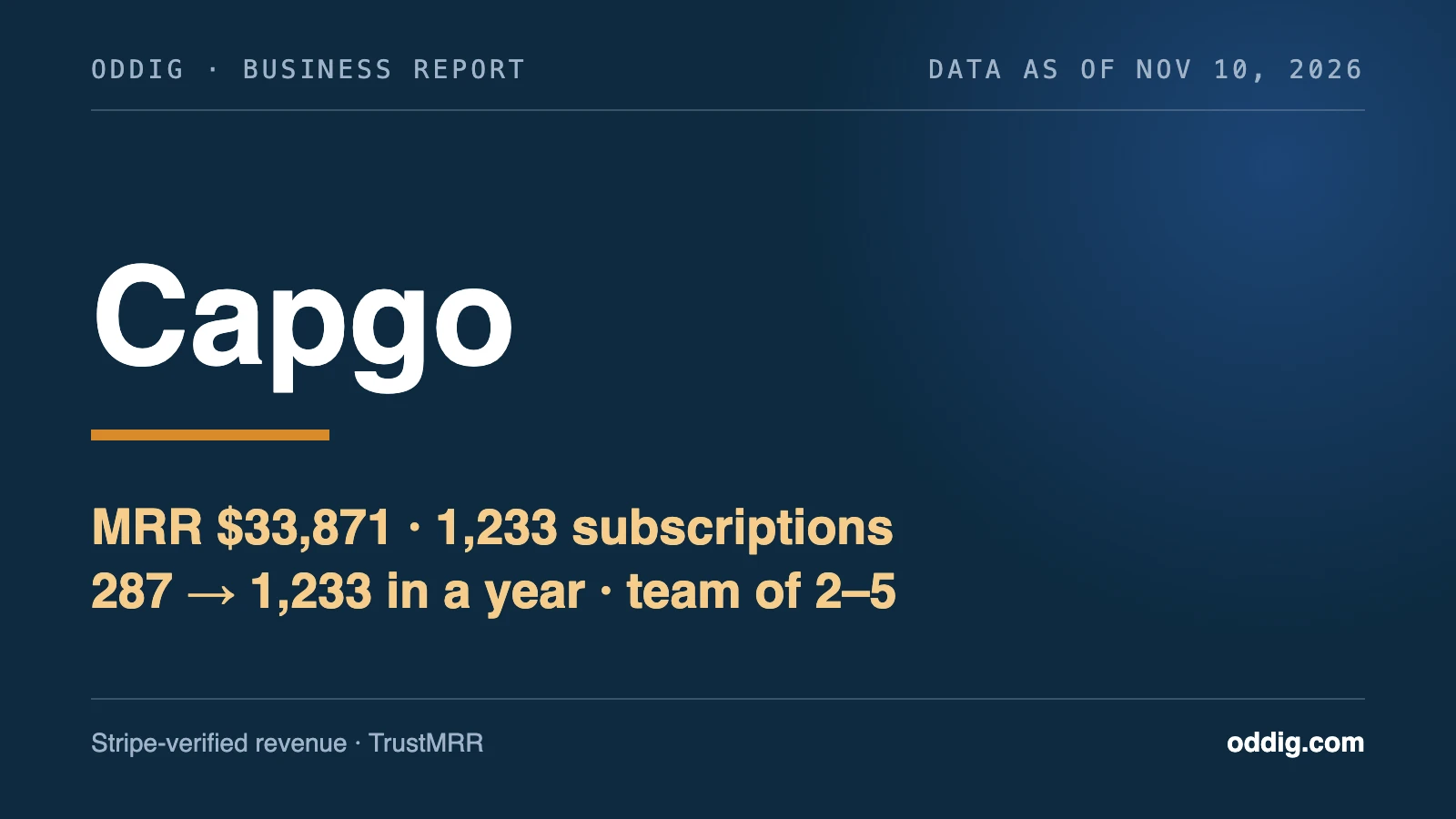
Capgo makes $33,871 a month by catching the customers a bigger rival is leaving behind
A small bootstrapped team sells app updates that skip app-store review. When Ionic stopped selling Appflow, Capgo built pages for every team that had to move. Subscriptions are up 4.3 times in a year.
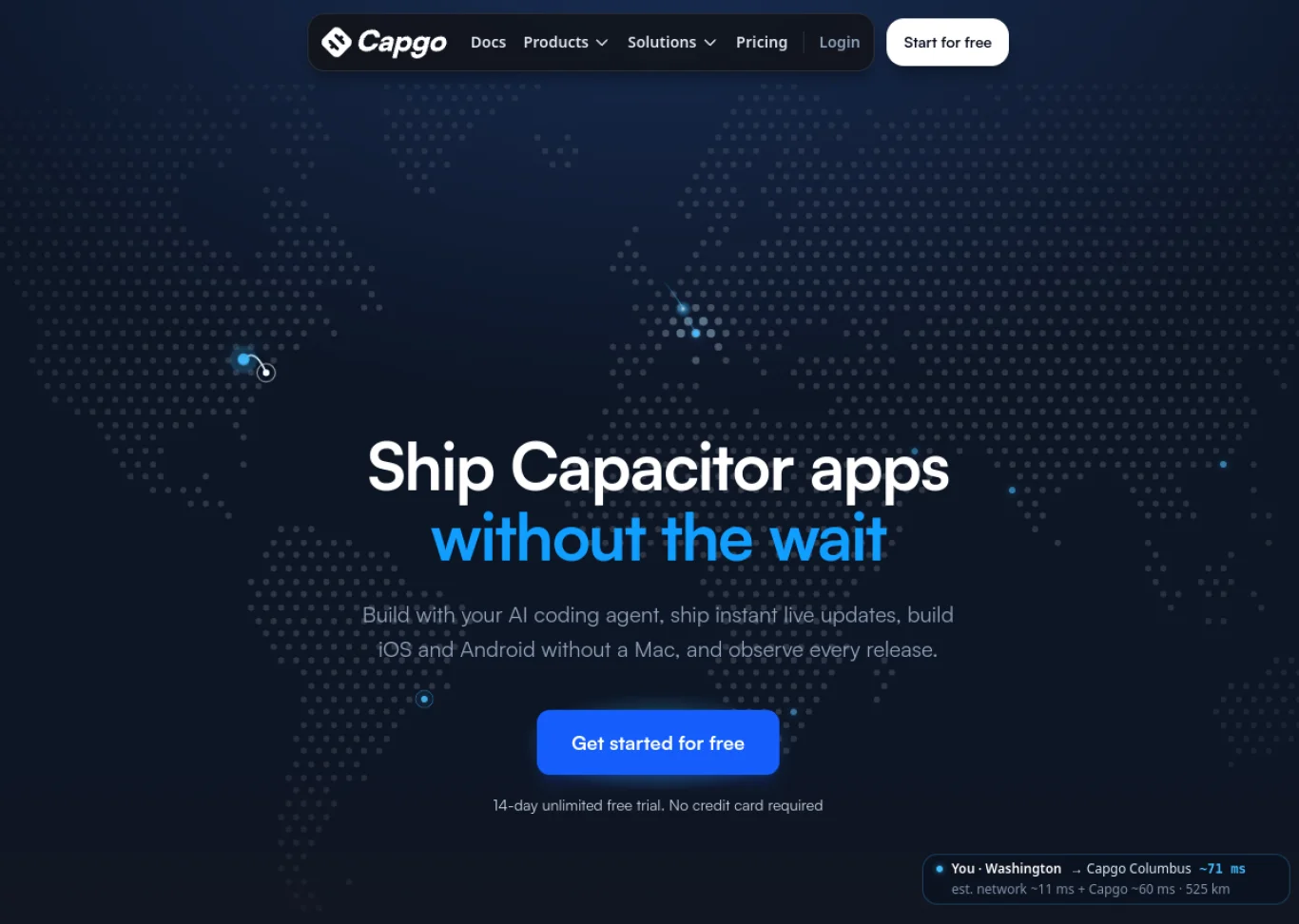
Product at a glance
Summary
What this business is
Capgo lets teams that build mobile apps with Capacitor send fixes straight to users’ phones, without waiting for App Store or Google Play review. Martin Donadieu started it in 2021; TrustMRR lists a team of two to five, no funding, and Estonia as the country. In February 2025 Ionic stopped selling Appflow, the best-known product for the same job, and Capgo built migration guides and comparison pages for the teams that had to move. Capgo now earns $33,871 a month from 1,233 subscriptions, up from 287 a year earlier, and has taken $596,738 in verified revenue.
Why these scores? See the reasons in Key takeaways →
Momentum
Rising. Revenue: last three complete months +46% on the three before; +62% on the same months half a year earlier; MRR +129% since Mar 15, 2026.Derived
Best suited for
Builder (main). Deep infrastructure work: update delivery, rollback, builds and security reviews.
Marketer (second). The growth came from being ready with the right pages when a rival left.
What you need to start. A technical niche you know well, and the speed to publish when a bigger player exits.Our read
Key findings
Product overview
Fix a live app in minutes instead of waiting days for review.
Capacitor apps run a web layer inside a native shell. Capgo’s plugin lets a team push new web code, styles and assets to installed apps, with channels for testing, staged rollouts and automatic rollback[2]. It also offers cloud builds for iOS and Android, so a team can ship without a Mac[1]. Native code changes still go through the stores.
The homepage claims 9,400+ teams, 90M+ devices and 3,201+ GitHub stars[2]. TrustMRR counts 1,233 paying subscriptions and estimates 7,800 users[1]. The gap is trials, free use of the open-source plugin and self-hosting. TrustMRR also lists SOC 2 Type II and ISO 27001 among the founder’s details[1].
What the site looks like
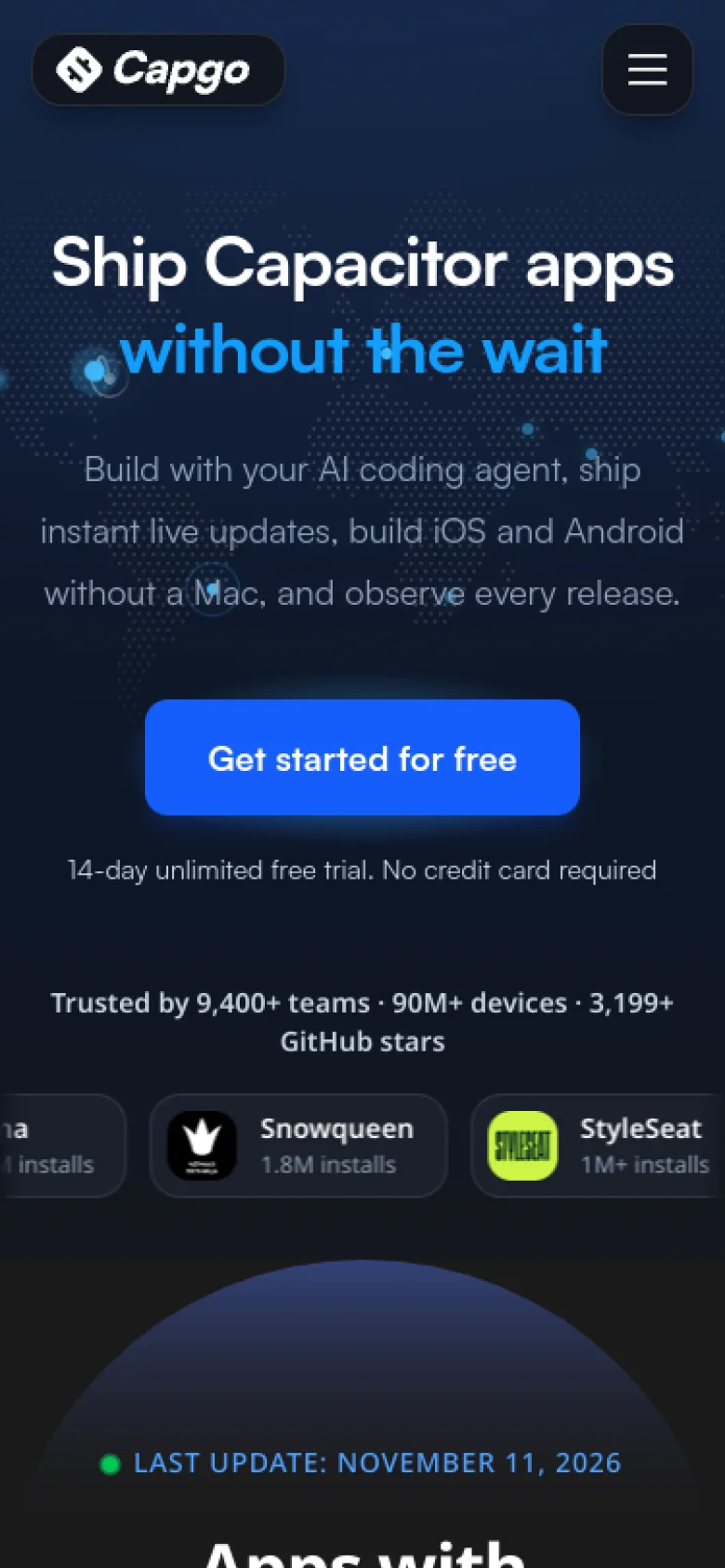
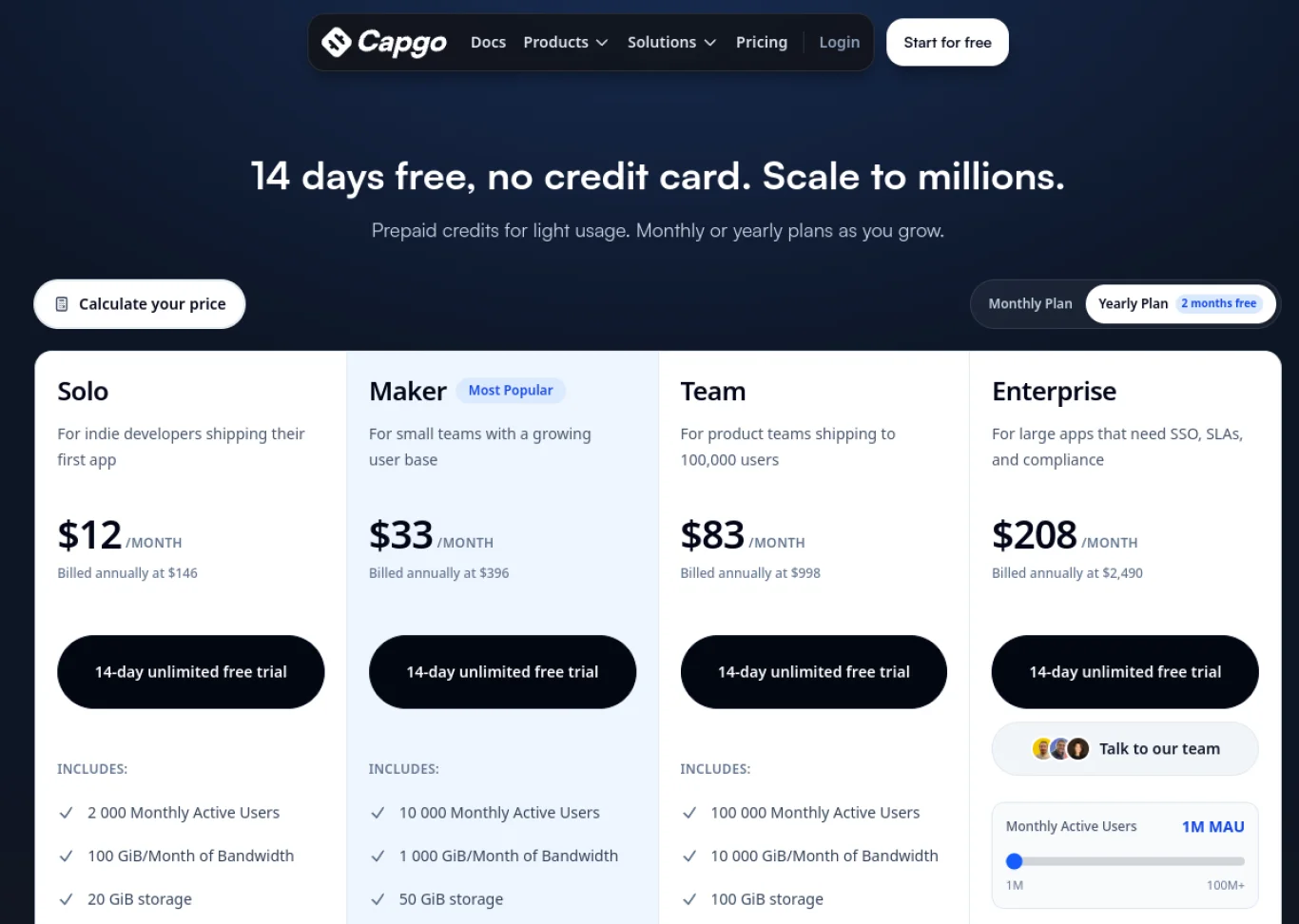
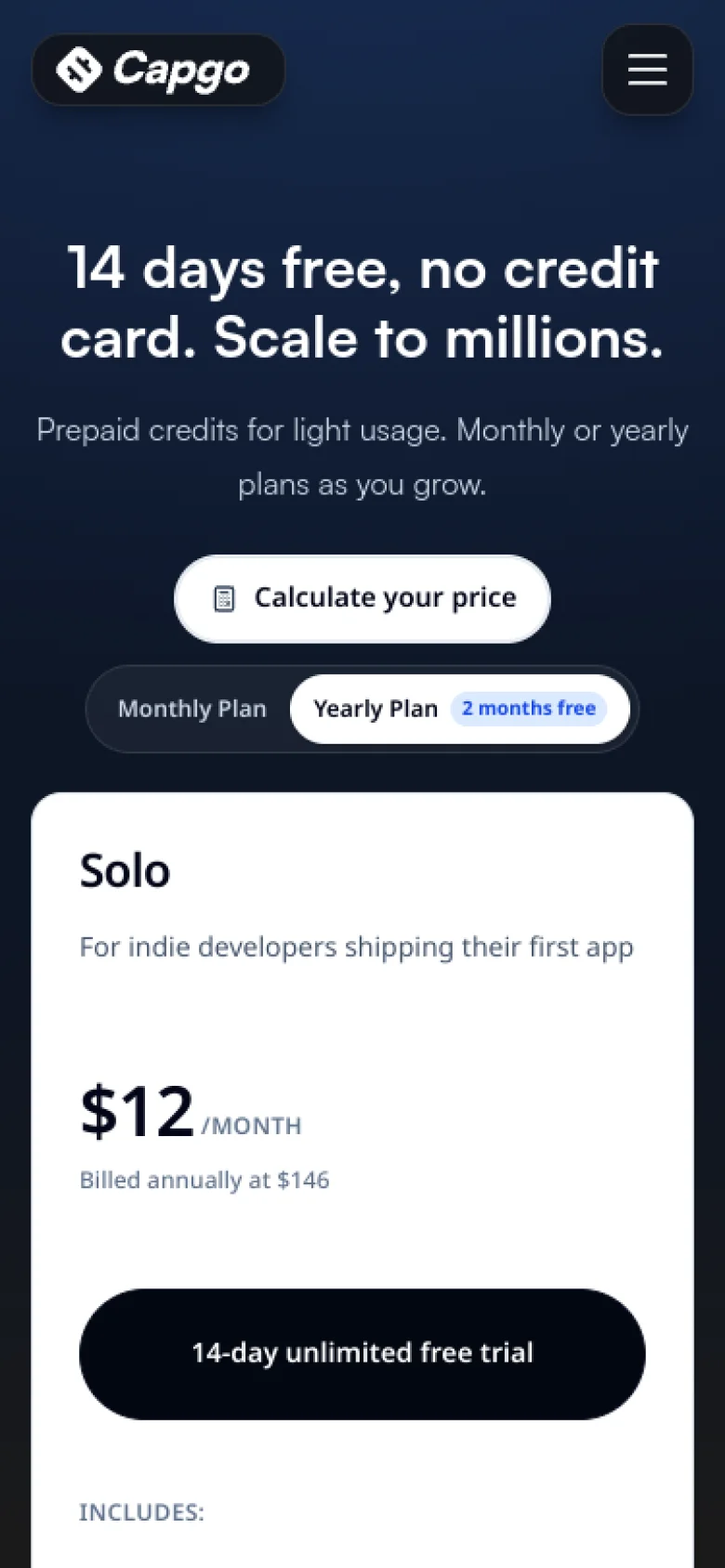
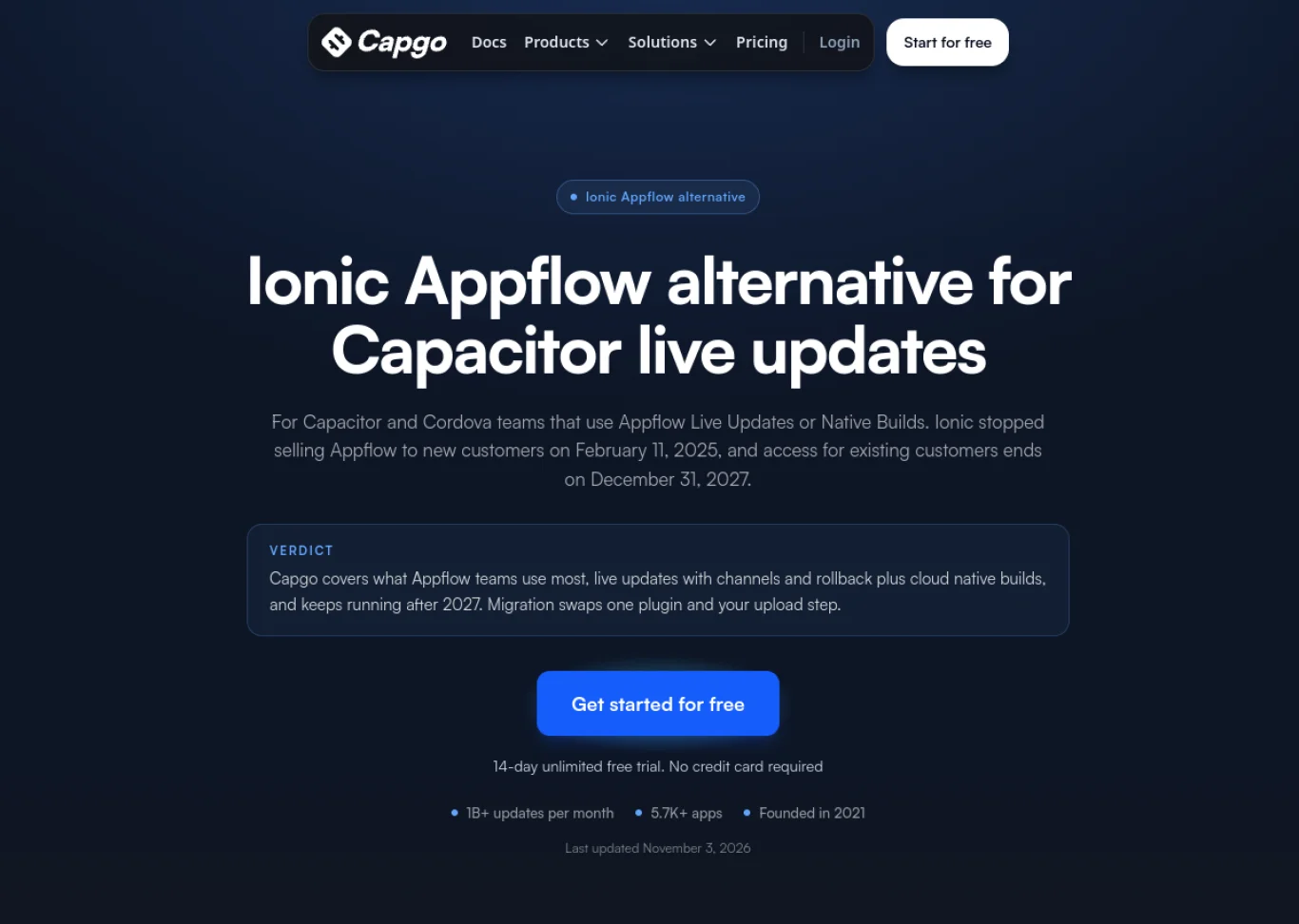
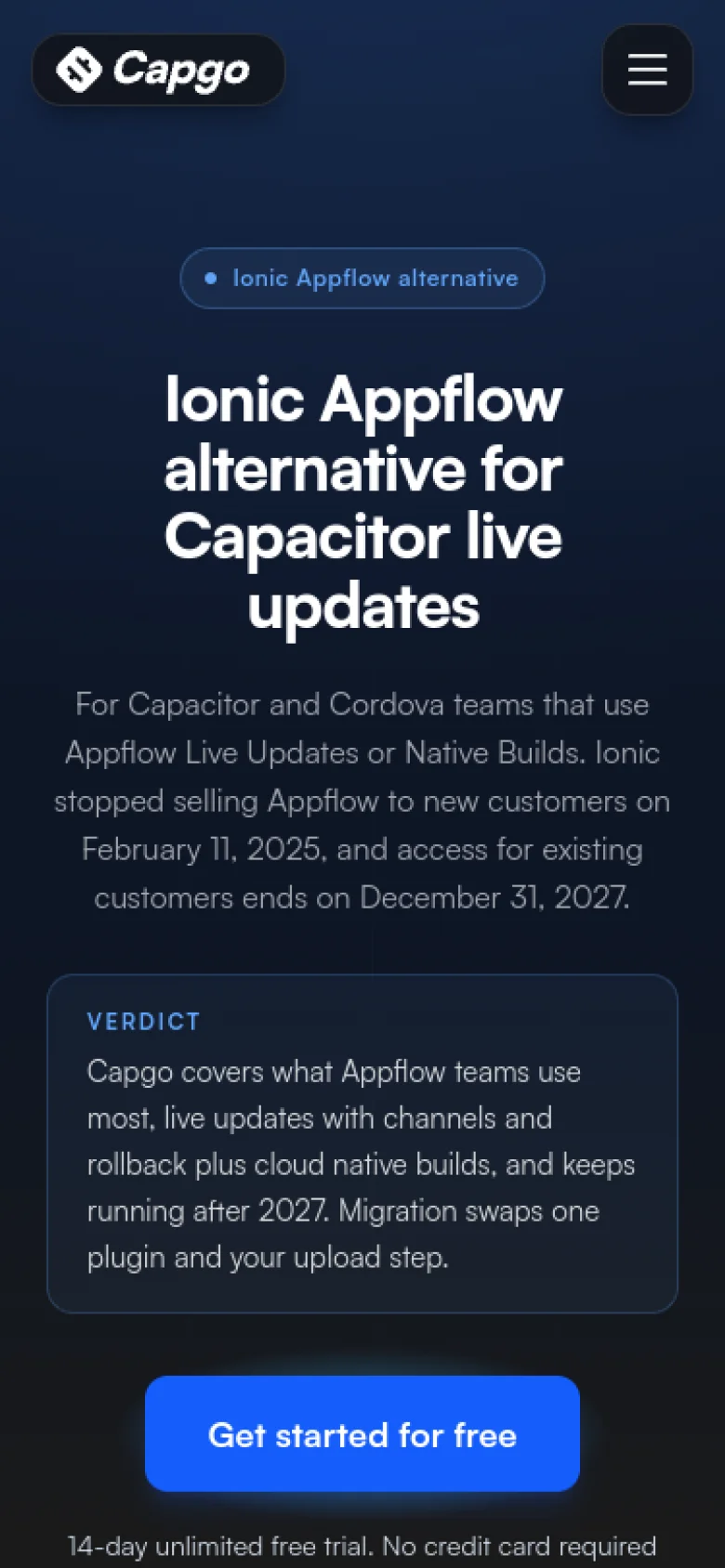
Captured Nov 11, 2026 · Screenshots: capgo.app.
What to look for
- 1“Ship Capacitor apps without the wait”: the pitch is speed past app-store review.Fact
- 2The site claims 9,400+ teams and 90M+ devices. TrustMRR counts 1,233 paying subscriptions. See §02.Fact
- 3A 14-day trial with no card is the main call to action.Fact
What to look for
- 1Four plans from $12 to $208+ a month on yearly billing, plus usage charges above each plan’s limits.Fact
- 2The yearly prices for Solo, Maker and Team are the same as in January 2025. See §03.Fact
- 3A side-by-side cost table against Expo’s EAS Update sits further down the page.Fact
What to look for
- 1A page written for one audience: teams leaving Ionic Appflow before it shuts down. See §04.Fact
- 2It states the dates plainly: no new Appflow sales since Feb 11, 2025, access ends Dec 31, 2027.Fact
- 3It names the rival Ionic recommends, Capawesome, and argues the comparison anyway.Fact
| Plan | Yearly billing | Monthly billing | Aimed at |
|---|---|---|---|
| Solo | $12/mo ($146/yr) | $14/mo | Indie developers shipping a first app |
| Maker | $33/mo ($396/yr) | $39/mo | Small teams with a growing user base |
| Team | $83/mo ($998/yr) | $99/mo | Product teams shipping to 100,000 users |
| Enterprise | $208+/mo | $249+/mo | SSO, SLAs and compliance |
From an archived copy of the pricing page, Oct 5, 2026[4]. Usage above each plan’s limits is charged per monthly active user and per GB of bandwidth.
Revenue analysis
Subscriptions up 4.3× in a year, with smaller plans doing most of the work.
| Date | MRR | Active subscriptions | MRR per subscription |
|---|---|---|---|
| Nov 10, 2025 | $11,451 | 287 | $39.90 |
| Mar 15, 2026 | $14,772 | 422 | $35.00 |
| Aug 26, 2026 | $28,266 | 1,017 | $27.79 |
| Nov 10, 2026 | $33,871 | 1,233 | $27.47 |
Earlier rows from archived copies of the TrustMRR page[3], where the first two MRR figures were marked as estimates; the last row from the live page[1]. The last column is our division.
MRR per subscription now sits between the Solo and Maker prices[4]. Most new customers are small teams on the cheaper plans, while a few larger accounts pay usage on top.Derived
Monthly revenue: two steps up
Hover or tap a bar. Monthly verified revenue from TrustMRR[1], December 2025 to November 2026. November covers Nov 1–10. Revenue before the last 12 months totals about $278,877.
Our arithmetic on the verified data in this report. Revenue ÷ MRR uses the last 30 days; the share of all-time revenue counts the months in the chart above; the swing is the median change between complete months.
Monthly revenue rose from $14,401 in December 2025 to $40,922 in October 2026, about 2.8 times[1]. The jumps came in June and August; the cause is not public.Derived
Daily revenue
Hover or tap a bar. Verified daily revenue, Oct 13 – Nov 9, 2026 (UTC), from TrustMRR[1]. Blue: Saturdays and Sundays. Nov 10 is left out because the day was not complete at sync.
19 weekdays, excluding Oct 16.Derived
8 weekend days.Derived
Oct 16, likely a yearly or Enterprise payment.Our read
$39,858 in 30 days against $33,871 MRR.Derived
Market
The direct rivals are Capawesome Cloud, which Ionic recommends to Appflow customers[6], and Expo’s EAS Update for React Native apps, which Capgo prices itself against[2]. We found no rival with verified revenue on the same basis, so revenue is not compared.
Pricing: same prices, more usage
The yearly prices did not move in almost two years; the model around them did.
| When | Plans |
|---|---|
| Jan 2025 | Solo $12, Maker $33, Team $83 a month billed yearly; a $249-a-month plan for large apps; charges per user and per GB above included limits |
| Oct 2026 | Same yearly prices; monthly billing at $14, $39, $99; Enterprise from $208 a month yearly; usage charges in tiers that get cheaper at volume |
From archived copies of the pricing page[4]. Exact dates of the changes between the two captures are not public.
Both captures charge for usage above each plan’s allowance. In January 2025 one plan listed 200,000 users and 5 TB of bandwidth included, then a price per extra user and GB[4]. The current page splits those charges into tiers that get cheaper at volume[4]. Small teams pay a fixed low price; large apps pay for what they use.
Where customers come from
Search pages built for one moment: a rival telling its customers to leave.
A dedicated Appflow alternative page, a migration guide and shutdown posts in several languages.[2]
FactThe updater plugin is free on GitHub; the hosted service is the paid product.[2]
FactThe competitor Ionic chose
Ionic named Capawesome its recommended migration partner for Appflow[6]. Capgo’s Appflow page names Capawesome too and argues the comparison on features and price[2]. Capgo won its share without the official endorsement.
What we could not read
Traffic sources, sign-ups by channel and how many customers came from Appflow are not public.
Growth strategies
Four moves, each visible from outside.
Timeline
- Nov 302021ProductFounding date on TrustMRR.[1]
- Jan 162025PricingSolo $12, Maker $33, Team $83 a month on yearly billing.[4]
- Feb 112025BackgroundIonic stops selling Appflow to new customers; access ends Dec 31, 2027.[5]
- Nov 102025RevenueMRR about $11,451 from 287 subscriptions.[3]
- Jun2026Revenue$30,110, the first month above $30,000.[1]
- Aug 262026RevenueMRR $28,266 from 1,017 subscriptions.[3]
- Oct2026Revenue$40,922, the best month on record.[1]
- Oct 52026PricingMonthly billing, Enterprise from $208 and tiered usage charges on the pricing page.[4]
- Nov 102026RevenueMRR $33,871 from 1,233 subscriptions; $596,738 all-time.[1]
Key takeaways
Capgo shows that a small team in a technical niche can grow fast by being ready when a bigger player leaves, then keeping prices low enough for the smallest customers to switch.
Why we scored it this way
Copy
- When a big player stops selling, publish the exit page first. Dates, a feature map, and a one-command migration. P1
- Compare yourself to the expensive default, with numbers. Capgo puts Expo’s prices next to its own. P2
- Keep the core open source. The plugin is free; hosting, scale and support are paid. P3
- Price low to enter, charge for usage above it. Small teams start at $12, large apps pay per user. P4
Avoid
- Reading a homepage team count as paying customers. §02
- Counting on one event for growth. The Appflow deadline ends in December 2027. §09
- Assuming the official migration partner is you. Ionic picked Capawesome. §04
Our predictions
Three claims with dates. We mark each one right or wrong on its date and keep the result on the page.
Track record: the predictions in our earlier reports are still open; the first checks land Dec 1, 2026. We mark each prediction right or wrong on its date and keep the result on the page.
What could prove us wrong
Things that would change our read, and how to check them.
- The Appflow link is our inference. Capgo’s growth lines up with the Appflow wind-down, but no public data shows how many customers came from it.Check: not public.
- Older MRR readings were labelled estimates. TrustMRR marked the Nov 2025 and Mar 2026 MRR as estimated; the method may differ from today’s.Check: the archived TrustMRR pages[3].
- The rush could fade. Teams that had to leave Appflow will mostly have moved before Dec 31, 2027.Check: new subscriptions on the next review.
- Ionic’s chosen partner may win the bigger accounts. Capawesome has Ionic’s recommendation.Check: Capawesome’s public customer claims.
Appendix
FAQ
How much does Capgo make?
$39,858 in the 30 days to Nov 10, 2026, verified through Stripe on TrustMRR. MRR is $33,871 from 1,233 subscriptions; all-time revenue is $596,738.
What does Capgo cost?
Solo $12, Maker $33 and Team $83 a month on yearly billing ($14, $39 and $99 monthly). Enterprise starts at $208 a month yearly. Usage above each plan’s limits is charged per monthly active user and per GB of bandwidth. There is a 14-day trial with no card.
Why are teams moving to Capgo from Appflow?
Ionic stopped selling Appflow to new customers on Feb 11, 2025, and existing customers keep access only until Dec 31, 2027. Capgo is one of the alternatives; Ionic itself recommends Capawesome.
Who runs Capgo?
Founder Martin Donadieu. TrustMRR lists a team of two to five people, no outside funding, and Estonia as the country.
Sources
- [1]TrustMRR: Capgo — revenue, MRR, subscriptions, traffic, daily and monthly data. Verified through a Stripe API key. Synced 2026-11-10 20:05 UTC.
- [2]
- [3]Wayback Machine captures of the TrustMRR page for Capgo on Nov 10, 2025, Mar 15, 2026 and Aug 26, 2026 — MRR, subscriptions and all-time revenue on those dates. Read 2026-11-11.
- [4]Wayback Machine captures of capgo.app/pricing on Jan 16, 2025 and Oct 5, 2026 — plans and prices. Read 2026-11-11.
- [5]Ionic: Important Announcement: The Future of Ionic’s Commercial Products, Feb 11, 2025 — end of new Appflow sales and the Dec 31, 2027 access date. Read 2026-11-11.
- [6]Capawesome: Migrating from Ionic Appflow to Capawesome Cloud — Ionic’s recommended migration partner. Read 2026-11-11.
Screenshots © Capgo, used for commentary. Oddig has no business relationship with Capgo. Numbers change daily; check the sources for the latest.


Comments are closed for this article.