
Skip to content

Founder notes · 1 min read

Love Letter Business Report: $68,050 Selling Little Wi-Fi Mailboxes for Couples

Connected gift hardware from one founder: $23,646 in October, 4× June, no subscription.

Love letter report cover
← All articles
ODDIG · Business report · Love Letter
Report v1 · Data as of 2026-11-10
Love Letterlovelettertech.com ↗ · connected gift hardware

Love Letter sold $23,646 of little Wi-Fi mailboxes in October, four times June, with one founder and no subscription

A small connected mailbox that lets couples and families send messages, pixel art and photos to each other. It started with a Kickstarter, sells as a gift through Meta and Pinterest ads, and has taken $68,050.
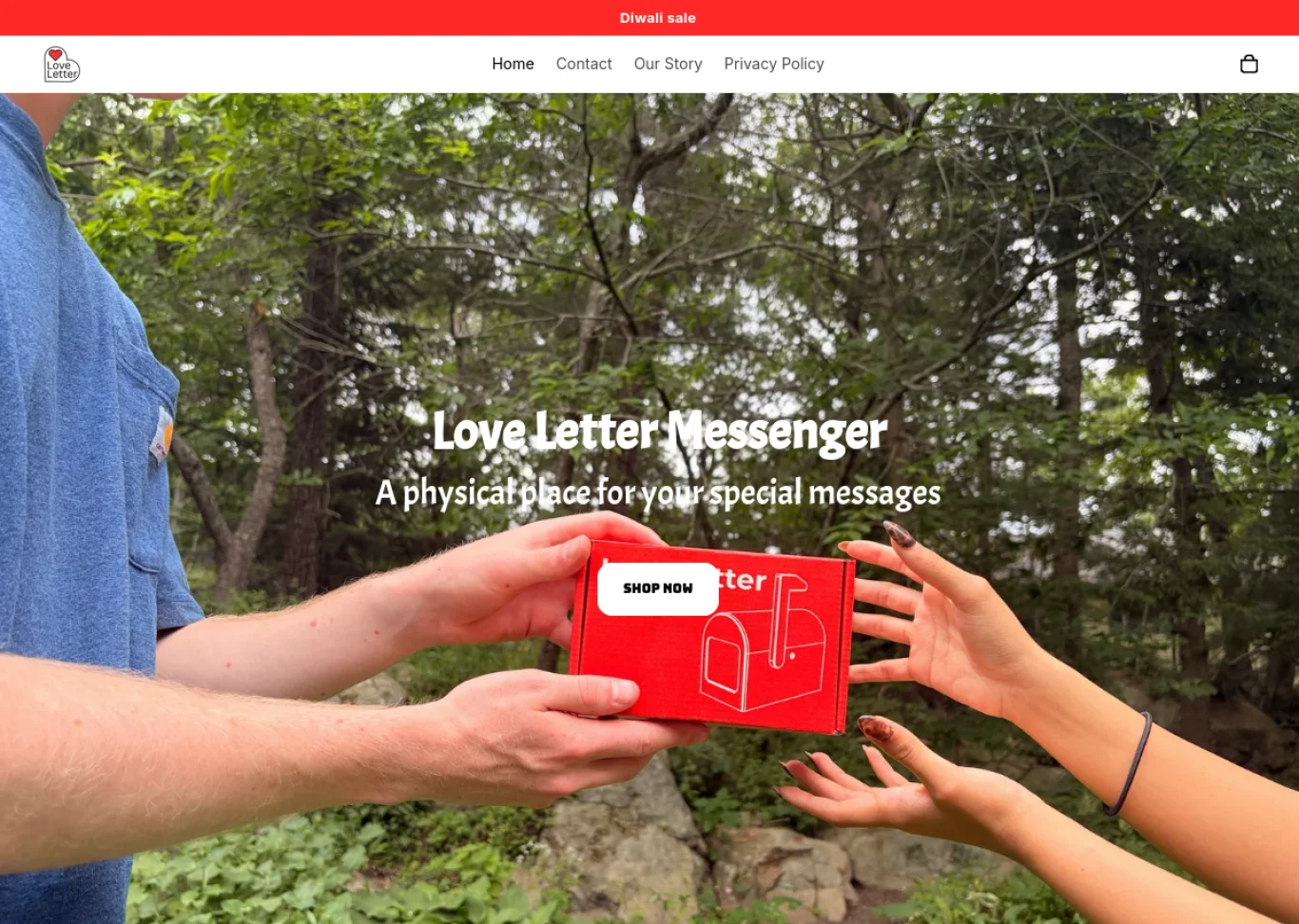
lovelettertech.com
lovelettertech.com homepage, captured Nov 11, 2026
Homepage · captured 2026-11-11

Product at a glance

What it isA Wi-Fi connected mailbox device for sending notes, pixel art and pictures to someone far away.
Who it’s forCouples in long-distance relationships, and families.
How it chargesOne-time purchase: $139 on sale (regular $160); bundles for two and for families.
Business modelDirect-to-consumer hardware through a Shopify store.
October sales
$23,646
4.1× June
Fact
Units sold (stated)
550+
about $124 each
Derived
Margin
40%
hardware + ads
Fact
All-time verified revenue
$68,050
since Jan 2026
Fact
Revenue verified via Shopify on TrustMRR · synced 2026-11-10 07:24 UTCResearched 2026-11-11 · Oddig
ODDIG Business Report · Love Letter · v1Data as of 2026-11-10 · Researched 2026-11-11
Quick read shows the scorecard, key findings, what to copy, our predictions and the bear case. Switch to Full report for the monthly chart, the daily sales, the prices and the channels.

Summary

What this business is

Love Letter is a small physical mailbox with a screen and Wi-Fi. Two people each have one; a message, a piece of pixel art or a photo sent from one shows up on the other. Owen, a solo founder in the US, built it for long-distance couples, took reservations through a Kickstarter in late 2025, and now sells it from a Shopify store. Sales have taken $68,050 in total, $23,646 of it in October 2026. There is no subscription: every dollar is a device sold.

FormConnected hardware
TeamOne founder
Price$139 (sale)
First salesJan 2026
Units (stated)550+
Margin40%
ODDIG scorecard1 = weak · 5 = strong · our judgement, no total score
Revenue qualityHow much recurs
1/5
Channel spreadNot one channel
2/5
CopyabilityFor a solo founder
3/5
DefensibilityHard to copy the product
2/5
Evidence strengthHow sure we are
3/5
Share

Why these scores? See the reasons in Key takeaways →

Momentum

Rising fast. Revenue: last three complete months +152% on the three before; up from near zero against the same months half a year earlier.Derived

Best suited for

Builder (main). Electronics, firmware and an app that make two devices talk.

Marketer (second). It sells as a gift through visual ads.

What you need to start. Comfort with hardware, suppliers and shipping, and a product people want to give.Our read

Key findings

01Hardware, not softwareNo subscription and no recurring revenue: $68,050 from devices sold.FactSee the product →
02October quadrupled JuneSales went from $5,826 in June to $23,646 in October.FactSee the monthly chart →
03The price went upTrustMRR lists $85 a device; the store now shows $139 on sale, $160 regular. Revenue per stated unit is about $124.DerivedSee the prices →
Evidence tagsFactfrom a listed public sourceDerivedour arithmetic on factsFounderclaimed by the founder or siteOur readour judgement
01

Product overview

A little mailbox on the shelf that lights up when someone thinks of you.

Love Letter is a Wi-Fi connected mailbox. Messages, pixel art and pictures sent from one device show up on the other[3]. The store sells single devices, a set for two and a family set, plus a second product, an ESP32 Mirror at $149[2]. The founder, Owen, says he built it to make long-distance relationships easier[2].

TrustMRR lists 550+ lifetime sales[1]; the store says over 150 monthly active users and shows 23 reviews[2]. Not every device sold is in daily use.Derived

What the site looks like
lovelettertech.com
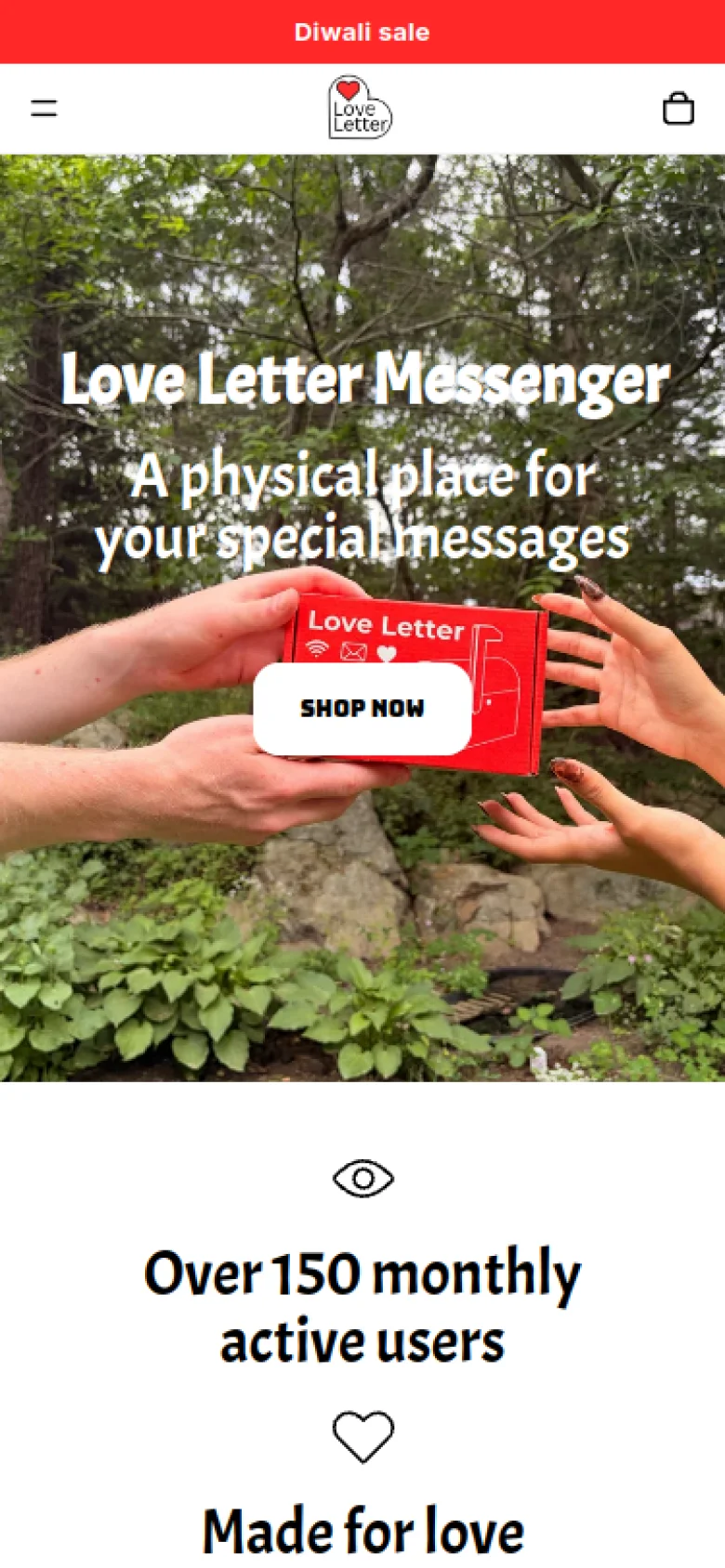
lovelettertech.com homepage on desktop, captured Nov 11, 2026
lovelettertech.com homepage on a phone, captured Nov 11, 2026

Captured Nov 11, 2026 · Screenshots: lovelettertech.com.

What to look for

  1. 1
    “Love Letter Messenger: a physical place for your special messages”, shown as a gift changing hands.Fact
  2. 2
    A sale banner across the top: the device is $139, down from $160. See §03.Fact
  3. 3
    “Over 150 monthly active users” and “Made for love” on the phone view.Fact
Our readThe product is a gift with a story. The buyer is often not the user, which is why the store sells pairs and sets.Our read
02

Revenue analysis

Almost nothing until May, then a climb to $23,646 in October.

Oct 2026
$23,646
$19.5K$13K$6.5K
JanFebMarAprMayJunJulAugSepOctNov

Hover or tap a bar. Monthly verified sales from TrustMRR[1], January to November 2026: the store’s whole record. April shows no sales. November covers Nov 1–10.

Revenue quality
Revenue ÷ MRR
No MRR (hardware sales)
Share of all-time revenue
100% since Jan 2026
Verified record starts
Jan 2026
Typical monthly swing
84% a month

Our arithmetic on the verified data in this report. Revenue ÷ MRR uses the last 30 days; the share of all-time revenue counts the months in the chart above; the swing is the median change between complete months.

Sales were under $1,000 a month until May, then $5,826 in June, around $8,000–10,300 from July to September, and $23,646 in October[1]. October was 2.3 times September and 4.1 times June.Derived

Daily sales

Oct 23, 2026
$1,727
Oct 13Oct 20Oct 27Nov 3

Hover or tap a bar. Verified daily sales, Oct 13 – Nov 9, 2026 (UTC), from TrustMRR[1]. Blue: Saturdays and Sundays. Nov 10 is left out because the day was not complete at sync.

Share
Weekday average
$856

20 weekdays.Derived

Weekend average
$683

8 weekend days.Derived

Revenue per stated unit
~$124

$68,050 ÷ 550.Derived

Margin
40%

Last 30 days.Fact

Market

Connected message gadgets for couples are a small but crowded gift category. We found no rival with verified revenue on the same basis, so revenue is not compared.

03

Pricing: one device, then sets

A one-time price that has gone up.

SourcePrice
TrustMRR listing$85 per device
Store, Nov 11, 2026$139 on sale (regular $160); bundles for two and families; second shipping address $8.50

TrustMRR listing[1] and the store[2]. When the price changed is not public.

Revenue per stated unit is about $124, between the two prices. That fits a rise from $85 or a mix of single devices and sets.Derived

Our readA gift buyer compares against flowers and jewellery, not gadgets; $139 for something that lasts reads as fair.Our read
04

Where customers come from

Crowdfunding first, then visual ads.

Mainlisted by the founder or archivedswipe →
Kickstarter
Late 2025

The December 2025 site offered reservations and linked to a Kickstarter.[3]

Fact
Meta ads
Listed

Named on TrustMRR.[1]

Founder
Pinterest
Listed

Named on TrustMRR.[1]

Founder
Supportingvisible, impact not measurableswipe →
Build in public
Live development

The early site invited visitors to watch development live.[3]

Fact

What we could not read

Ad spend, the Kickstarter total and October’s unit count are not public.

05

Growth strategies

Three moves, each visible from outside.

P1A gift that needs two
What they didMade a device that only works with a second one, and sold sets.[2]
What happened$68,050 in sales; 550+ devices stated.[1]Fact
How you can use itDesign the product so buying one leads to buying another.
Cost & conditions Hardware costs double with every set. 7-day test: add a ‘for two’ bundle to your store and track its share of orders.
P2Pre-sell first
What they didTook reservations and ran a Kickstarter before selling in the store.[3]
What happenedSales began in January 2026.[1]Fact
How you can use itTest demand with pre-orders before you buy stock.
Cost & conditions Delivery delays hurt trust. 7-day test: put up a reservation page with a refundable deposit.
P3Visual gift ads
What they didUses Meta ads and Pinterest.[1]
What happenedOctober sales 4.1× June.[1]Derived
How you can use itShow the moment of giving; let visual channels sell the feeling.
Cost & conditions Ad costs rise before holidays. 7-day test: post three gift-moment images on Pinterest and track clicks.
06

Timeline

  • Oct 272025
    ProductFounding date on TrustMRR.[1]
  • Dec 172025
    MarketingSite offers reservations and links to a Kickstarter.[3]
  • Jun2026
    Revenue$5,826, the first month above $1,000.[1]
  • Oct2026
    Revenue$23,646, the best month so far.[1]
  • Nov 112026
    PricingStore price $139 on sale, $160 regular.[2]
07

Key takeaways

Love Letter shows that one person can build and sell connected hardware, as long as it is a gift people want to give in pairs, and that hardware trades recurring revenue for a product people can hold.

Why we scored it this way

ODDIG scorecard1 = weak · 5 = strong · our judgement, no total score
Revenue qualityHow much recurs
1/5
No recurring revenue: each sale is one device, and gifts are seasonal.Fact
Channel spreadNot one channel
2/5
Meta ads and Pinterest, both paid or visual-search channels.Fact
CopyabilityFor a solo founder
3/5
One founder did it, but hardware means suppliers, stock, shipping and support.Our read
DefensibilityHard to copy the product
2/5
Connected message devices exist; the brand and the gift story are the edge.Our read
Evidence strengthHow sure we are
3/5
Shopify-verified sales, but no archived TrustMRR readings and unit numbers are self-reported.Our read
Share

Copy

  1. Make something people give. A gift has its own reasons to buy. P1
  2. Pre-sell on Kickstarter. Reservations came before the store. P2
  3. Sell in pairs and sets. The device only works with a second one. P1
  4. Use visual channels. Pinterest and Meta show the gift moment. P3

Avoid

  1. Reading October as the new normal. Gift sales rise into the holidays. §09
  2. Ignoring unit costs. A 40% margin leaves little room for ads. §02
  3. Counting devices sold as users. 550+ sold, 150+ monthly active. §01
08

Our predictions

Three claims with dates. We mark each one right or wrong on its date and keep the result on the page.

#PredictionCheck onStatus
#1
November verified sales land between $15,000 and $35,000TrustMRR, $23,646 in October; Nov 1–10: $8,761.
Dec 1, 2026Open
#2
December sales are higher than October’s $23,646A gift product heading into the holidays.
Jan 2, 2027Open
#3
January 2027 sales are below December 2026Gift demand usually drops after the holidays.
Feb 1, 2027Open

Track record: the predictions in our earlier reports are still open; the first checks land Dec 1, 2026. We mark each prediction right or wrong on its date and keep the result on the page.

09

What could prove us wrong

Things that would change our read, and how to check them.

  1. Unit numbers are self-reported. 550+ sales comes from the founder’s TrustMRR profile.Check: not verifiable.
  2. Kickstarter money may sit outside these numbers. Pledges are not Shopify sales.Check: the campaign page.
  3. The price change is our inference. $85 may have been an early or Kickstarter price.Check: not public.
  4. Holiday demand could carry or flatten the trend. One autumn of data is short.Check: January and February sales.

Appendix

FAQ

How much does Love Letter make?

$23,168 in the 30 days to Nov 10, 2026, verified through Shopify on TrustMRR. October brought $23,646; all-time sales are $68,050. There is no subscription revenue.

How much does a Love Letter cost?

The store shows $139 on sale, regularly $160, with bundles for two and for families. TrustMRR lists $85 per device.

Who makes Love Letter?

Owen, a solo founder, who built it to make long-distance relationships easier.

How does Love Letter find customers?

Its TrustMRR listing names Meta ads and Pinterest.

Sources

  1. [1]
    TrustMRR: Love Letter — sales, units, price, channels, daily and monthly data. Verified through a Shopify connection. Synced 2026-11-10 07:24 UTC.
  2. [2]
    lovelettertech.com — product, prices, bundles, user claim, founder. Read 2026-11-11.
  3. [3]
    Wayback Machine capture of lovelettertech.com on Dec 17, 2025 — reservations and the Kickstarter link. Read 2026-11-11.

Screenshots © Love Letter, used for commentary. Oddig has no business relationship with Love Letter. Numbers change daily; check the sources for the latest.

The projects worth a look, in your inbox.

New reports like this one, what is for sale, and who is holding up or fading.

Free. Unsubscribe any time.

The discussion

Comments are closed for this article.

Still building?

Get the next useful signal in your inbox.