
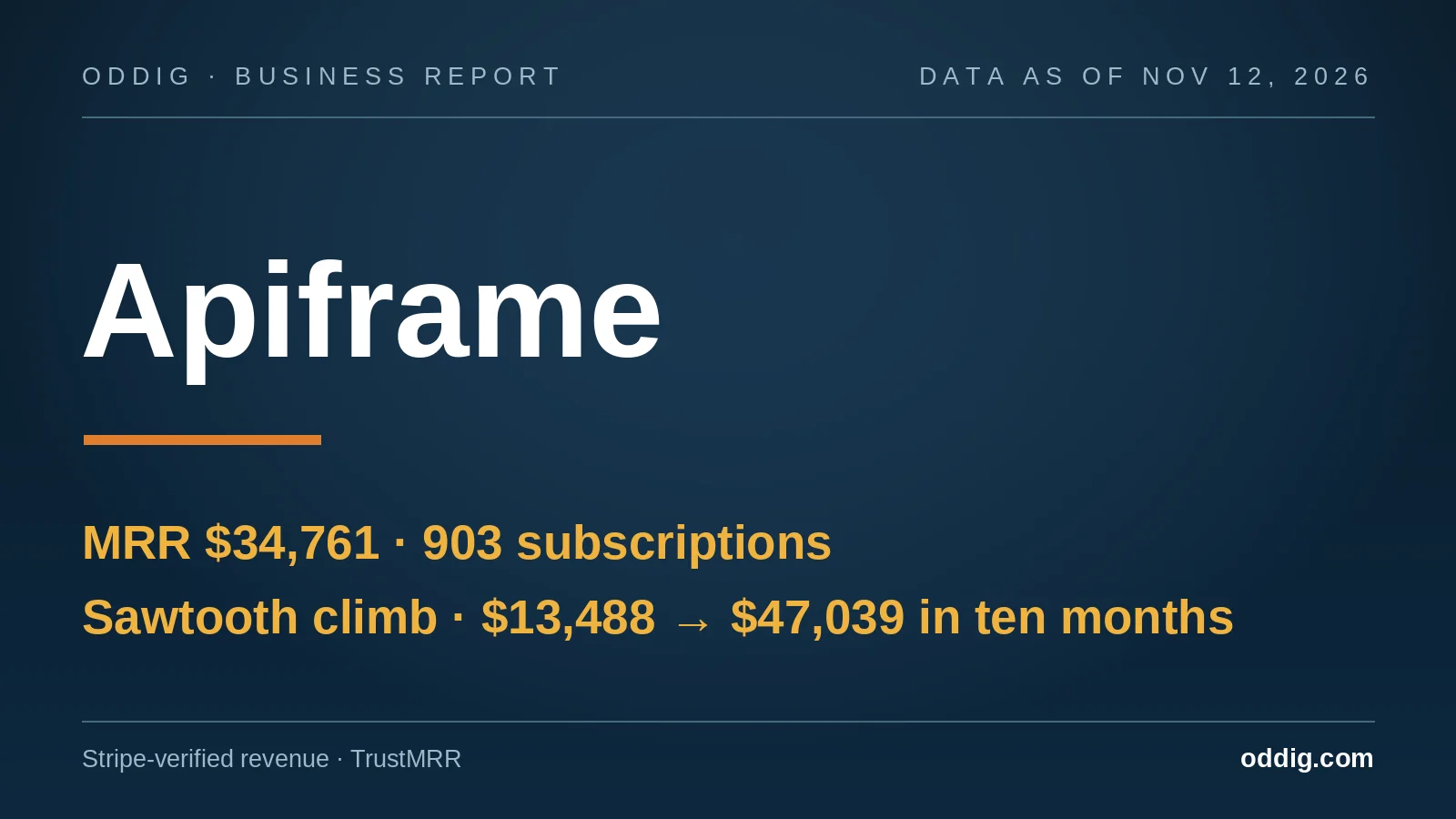

Apiframe makes $34,761 a month selling one API for AI image, video and music generation
One API for AI image, video and music generation, founded in 2021. The verified record is a sawtooth: down in January, then a climb — with dips — to $47,039 in September, and a first step back in October.
Product at a glance
Summary
What this business is
Apiframe sells one API for AI image, video and music generation to developers, founded on Aug 4, 2021. Its verified record covers only the last twelve months and reads like a seismograph: $13,488 in Dec 2025, a halving in January, then a climb with one more dip to a $47,039 peak in September 2026 and $44,106 in October. MRR is $34,761 from 903 subscriptions at a derived $38.50 — almost exactly the entry tier — and the stated margin is 67%.
Why these scores? See the reasons in Key takeaways →
Momentum
Rising. Revenue over the last three complete months is up 67.3%, but MRR fell 5.6% in the last 30 days; the rule downgrades ‘revenue up, MRR flat-to-down’ one notch, to Rising.Derived
Best suited for
Builder (main). Aggregating fast-moving models behind one API — selling integration savings, not generation.
Operator (second). A five-year-old business whose verified record only shows the last year — patience plus a truncated paper trail.
Key findings
Product overview
Integration savings, sold by the credit.
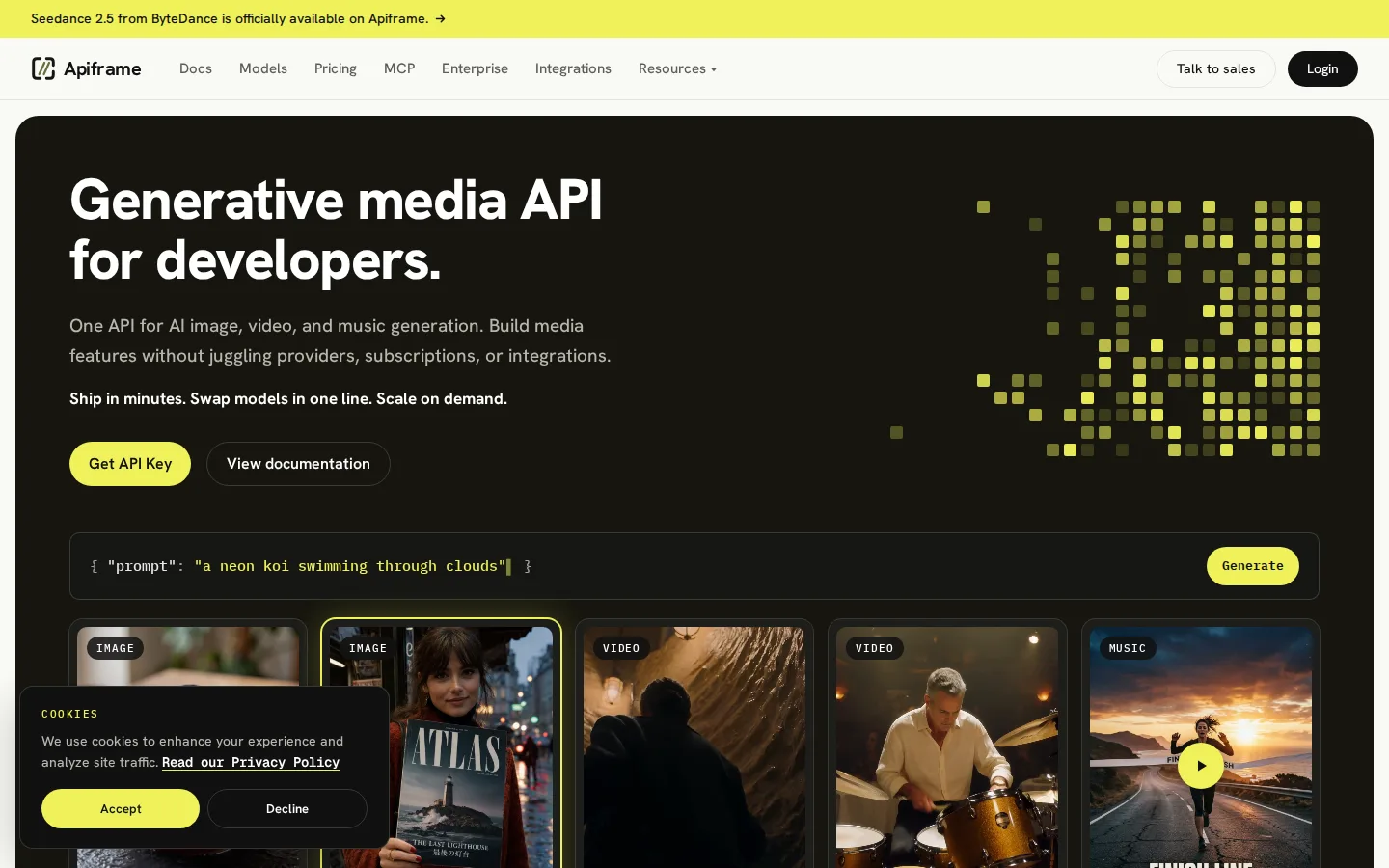
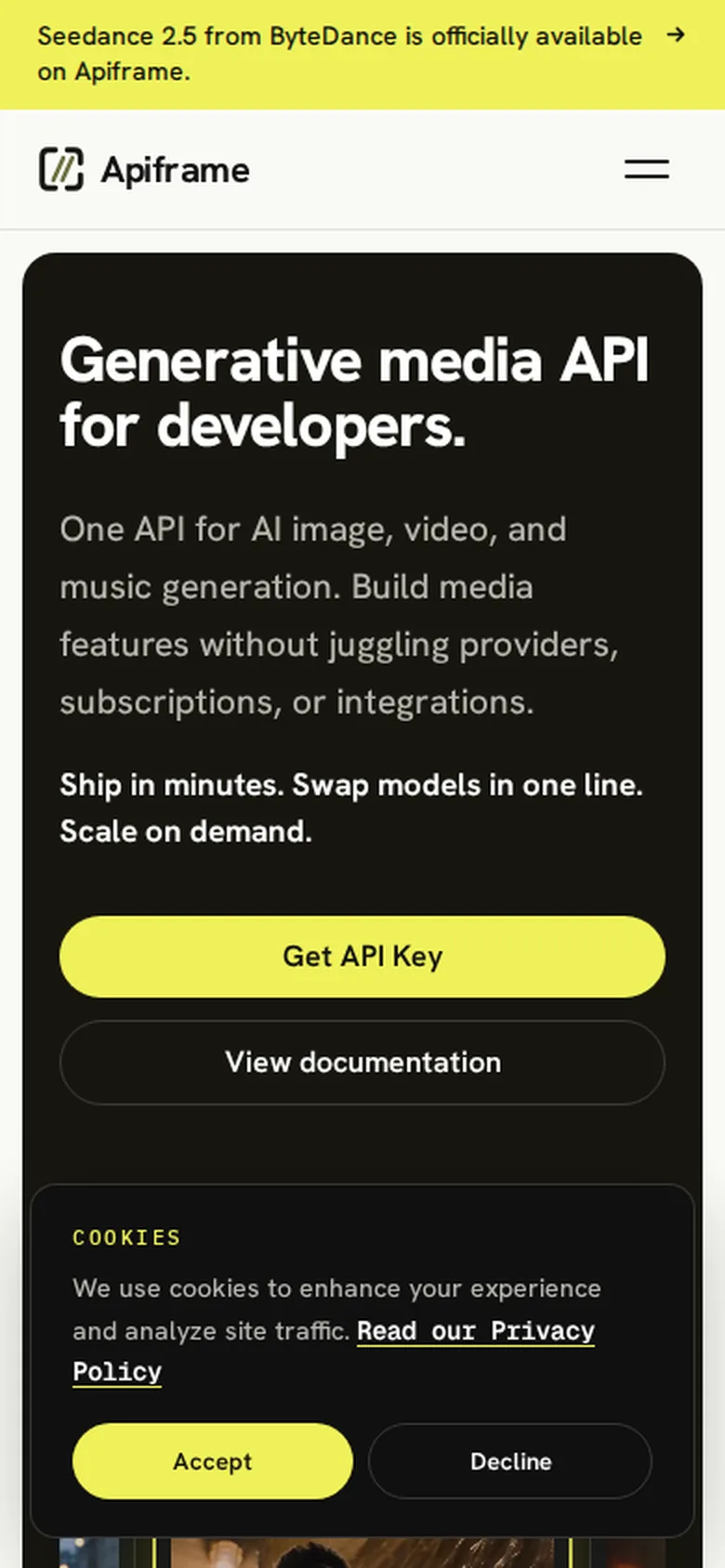
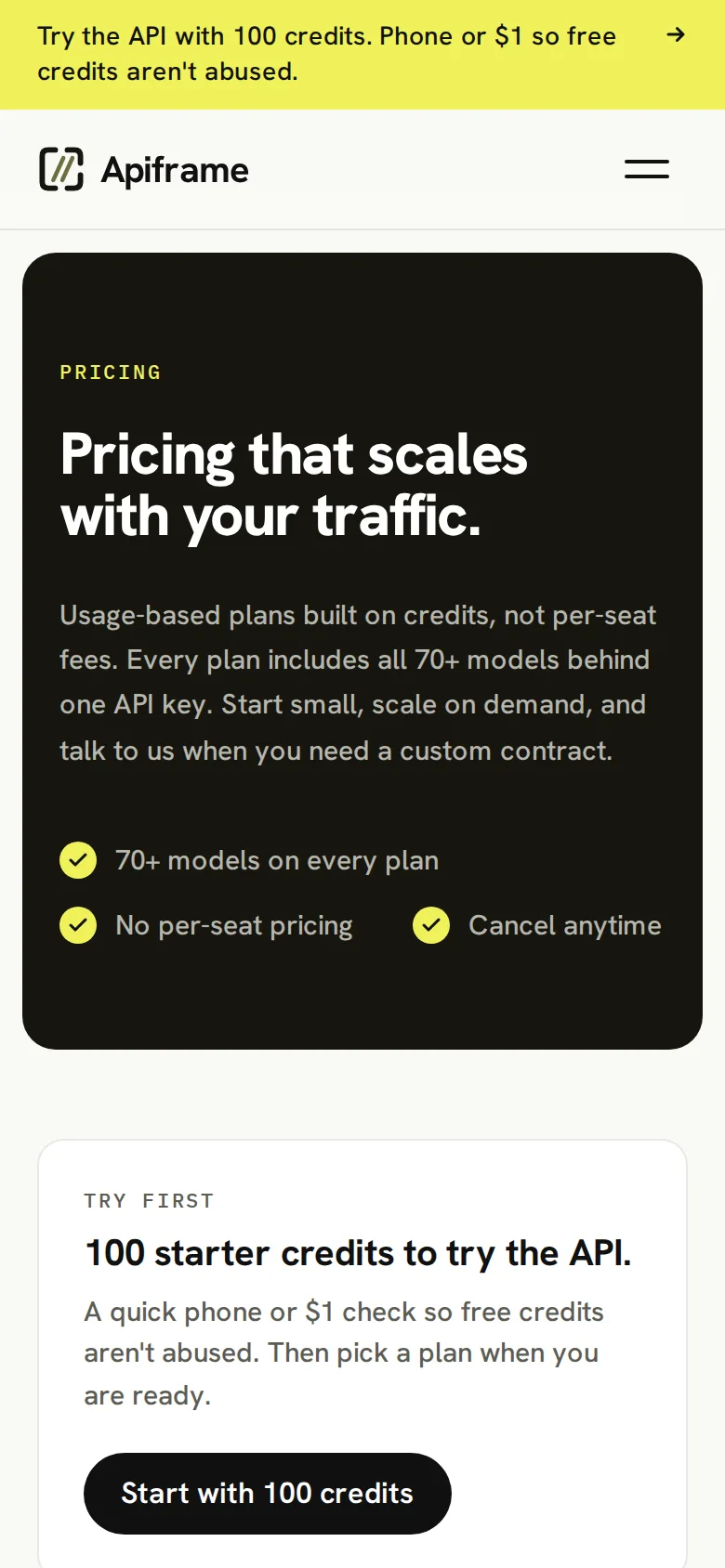
Apiframe routes the major AI image, video and music models behind one API, so a developer integrates once and swaps models without rewiring. The pitch is operational: concurrency limits, unified billing and top-ups, with a $1 verification step to keep free-credit abuse down.[2]
The customer math shows where the product sits in its market: 903 subscriptions and an estimated 9,800 users — a long free and trial tail — and the average paying account spends $38.50, the Basic tier. The business today is many small developers, not a few large ones.Derived
What the site looks like
What to look for
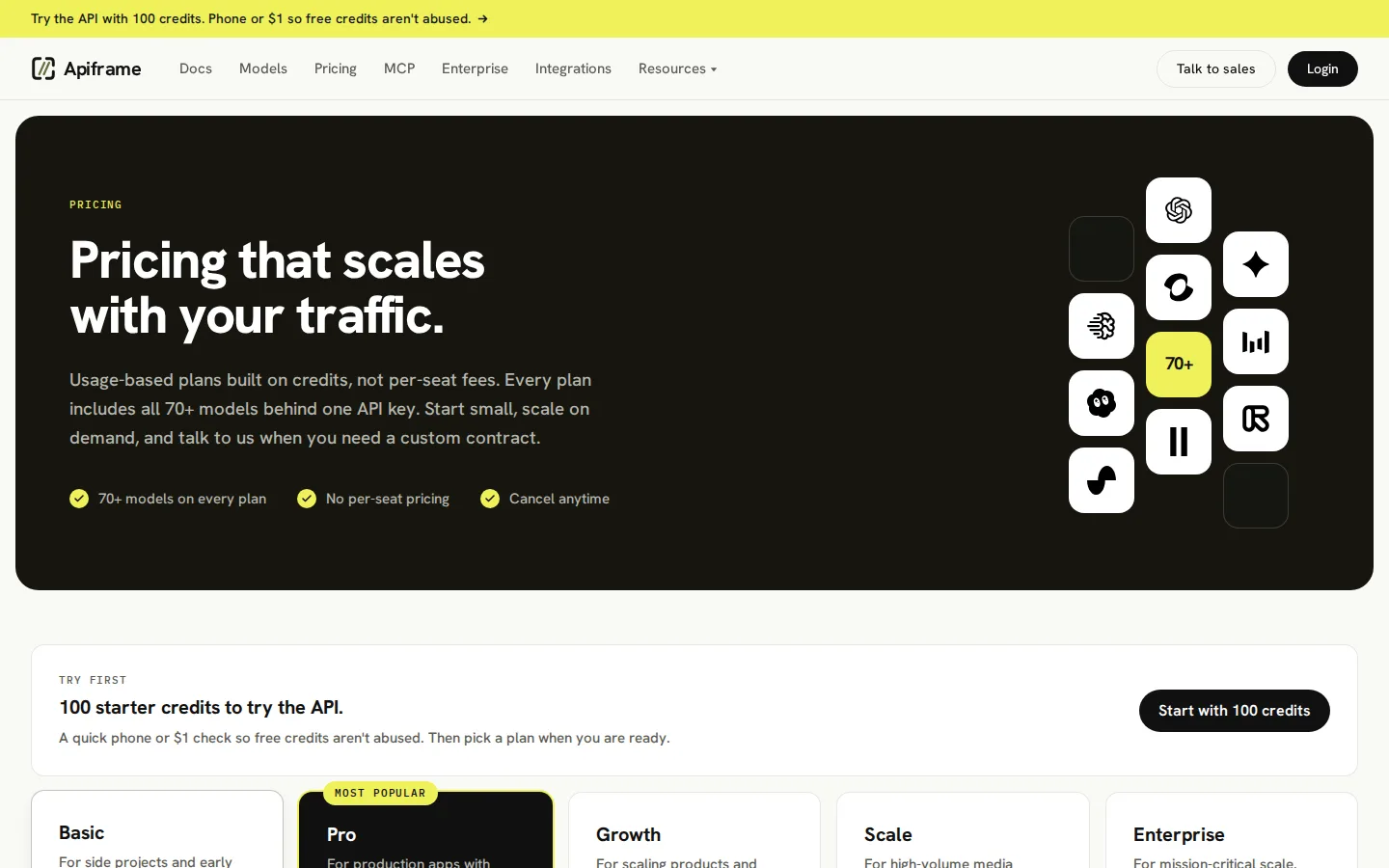
- 1Pricing is credit-based and public, from $39 to $749 — a developer reads the whole offer in one screen.Fact
- 2The anti-abuse phone/$1 check on signup is visible in the funnel — a tell that free tiers attract farmers.Fact
What to look for
- 1The plans as captured: Basic $39/mo (first month $19) · Pro $99/mo · Growth $399/mo · Scale $749/mo — the same lineup the pricing chapter below works through.Fact
Revenue analysis
Growth that never travels in a straight line.
October’s daily chart is spiky at a small scale — best day $2,830 (Oct 22) in a $44,106 month — the signature of usage-driven billing rather than a smooth subscription base. November’s first eleven days average $1,435, inside the autumn band.Derived
| Reading | MRR | Active subscriptions | MRR per subscription |
|---|---|---|---|
| Nov 12, 2026 | $34,761 | 903 | $38.50 |
Daily revenue
TrustMRR snapshot.Fact
As reported on TrustMRR.Fact
Oct 22, 2026.Fact
The January hole
The record’s strangest feature is its second month: revenue halves from $13,488 to $6,766 in January 2026, then rebuilds for eight months. Nothing public explains it — a lost customer, a pricing change, a tracking break are all consistent with the shape. It is the first question a diligence process would ask, and the reason this report treats the growth rate as a band (roughly $27K–$47K since June) rather than a line.Our read
Market
AI media APIs are a knife fight among aggregators and the model labs’ own endpoints. Apiframe’s defence is the unglamorous layer — billing, concurrency, fallbacks — which is exactly the layer customers least want to build.Our read
Pricing: credits from $39 to $749
Four credit tiers and a top-up valve.
| Plan | Price | Credits / month |
|---|---|---|
| Basic | $39/mo (first month $19) | 4,000 credits · 5 concurrent jobs |
| Pro | $99/mo | 10,000 credits · 12 concurrent jobs |
| Growth | $399/mo | 40,000 credits · 50 concurrent jobs |
| Scale | $749/mo | 75,000 credits · 100 concurrent jobs |
The derived average, $38.50, lands a cent under Basic — the paying base is entry-tier almost to a subscriber. With Pro at $99, moving even a tenth of the base up a tier is worth more than the last quarter’s growth.Derived
Where customers come from
A developer product with a real search surface.
Domain rating 49 — developers searching for model APIs find documentation-led sites; this is the strongest organic surface in the batch.[1]
DerivedThe TrustMRR profile lists no marketing channels and connects no analytics, so channel shares are not estimated here.
Growth strategies
Two moves: one contract over many models, and credits instead of tiers of features.
Timeline
- Aug 42021ProductFounding date on TrustMRR.[1]
- Dec2025RevenueVerified record opens at $13,488 a month.[1]
- Jan2026RevenueRevenue halves to $6,766 — the record’s deepest dip.[1]
- Jun2026RevenueRevenue crosses $27,000 as the climb steepens ($27,063).[1]
- Sep2026RevenueBest month on record: $47,039.[1]
- Oct2026RevenueFirst step back: $44,106, down 6.2%.[1]
Key takeaways
Apiframe is a five-year-old aggregation business having its best recorded year — unevenly. The chart’s teeth are the story: this revenue breathes with its customers’ usage.
Why we scored it this way
Copy
- Aggregate what churns. Models change monthly; one stable API contract on top of them sells certainty to developers who cannot re-integrate every quarter.
- Let credits carry the pricing. Four tiers from $39 to $749 with top-ups means a customer’s growth raises revenue without a renegotiation.
Avoid
- Reading a sawtooth as a slope. Three down months inside a growth year means the average lies; plan on the band, not the trendline.
- Sitting everyone on Basic. 903 subscribers at the entry price is an upsell failure hiding inside a growth story.
Our predictions
Three dated calls, set against the band ($27K–$47K) rather than the trendline, because this series punishes trendlines.
Track record: the predictions in our earlier reports are still open; the first checks land Dec 1, 2026. We mark each prediction right or wrong on its date and keep the result on the page.
What could prove us wrong
Things that would change our read, and how to check them.
- October may be noise. The series has recovered from worse dips twice this year; a new high by December would make the step back a sawtooth tooth, not a turn.Check: monthly revenue for Nov–Dec 2026 against September’s $47,039.
- The upsell may already be starting. If newer cohorts land on Pro, the $38.50 average rises; a higher reading in January would change the pricing story.Check: the MRR-per-subscription reading on Jan 31, 2027.
- Usage revenue may be one customer. A single integrating app can drive a sawtooth; if one launch powered the summer, its fade looks like decline.Check: monthly revenue into Mar 2027.
Appendix
Frequently asked
How much does Apiframe make?
$42,109 in the 30 days to Nov 12, 2026, verified through Stripe on TrustMRR. MRR is $34,761 from 903 subscriptions; the verified record totals $275,511 since Dec 2025.
How long has Apiframe been around?
The founding date on TrustMRR is Aug 4, 2021 — but the verified revenue record covers only the last twelve months, so its earlier scale is not public.
How much does Apiframe cost?
Basic is $39 a month for 4,000 credits, Pro $99 for 10,000, Growth $399 for 40,000 and Scale $749 for 75,000, with pay-as-you-go top-ups (pricing page, Nov 2026).
Sources
- [1]TrustMRR: Apiframe — revenue, MRR, subscriptions, margin, daily and monthly data. Verified through a Stripe API key. Synced 2026-11-12.
- [2]Apiframe — product description and pricing as shown on the site, Nov 2026.
Screenshots © Apiframe, used for commentary. Oddig has no business relationship with Apiframe. Numbers change daily; check the sources for the latest.


Comments are closed for this article.