
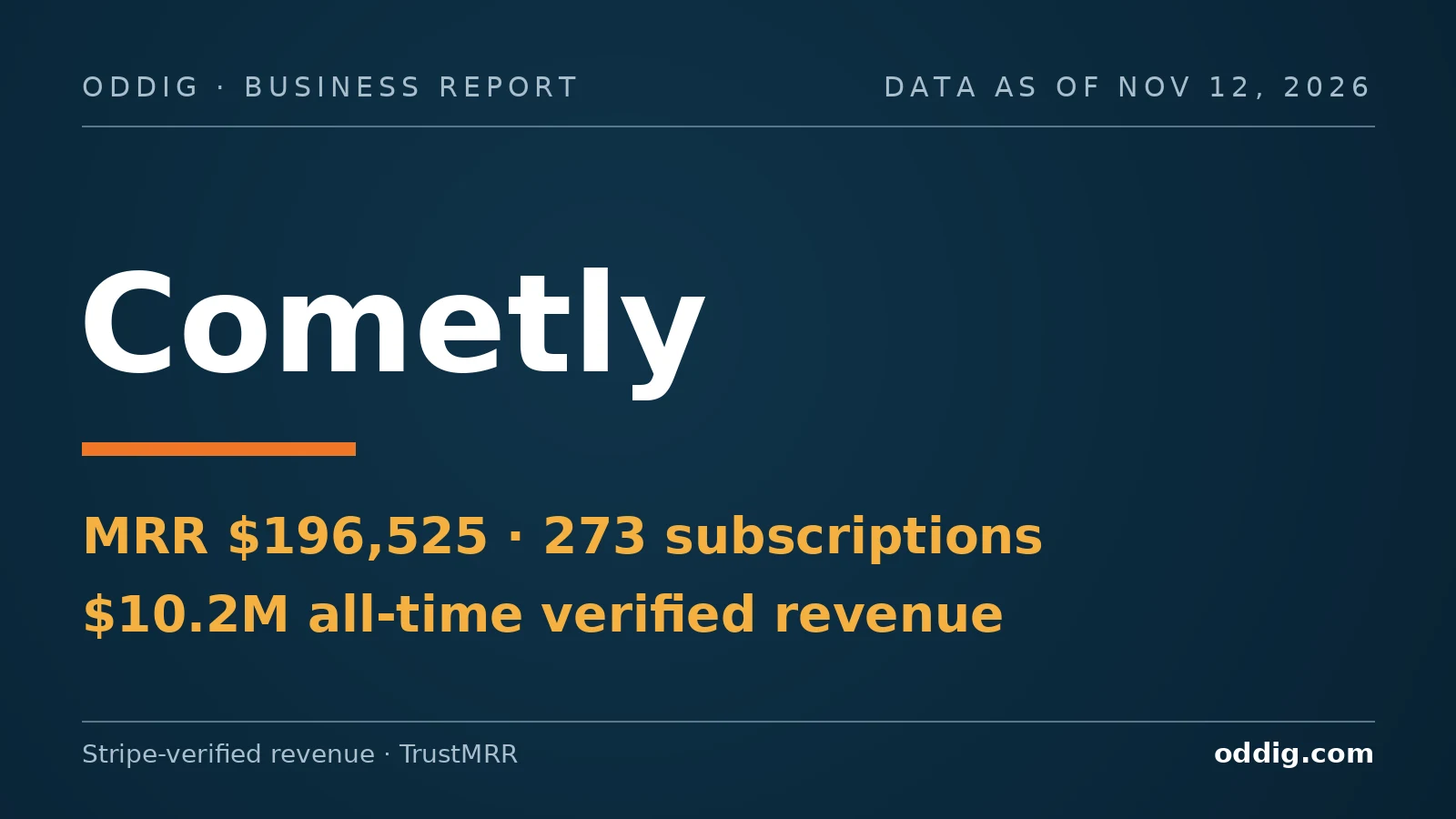

Cometly makes $196,525 a month from 273 attribution customers — $10.2M verified all-time
Cometly sells marketing attribution to B2B SaaS companies — which ads and campaigns actually produce revenue — at enterprise prices to a tiny customer count: 273 subscriptions averaging $720 a month. Its verified year never leaves the $185K–$286K band, and its all-time verified revenue is $10,209,207, the largest in this library.

Product at a glance
Summary
What this business is
Cometly is marketing attribution for B2B SaaS: it connects ad platforms to CRM revenue so customers can see which spend closes deals, and sends that truth back to the ad algorithms. The verified record is a study in steadiness — eleven months between $185,017 and $286,268, MRR of $196,525 from just 273 subscriptions at a derived $719.87 average, and $10,209,207 of all-time verified revenue since long before this record begins. Its review record splits by platform: 4.8 on G2 (36 reviews), 3.8 on Trustpilot (93). Nothing about this business is viral; everything about it is expensive, sticky and quiet.
Why these scores? See the reasons in Key takeaways →
Momentum
Steady. Revenue is up 13.8% over the last three complete months — inside the ±15% Steady band — and MRR is essentially flat (−2.5% over 30 days), so no cross-check adjustment applies. Steady, at the top of the band.Derived
Best suited for
Operator (main). High-ACV B2B infrastructure: attribution touches the customer’s ad budget and board reporting, which is why 273 accounts can carry a $2.4M run rate.
Builder (second). How a niche tool out-earns louder consumer apps — price per customer instead of customer count.
Key findings
Product overview
Attribution that closes the loop back into the ad platforms.
Cometly’s job is to answer the most expensive question in B2B marketing — which spend actually produced revenue — and then act on the answer: it sends verified conversion data back to Google and Meta so their algorithms optimise toward closed deals instead of clicks. The newest layer is conversational: AI agents that let marketers chat with their ads data.[1][2]
It sells to a narrow, expensive niche: B2B SaaS companies with real ad budgets and long sales cycles, where last-click attribution is fiction. The customer count (273) looks small only until it is multiplied by the derived $719.87 each one pays.Derived
How it compares
| Business | What it does | MRR or pricing | The difference |
|---|---|---|---|
| Cometly | Attribution for B2B SaaS, AI-agent layer | Sales-led · avg sub $719.87 · MRR $196,525 | The B2B-SaaS specialist at mid-market prices |
| Northbeam | Attribution and media mix modelling | From $1,000/mo | DTC/e-commerce heritage, higher floor price |
| Triple Whale | Attribution plus analytics suite (Triple Pixel) | From $129/mo starter; core platform $999–$2,599/mo | Shopify-first, broader suite, entry tier below |
Competitor pricing as published on their pricing pages, Nov 2026; Cometly’s average is derived from TrustMRR.[1][4][5] The shelf is splitting by customer: Shopify stores one way, B2B SaaS the other. Cometly owns the second shelf and prices like it.
What the site looks like

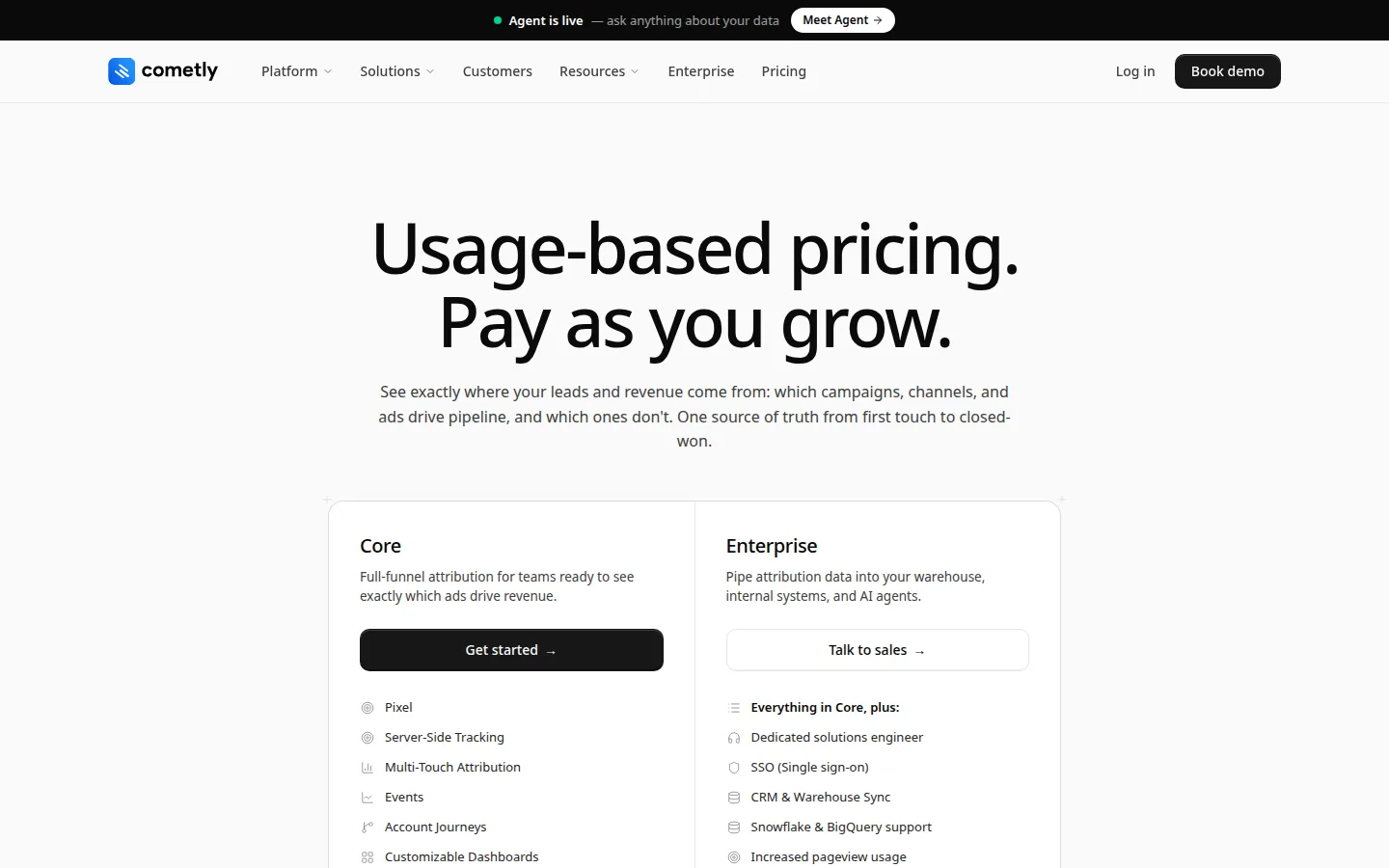
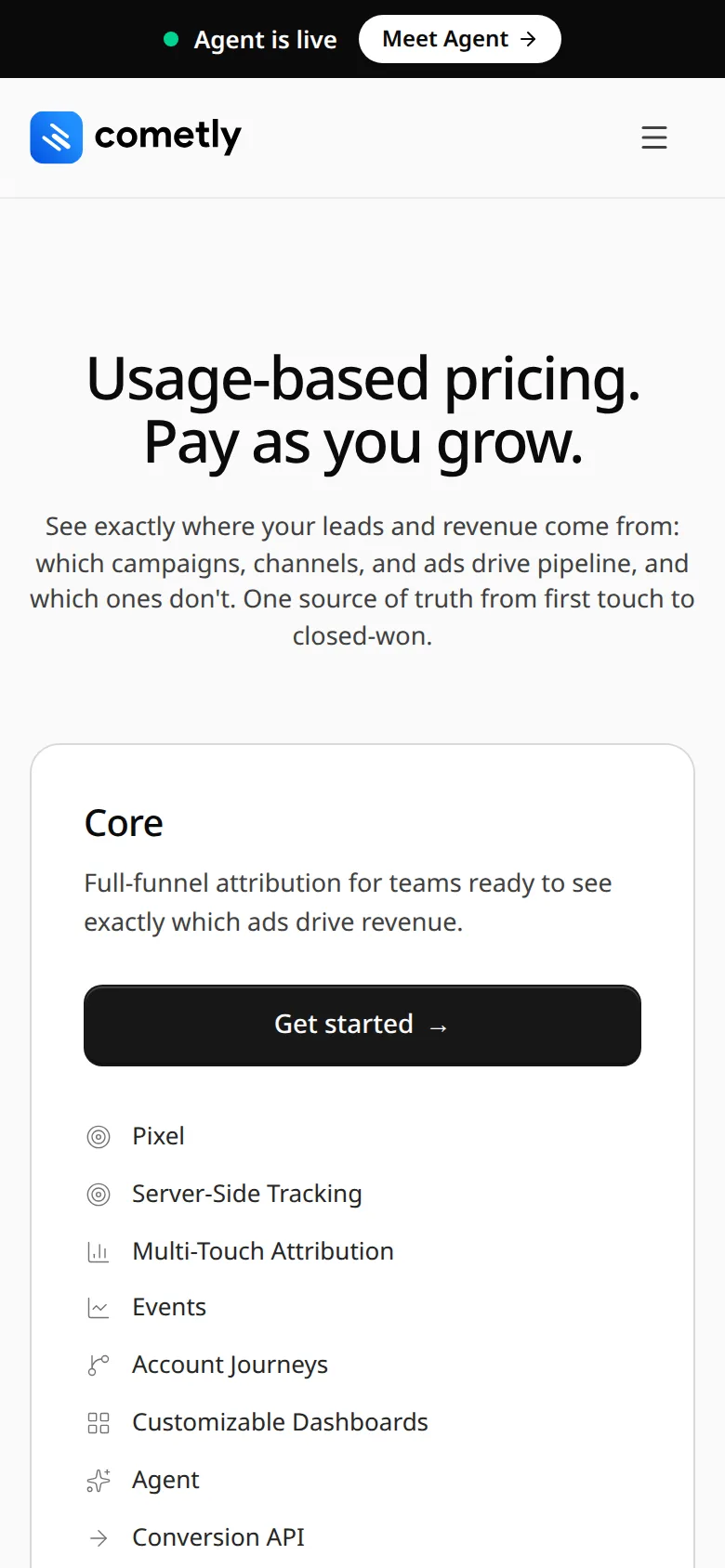
What to look for
- 1The headline has moved with the market: “AI Marketing Attribution Software. Power AI agents with accurate data.” — attribution is now sold as fuel for agents.Fact
- 2The pitch stays board-level — accurate data, proven ROI — aimed at the person who signs a $720-a-month contract, not a growth hacker.Fact
What to look for
- 1The pricing page as it stood in November 2026 — the tiers and terms the pricing chapter below is built on.Fact
Revenue analysis
The steadiest record in this library — a band, not a curve.
The daily series shows enterprise billing rhythm: $196,511 across the 29 complete days, a best day of $18,662 (Oct 16) and three zero days — large invoices landing on their own schedule. November’s partial month ($55,283) runs at about half of October’s daily pace, which for lumpy monthly and annual billing is a calendar artefact until proven otherwise; the December read will settle it.Derived
| Reading | MRR | Active subscriptions | MRR per subscription |
|---|---|---|---|
| Nov 12, 2026 | $196,525 | 273 | $719.87 |
Daily revenue
TrustMRR snapshot.Fact
October 2026 — the record’s ceiling.Fact
Oct 16, 2026 — enterprise invoices land lumpy.Fact
The shape of the record
There is no story arc in this chart, and that is the story: December $194,721 through October $286,268, with the weakest month ($185,017 in March) within 9% of the median. A business that sells certainty has a certain chart.Derived
October’s jump to $286,268 — 39% above September — is the one break in the pattern. On lumpy enterprise billing, a single annual contract or a cohort renewal can do that; the following months will show whether it is a new level or a receipt. November’s partial data is too billing-dependent to judge yet.Our read
A note on the numbers
All-time verified revenue ($10,209,207) dwarfs the public record: the monthly series sums to $2,354,879, so roughly three-quarters of this business’s lifetime revenue predates the visible window — the record shows the plateau, not the climb. Daily zero days and a $0 last-24-hours reading are billing-calendar artefacts of enterprise invoicing, not sync failures; the monthly series and MRR are current to Nov 10–12.
Market
Attribution is a market created by platform opacity: iOS privacy changes and walled-garden ad platforms broke the old measurement, and every serious advertiser now pays someone to rebuild it. The moat is trust in the number — which is why a six-year record and reviewers who name its support staff matter more here than features.Our read
Pricing: no public ladder — a $720 average tells the story
Sales-led pricing at enterprise levels.
Cometly does not publish a self-serve ladder; pricing runs through sales. The verifiable facts are the outcomes: 273 subscriptions averaging a derived $719.87 a month, against a category shelf where Northbeam prints a $1,000/mo floor and Triple Whale’s core platform runs $999–$2,599/mo.[1][4][5]
At these prices the buyer is not comparing features; they are comparing confidence. The G2 badges (Leader, Best Support, Best Usability in 2025 categories) are pricing assets — they defend the number at renewal.Our read
Where customers come from
A known name in a small room: brand, direct, and the customer base itself.
Direct is 55.47% of measured traffic and the top keyword is the brand itself — “cometly”. Prospects arrive pre-sold or already paying.[3]
FactSemrush tracks 23,362 organic keywords (Authority Score 38) — the brand term leads, but generic category terms (“scheduling”, “market analysis”, “performance analytics”) rank beneath it: a real organic asset, not just a name.[1][3]
FactSemrush estimates ~37K visits in October — tiny next to this batch’s consumer apps, and irrelevant: at $720 per customer, Cometly needs a handful of right visitors, not millions of any visitors.[3]
FactTraffic figures are Semrush estimates for October 2026, read Nov 12–13, 2026 — modelled data, not the company’s analytics; the TrustMRR profile connects no analytics of its own. Sales-led motion (demos, partnerships, outbound) is invisible to traffic models and is likely the real channel mix at this price point.[3]
What customers say
One of only two products in this batch with a review record deep enough to read — and the two platforms disagree.
On G2, Cometly carries 4.8 across 36 reviews. On Trustpilot it carries 3.8 across 93 — a separate, larger pool, not the same reviewers counted twice, and a colder one. Cometly’s own site advertises 4.9; neither platform shows that number today.[6][7]
What reviewers praise is the core promise and the people around it: attribution they trust more than the ad platforms’ own reporting (“highly precise tracking”), event-match scores jumping overnight (5.2 to 9.3 in one account), and support named by person — Tom and Buddy recur across both platforms. What they complain about is equally specific: price and value (a 0/5 G2 review titled “not worth of its price”), tracking that stops on some campaigns, documentation out of sync with the product, and — flatly contradicting the praise — support that can take days to answer. The honest summary is polarisation: customers with a named human love it; customers without one churn loudly.Fact
| Theme | What reviewers say | Sources |
|---|---|---|
| Praise: accuracy | Attribution trusted over native platform reporting; event-match jumps | G2 + Trustpilot[6][7] |
| Praise: named support | Hands-on help from named people (Tom, Buddy) — the most repeated praise | G2 + Trustpilot[6][7] |
| Complaint: price & value | Quote-only pricing called too high; a 0/5 “not worth it” on G2 | G2 + Trustpilot[6][7] |
| Complaint: reliability & support variance | Tracking gaps on some campaigns; slow replies in the Trustpilot pool | Trustpilot[7] |
Growth strategies
Two moves from the high-ACV end of the playbook.
Timeline
- Oct 272020ProductFounding date on TrustMRR; founder Grant Cooper.[1]
- Dec2025RevenuePublic record opens at $194,721; all-time verified revenue already stands near $7.9M by then (derived from the current $10.2M total).Derived
- Mar2026RevenueSoftest month of the record: $185,017 — still within 9% of the median.[1]
- Oct2026RevenueBest month of the record: $286,268; MRR $196,525 on 273 subscriptions.[1]
Key takeaways
Cometly is the batch’s control group: proof that in B2B, the boring variables — price per customer, switching cost, a trusted number — beat audience size every month of the year.
Why we scored it this way
Copy
- Price against the budget you inform. Attribution that steers six-figure ad spend can charge $720 a month to 273 companies.
- Close the loop. Feeding truth back into the ad platforms turns a reporting tool into infrastructure the customer cannot remove.
Avoid
- Chasing customer count at enterprise prices. Every low-fit logo at $720 is support load and churn risk; the base is the strategy.
- Letting complexity tax the praise. The setup-friction complaints inside a mostly-positive G2 record are tomorrow’s churn if onboarding stops improving.
Our predictions
Three dated calls, set against the band: the ranges assume the plateau is the business’s normal state.
Track record: the predictions in our earlier reports are still open; the first checks land Dec 1, 2026. We mark each prediction right or wrong on its date and keep the result on the page.
What could prove us wrong
Things that would change our read, and how to check them.
- October may be a new level, not a spike. If revenue holds above $260K for two more months, the band has moved up and this report’s Steady framing undersells a step-change.Check: monthly revenue for Nov and Dec 2026 against the $286K October level.
- Concentration may be hiding in the average. 273 subscriptions at $720 could be 273 similar companies or 30 whales and a tail; a sudden count drop with stable MRR would reveal which — and change the risk read entirely.Check: TrustMRR subscription counts into Mar 2027.
- The AI-agent layer may shift the buyer. If the agent story lands, expect smaller self-serve customers to appear in the review stream — and the $720 average to start falling for the right reasons.Check: G2 review count and rating in early 2027.
Appendix
Frequently asked
How much does Cometly make?
$200,886 in the 30 days to Nov 12, 2026, verified through Stripe on TrustMRR. MRR is $196,525 from 273 subscriptions, and all-time verified revenue is $10,209,207.
Is Cometly growing?
Steadily, at most: revenue is up 13.8% across the last three complete months, inside a band held for eleven months ($185K–$286K). October 2026 was its best month on record.
How much does Cometly cost?
Pricing is sales-led and not published as a self-serve ladder. The outcome is visible: subscribers pay an average of $719.87 a month, in a category where rivals publish $999–$1,000+ floors.
What do Cometly customers say?
G2 rates it 4.8 from 36 reviews; Trustpilot rates it 3.8 from 93 — two separate pools that disagree. Reviewers praise attribution accuracy and named, hands-on support; complaints centre on price, tracking gaps and setup friction on complex stacks.
Sources
- [1]TrustMRR: Cometly — revenue, MRR, subscriptions, daily and monthly data. Verified through a Stripe API key. Synced 2026-11-10.
- [2]Cometly — product description and positioning as shown on the site, Nov 2026.
- [3]Semrush: cometly.com — traffic estimates for October 2026 (visits ~37K, channels, keywords), read Nov 12–13, 2026. Modelled estimates, not measured analytics.
- [4]Northbeam pricing — competitor pricing as shown on the page, Nov 2026.
- [5]Triple Whale pricing — competitor pricing as shown on the page, Nov 2026.
- [6]G2: Cometly reviews — 4.8 rating, 36 reviews, read Nov 2026.
- [7]Trustpilot: Cometly reviews — 3.8 rating, 93 reviews, read Nov 2026.
What we could not include: Cometly’s pre-2025 revenue history (roughly three-quarters of its all-time total) is not in the public record, and its pricing ladder is sales-led, so per-tier analysis is not possible from outside. Review figures in the voice section are G2 (4.8 from 36 reviews) and Trustpilot (3.8 from 93) — two separate pools, read directly from each platform in Nov 2026.
Screenshots © Cometly, used for commentary. Oddig has no business relationship with Cometly. Numbers change daily; check the sources for the latest.


Comments are closed for this article.