
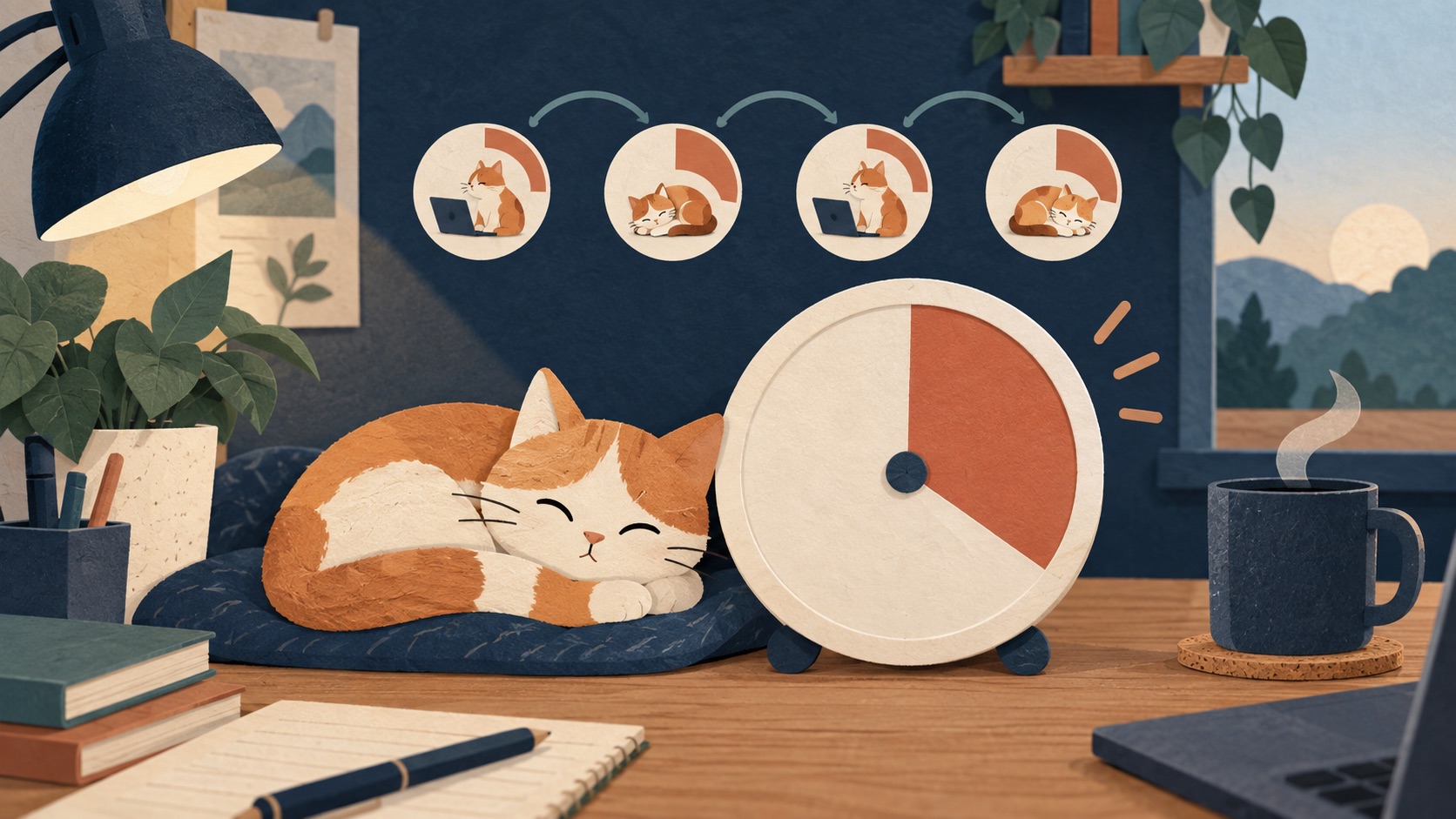
Cat on Chair does a familiar job: it times a work session. The difference is what the timer feels like. Start a session and a cat appears beside you. Finish and it leaves a gift. The gift can feed a collection and customization loop. That might sound like decoration around a commodity Pomodoro timer, but it changes the emotional cost of returning to the app. A person may have no difficulty understanding a 25-minute countdown. They may still resist beginning another session. Cat on Chair puts a small, pleasant event on both sides of that decision.
In a Starter Story interview, product designer Ryan describes building the app with his girlfriend, whose illustration work gives it its visual character. He reports more than 127,000 downloads and over $18,000 in sales during one 30-day period. The useful business question is not whether a cat can be pasted onto any productivity tool. It is how an ordinary utility, a distinct aesthetic, a completion ritual, and social sharing reinforced one another—and which parts of that mechanism a new builder can test without pretending the result is guaranteed.
The product demo in the interview shows the timer, cat arrival, gift, fish currency, room customization, and focus history. Watch the full chain rather than judging the app from the revenue headline alone.
Read the revenue figure correctly
Ryan says the app earned more than $18,000 in sales over a recent 30-day window and had earned close to $80,000 over roughly eight or nine months. He also reports about 24,000 new downloads in that 30-day window. He describes a free download with paid features and says most sales came from a lifetime plan. At the time of the conversation, he quoted $29.99 for lifetime access and $19.99 for an annual plan. These are interview-era figures, not a promise about current pricing in every country.
The $18,000 figure is not monthly recurring revenue. A lifetime purchase is money collected once, even if a customer uses the app for years. If most purchases are lifetime, multiplying a strong sales month by 12 would overstate predictable recurring revenue. Annual purchases also have a different cash-flow and service-obligation profile from monthly subscriptions. App-store commissions, taxes, refunds, support, art production, and ongoing development are not broken out in the interview. The recording shows a sales dashboard, but Oddig has not verified the underlying transactions.
There is an additional denominator problem. Downloads are not paying users. Dividing $18,000 by 24,000 recent downloads yields $0.75 of sales per recent download only as a rough period ratio, not an actual conversion rate or lifetime value. Some purchases may come from older users, some recent downloaders may buy later, and a user may install on more than one device. To understand the business, we would need cohort data: new installers, activated users, paywall views, purchasers by plan, refunds, and retention over time.
| Founder-reported measure | What it tells us | What it cannot establish |
|---|---|---|
| Over 127K downloads | The app achieved broad installation reach | Active use or paid conversion |
| About 24K first-time downloads in one 30-day window | Recent distribution was strong | Which channel caused each download |
| Over $18K sales in that window | Customers spent money in the period | Monthly recurring revenue or profit |
| Lifetime plan as the largest sales source | A one-time offer fits many buyers | Sustainable revenue from the installed base |
The current App Store listing corroborates that the product is live, free to install, and offers in-app purchases. It also lists a much wider set of features than the demo describes, including app and website blocking, focus history, widgets, and pro customization. Prices and features have changed or vary by storefront. Use the official listing for current capabilities, the interview for the historical growth story, and do not merge the two into one invented snapshot.
The real product job: begin, stay, and return
n
n
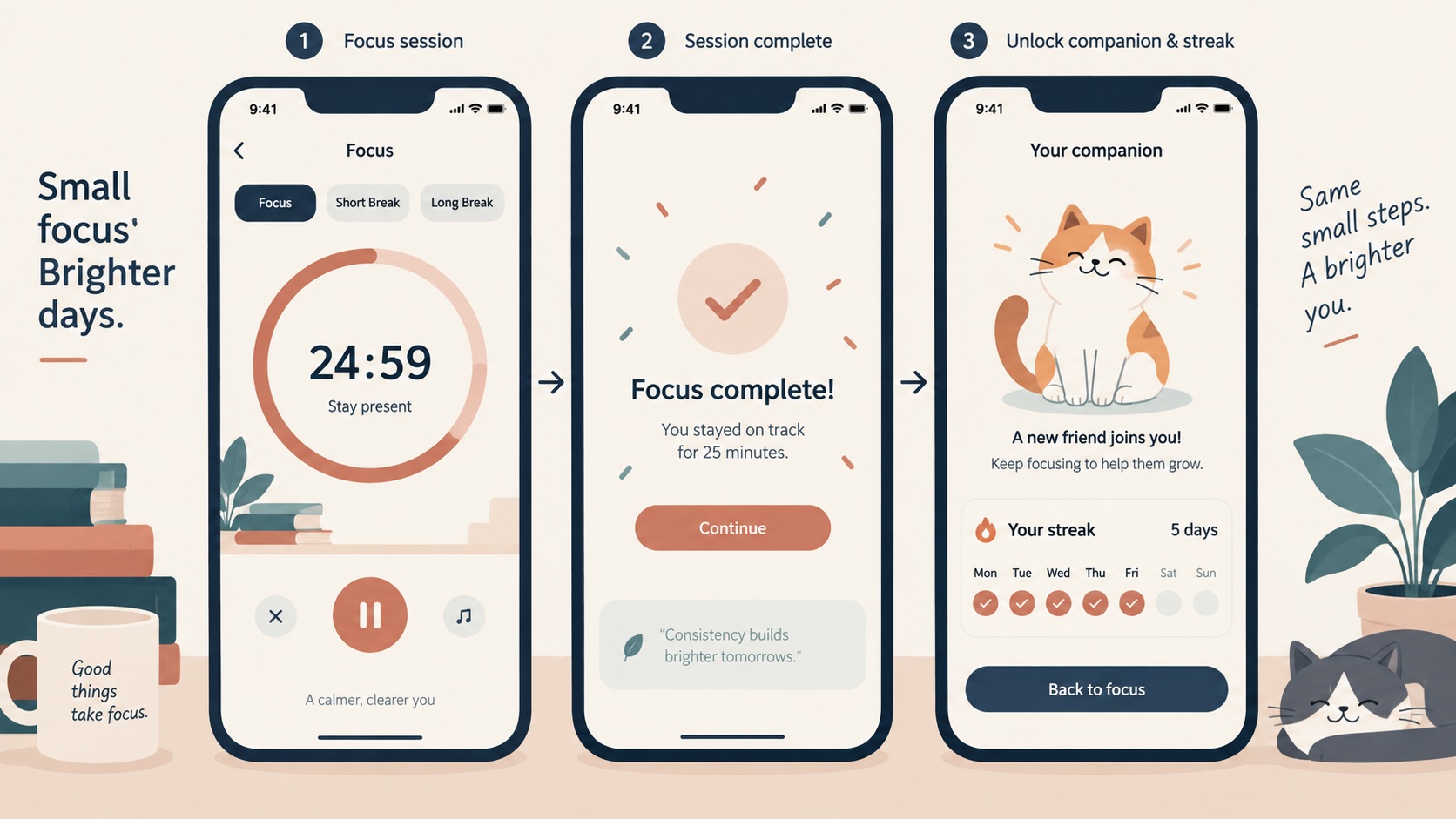
A Pomodoro timer handles a measurable task: divide work into focus and break intervals. Many apps can do that. Cat on Chair adds three related jobs. First, it makes starting feel inviting through an expressive, hand-drawn environment. Second, it makes staying with a session feel companionable: the cat appears while the timer runs. Third, it makes finishing produce a small reward that can be collected or used in the room. The core utility and the emotional layer are not separate. The reward only matters because the user has completed the work session.
The interview describes how the gift system came from the idea of a cat bringing something back. Successful focus yields a gift; an incomplete session can yield trash. Users can trade gifts for fish and use fish to change cats, furniture, or backgrounds. The product demo also shows a focus timeline, to-do list, and session controls. The official App Store description now says the free tier includes a Pomodoro and count-up mode, gift collection, a task list, and statistics, while Pro adds deeper customization and other tools. The parts may evolve, but the causal loop is stable: effort produces feedback, feedback changes the room, and the room invites another effort.
That loop creates a design constraint. A reward must make a user glad they finished a focus session; it must not make them keep a timer running while doing something else merely to accumulate items. If the collectible economy becomes the primary purpose, the app can optimize for time inside the app rather than work done outside it. If punishment for interruption feels harsh, it may backfire for users with unpredictable days. A builder borrowing the pattern should test whether the reward supports the underlying job and whether it remains pleasant after novelty fades.
The distinctive illustration also matters economically. Ryan was a product designer, and the project had an illustrator close to the team. That let them make a coherent world rather than buying a generic mascot and placing it on a standard timer. The art was not an afterthought; it shaped the product's concept, screenshots, animation, rewards, and the way people described it to friends. Someone without that design capacity cannot simply copy the feature list and expect the same referral effect.
A build-and-launch timeline with friction intact
Ryan says he began around May 2025. A first timer took weeks, but the team needed more time to work out animations and the full interaction. A version was ready in August. They invited dozens of people from RedNote to beta test, collected feedback for about a month, and launched on August 27. He reports roughly 3,000 downloads in the first week. This was not a perfect release: synchronization across devices and other bugs remained. According to his account, the app was not relatively stable until around December or January.
This is important because a smooth “AI built it in days” narrative would conceal the costly parts of consumer software. A countdown is easy to demo. Reliable sync, purchases, notification behavior, device support, and state recovery are much harder to live with every day. Ryan says he used an AI coding assistant and RevenueCat for purchase management, but the interview does not provide engineering hours or a full cost ledger. His design experience, his partner's artwork, beta testers, and months of iteration are part of the build effort.
The later distribution story is similarly specific. The founders already had some attention on RedNote because his partner had shared illustrations there. Small viral moments followed. Ryan says Instagram creators then included the app in roundups; one post exceeded two million views. A person in Taiwan saw the app and shared it on Threads, where it spread again. He reports that this sequence roughly doubled downloads and revenue overnight. That is a founder account of a plausible chain, not a controlled attribution study. It does show why a product whose experience is visible in a few seconds can travel through collection posts: the cat, chair, and reward can be understood without a long explanation.
| Product event | Likely mechanism | Evidence to seek in your own app |
|---|---|---|
| A cat appears at session start | Makes beginning feel rewarding | Start rate after opening the app |
| A gift arrives at completion | Gives work a visible ending | Completion rate and next-session return |
| A room changes over time | Makes progress personally meaningful | Multiweek retention, not only first-day play |
| A short creator video shows the loop | Communicates the idea in seconds | Installs and activated users by creator link |
This table is an Oddig analysis, not a report of Cat on Chair's internal analytics. It is a model a product team can falsify with its own events and interviews.
Why this app was shareable—and why that is not a growth plan
The visual hook matched the product's audience. People who enjoy cats, soft illustration, and light game mechanics can recognize the appeal quickly. A creator does not need to explain how the timer works. They can show the cat arriving, a focus session ending, and a new item appearing. The app's design becomes a demonstration asset. That is more useful than a generic claim that “good design goes viral.”
Yet the interview gives limited attribution data. The team mentions RedNote, Instagram roundups, and Threads, but does not disclose the number of creators contacted, paid versus unpaid posts, source-specific conversion, or how much ongoing traffic persisted after spikes. An organic post that doubles downloads overnight can produce a large revenue month and then fade. A more durable system would identify which creators' audiences activate, not merely which posts earn views. It would save the most effective format, build relationships with creators who reach the right users, and compare cohorts arriving through each channel.
This is where regional context matters. Ryan says early users were mainly in Chinese and Taiwanese markets, partly because the team had an existing audience on RedNote. Success in one language or platform does not automatically transfer to English-speaking markets. The App Store now lists multiple supported languages, but localization is more than translating interface labels. App-store search terms, creator networks, cultural tone, price expectations, and platform use all change. A new founder should validate the same emotional premise with the audience they can actually reach.
The economics a copycat would need to prove
For a new consumer app, the most useful model separates acquisition, activation, conversion, and service cost. Start with a cohort of 1,000 first-time installs from one channel. Count how many start a session, finish one, return after seven days, see the paywall, and buy. Keep lifetime, annual, and monthly buyers separate. Estimate gross proceeds and then subtract platform fees, refunds, taxes where applicable, paid creator spend, tools, and support. Only then compare the contribution to the cost of acquiring the cohort.
The most subtle cost in this kind of app is future attention. A lifetime customer may pay once but expect new cats, furniture, device compatibility, and bug fixes indefinitely. That does not make lifetime pricing wrong; it means the team must understand how many buyers are new, how often they ask for support, and whether new releases produce new purchasers or merely extend obligations. Annual subscriptions may stabilize revenue but require visible ongoing value. A free tier that is genuinely useful can build goodwill, but it also creates support demand from users who may never pay.
Cat on Chair's official listing shows the team has expanded beyond the interview's basic timer demo into app blocking, calendar and health sync, widgets, social features, and detailed statistics. These may deepen utility. They also add surface area, maintenance, and the risk of losing the app's initial clarity. A feature should earn its place by making focus easier or improving retention among a real customer segment, not because another productivity app has it.
How to test the underlying opportunity without copying the cat
The transferable opportunity is to take a task people repeatedly avoid and give it a distinct, emotionally appropriate completion loop. The product can be small, but it must resolve a real reluctance or frustration. Use this test before building a collection economy.
- Choose a repeated task with a visible finish. Focus sessions qualify. So might language practice or physical therapy exercises. An occasional task with no clear end is a weaker fit.
- Ask why the current tool feels cold or hard to reopen. Interview people who already attempt the task. If they only complain about missing functionality, a character and reward may not address the problem.
- Prototype one beginning and one ending. A simple timer plus a meaningful companion interaction is enough to test the idea. Do not build dozens of collectible assets before measuring return use.
- Observe unprompted behavior. Can a new user explain what to do? Do they finish a real session? Do they come back without a reminder? Ask what they were trying to accomplish outside the app.
- Test shareability and purchase separately. Show a short demo to the intended audience and track installs and activated sessions. Then test whether enough of those users pay for a sensible upgrade. A delightful video and a viable business are two different hypotheses.
Set stopping conditions before the test. For example, if users enjoy the art but rarely finish a real task, redesign the core utility. If they finish but never revisit, test whether the task or reward is truly recurring. If they return but do not pay, re-examine what is free, what is premium, and whether the paid feature is valuable to the people getting the most utility. The threshold depends on your cost base and market, not on a number borrowed from this interview.
The strongest conclusion from Cat on Chair is that a familiar tool can win through a specific experience that changes user behavior. The weakest conclusion would be that a cute theme alone makes a business. The art, interaction loop, engineering reliability, existing audience, and creator-friendly demonstration all contributed to the account Ryan gave. The next builder's job is to find their own combination and measure whether it actually helps users do the work they came to do.
Sources & further reading
- Starter Story interview with Cat on Chair creator Ryan, published July 26, 2026 in YouTube's Pacific timestamp. Historical sales, download, timeline, and channel details are attributed to the interview.
- Cat on Chair's official website, accessed September 24, 2026. Used to confirm product positioning.
- Official App Store listing, accessed September 24, 2026. Used for current feature and purchase-model corroboration; prices vary by storefront and over time.
Reporting note: Oddig has not independently verified the founder's sales dashboard, download analytics, creator attribution, or costs. The App Store listing establishes availability and product features, not historical revenue.