

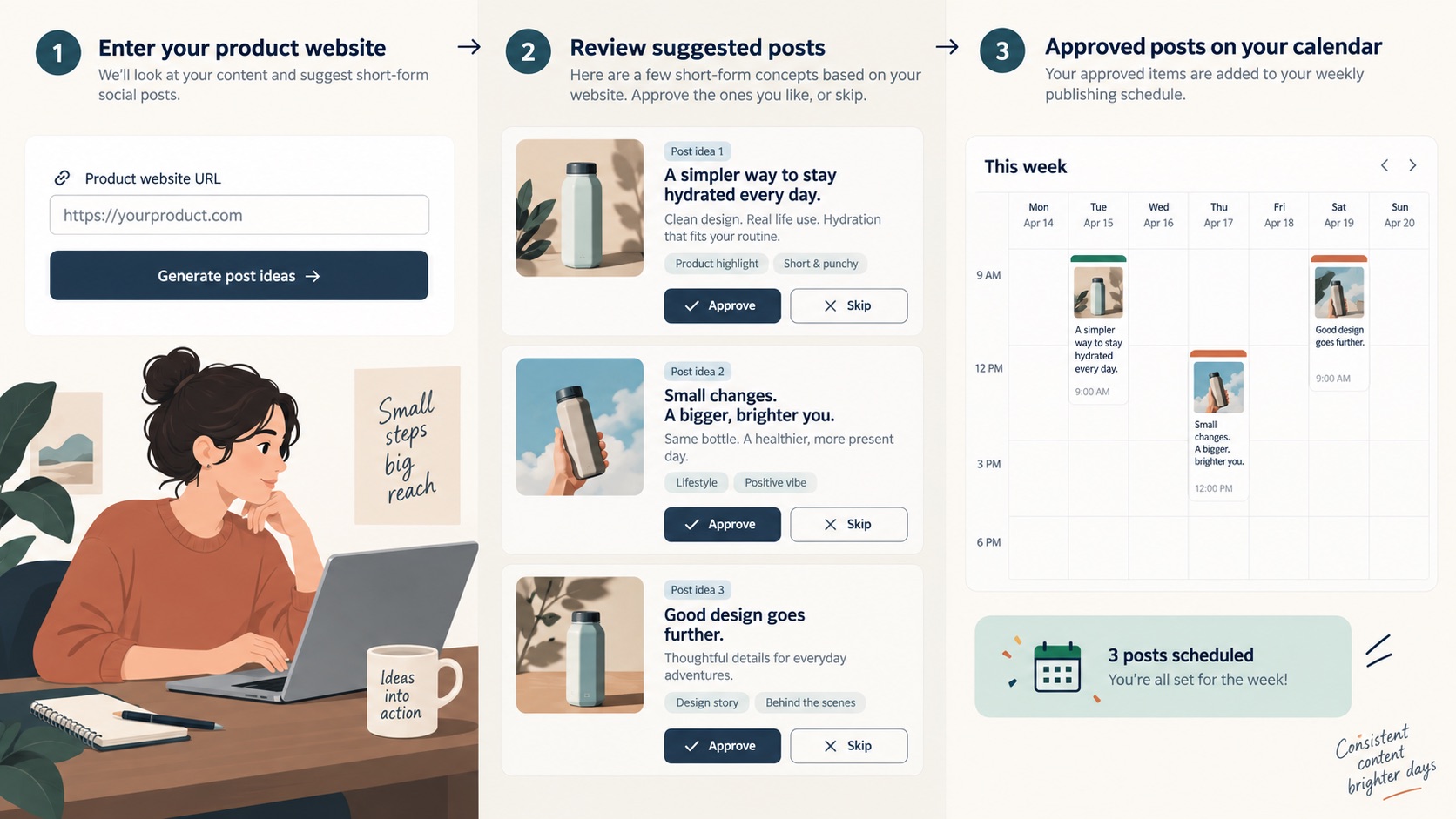
A founder says a new SaaS reached $69,000 in monthly recurring software revenue soon after launch. The tempting headline is speed. The more useful question is what the team learned before the version that grew. Fastlane's interview with Starter Story points to a less glamorous answer: the founders began with a broad AI-marketing tool, kept speaking with prospective customers, and ultimately concentrated on making short-form posts for small app and SaaS builders. The current Fastlane website shows a product that turns a customer's website and relevant trends into suggested social posts, lets a user approve or skip them, and schedules selected posts to social platforms. That product is narrower than the original idea described in the interview.
This case is useful if you are deciding whether to add more features to an AI product or to make one repeated job dramatically easier. It also shows how to read a fast-growth founder interview without confusing a video demonstration, a revenue claim, and durable business economics. The operating lesson is not “make 2,000 calls.” It is to connect a specific customer complaint to a product change, a usage measure, and a distribution experiment.
Watch for the transition from the original broad tool to the short-form workflow, the on-screen product demonstration, and the discussion of how the team categorized customer calls. The interview is the primary source for historical figures; it is not an independent audit.
What is actually supported
In the interview, founder Gaurav describes Fastlane as an AI short-form marketing tool for solopreneurs who build mobile apps or SaaS. He says it generated about $69,000 per month in recurring revenue from the software product and had more than 1,000 paying users when the interview was recorded. He also speaks of more than $1 million in annualized revenue across the whole business. Those are different measures. Multiplying $69,000 by 12 gives $828,000 in annualized software MRR, not more than $1 million; the broader claim evidently includes other business revenue or a different run-rate definition. The video shows a dashboard, but Oddig cannot inspect its underlying account, refunds, discounting, billing cohorts, or cash flow. Treat each figure as founder-reported.
The interview also contains a timeline that needs a date label. The founder says the public Fastlane launch was March 23, after a beta delivered to a roughly 2,000-person waitlist in December. The episode was published August 30 in YouTube's Pacific timestamp, while the narration calls the launch “just over two months” earlier. Recording may have taken place well before publication, but the recording date is not established in the video. We should not present “$69K in two months” as a calendar-verified outcome. What we can say is that the founder reports rapid growth after the public launch and that the product had a prior period of discovery, building, and beta testing.
| Interview claim | What the reader can use | What remains unknown |
|---|---|---|
| Approximately $69K monthly recurring software revenue | The offer had paying demand at the reported point in time | Net revenue, churn, refunds, payment fees, and independent verification |
| More than 1,000 paying users | There was a sizable reported paid base | Active use, plan mix, cohorts, and revenue concentration |
| Roughly 2,000 customer calls | The team invested heavily in direct research | Distinct people versus repeated calls, exact period, and sampling method |
| Product narrowed to short-form content | The visible workflow and current site support a focused offer | Whether narrowing alone caused revenue growth |
The call total deserves its own caution. The founder says the cofounders did “around 20 calls a week” and “2,000 customer calls” since discovery began. Twenty per week for one year is about 1,040 calls. The figures could reflect two calendars, multiple calls per person, an earlier start, or an imprecise recollection. The interview does not reconcile them. A founder building their own research practice should borrow the method, not the impressive-sounding total.
The job Fastlane found underneath “AI marketing”
n
n
The founder describes an earlier product that tried to cover search, AI-search visibility, Reddit engagement, and short-form content. It was an understandable bundle: small teams often have a general problem of getting attention. But a general problem does not create one clear interface, one onboarding path, or one success measure. A builder who signs up to “do marketing” may need help with a thousand different tasks. A builder who signs up to “get a relevant video posted this week” can judge progress almost immediately.
That distinction changes the product. Fastlane's current public page presents four linked actions: enter a product website, review generated content based on trends, schedule across social channels, and track performance. Its “Blitz Mode” is a swipe-style review queue. The interview's demo shows a trend example beside a proposed adaptation for the customer's product, followed by an approve-or-reject choice, captioning, and scheduling. These are verifiable product features, not proof that every suggested post produces results. Fastlane's current feature description is useful corroboration of the product shape.
This is a workflow compression story. A solo founder normally has to notice a relevant format, adapt it to the product, make media, write a caption, connect an account, publish, and learn what happened. Fastlane bundles much of that sequence. The buyer is not buying “AI content” in the abstract. They are buying relief from a repeated bottleneck between having an app and telling potential users about it.
There is a critical qualification: removing creation work does not remove strategic work. A post can collect views but fail to produce qualified traffic, sign-ups, or retained customers. A system that makes more content can also make more ineffective content. The relevant outcome for a customer is not the size of the content calendar; it is whether the new distribution activity creates valuable users at a tolerable cost.
The three kinds of conversations in the case
The founder groups the team's calls into discovery, usability, and customer-success conversations. That sequence is more useful than a blanket instruction to “talk to users,” because each kind of call asks a different question and should change a different decision.
Discovery: identify the expensive current workaround. The founder says the team asked prospective customers how they last handled a marketing problem, how much time or money it cost, and what happened if they did nothing. This avoids asking a person to grade a hypothetical app. The evidence to record is the exact workaround: for example, “we save trends in a spreadsheet, ask a contractor to remake one, and post only when we remember.” The product hypothesis should describe that observed job before proposing a feature.
Usability: watch the first attempt without coaching. In the beta period, the team says it invited people from a waitlist, sent them a product link, and watched screen-sharing sessions. The founder emphasizes not telling a participant which button to press. The useful output is a list of points where the participant expected a different next step, abandoned a task, or could not explain the result. Calling the interface “intuitive” after an internal demo is weak evidence; watching a new user move through it is stronger.
Customer success: find which use produces the promised outcome. The team says it tracked people using the platform heavily and spoke to them about results, including social views, conversions, and app installs. It organized notes and customer data in a separate internal dashboard. The founder also describes a “customer love” score, but the interview does not disclose the algorithm or prove that the score predicts retention. The practical method is simpler: compare users who say they urgently need marketing with those who merely explore the tool. If the urgent group activates, keeps publishing, and generates qualified visits while the curious group does not, onboarding and positioning should target the first group.
These three conversations form a loop, not a fixed sequence that ends after launch. A product can pass a usability test while failing to create a good business outcome. Conversely, a power user can get results despite a poor interface. Interviewing one group without checking the other can send the roadmap in the wrong direction.
A practical evidence system for a small team
Fastlane's founder says the team used an incentive for booking calls: extra access in exchange for time with the team. That probably increased the number of conversations, but an incentive can also bias the sample toward people who want freebies. If you use it, tag the origin of every participant and compare their behavior with non-incentivized customers.
You do not need an elaborate AI dashboard to test this method. Start with one row per call, and make the fields decision-oriented: customer segment; acquisition source; current workaround; last occasion of pain; cost of the problem; task attempted in the product; friction observed; first successful output; and result one week later. Store an exact paraphrase of what happened rather than an invented “insight” such as “users love convenience.” Link call notes to product behavior only with appropriate consent and data handling. The goal is to find patterns that can be challenged, not to create a bigger repository of anecdotes.
After ten to fifteen conversations within one clearly defined segment, write down a provisional pattern and a counterexample. Suppose eight builders say their hard part is producing the first post and two say approval speed is the problem. Build one small workflow around the first pattern; do not silently merge those problems. Ask a new set of users to attempt the workflow. Count whether they can create an acceptable post without founder assistance, whether they publish, and whether they return. Those thresholds are experiment choices, not industry benchmarks. If the first-run outcome does not improve, more interviews alone have not solved the design problem.
| Stage | Question | Observable evidence | Decision |
|---|---|---|---|
| Discovery | Which repeated marketing task costs this buyer time? | Specific recent example and current workaround | Choose a narrow job |
| Usability | Can a new buyer finish the task unaided? | Completed first post, time and confusion points | Simplify or repair the workflow |
| Activation | Does the first output go live? | Connected channel, approved post, successful publish | Improve onboarding or channel reliability |
| Value | Does posting attract the right people? | Attributed qualified visits, sign-ups, or installs | Continue, change creative, or change channel |
| Retention | Does the buyer repeat the workflow? | Publishing and payment by cohort | Decide whether the product solves a recurring job |
This table is an original Oddig analytical visual. It should be rendered as a readable responsive table or a compact five-step diagram on mobile, not as tiny text in a decorative image.
Acquisition and economics: where the interview stops
The interview mentions Reddit outreach, social lead magnets, a waitlist, and direct invitations to try the product. It does not provide a channel-by-channel customer acquisition cost, conversion rate, paid-ad spend, or cohort retention. The site now advertises multiple price tiers and additional managed accounts. Those are current public offers; the interview's reported revenue cannot be reverse-engineered reliably by applying today's prices to a reported subscriber total. A thousand customers could include discounted plans, annual prepayments, agency arrangements, churned accounts, and a shifting plan mix.
For a similar product, variable costs matter more than the headline MRR suggests. Generated video and images, model calls, storage, posting infrastructure, support, and occasional human review all increase with usage. An “unlimited” plan can have very different gross margins from a plan with explicit credits. A $49 customer who needs frequent expensive renders could be less attractive than a $29 customer who mostly reuses lightweight formats. The founder names infrastructure and model vendors in the interview, but not the invoices or cost per account. No profit claim follows from the $69,000 figure.
The customer also bears an economic test. Suppose a subscription costs $49 a month and saves four hours of work; for one builder, that may be compelling even before attributable new users. For another, if generated posts still require heavy editing and bring no relevant visitors, it is not. The decision should compare all-in time plus cash to a defined alternative: making content manually, hiring a creator, or not running short-form at all. Track the consequence that matters to the customer's business, not only outputs Fastlane can easily count.
What can break this model
The most obvious risk is that a recommendation engine optimizes for familiar viral formats rather than the customer's truthful product promise. A creator can produce a highly viewed post that draws the wrong audience. The second risk is platform dependence: social platforms change formats, API rules, reach, and policies. The third is commoditization. If generating plausible short videos becomes a default feature in several tools, the defensible value must shift to better relevance, easier decisions, reliable publishing, or measured results.
There is also a data risk in customer discovery. Centralizing recorded conversations and customer attributes can improve decisions, but it requires consent, access controls, retention limits, and a reason for collecting each field. A founder should not copy the practice of feeding all customer calls into an AI system without first checking privacy commitments and vendor terms. That is a boundary on the method, not a reason to stop learning from users.
Finally, avoid treating this example as a formula. The founder may have benefited from audience access, timing, creator relationships, launch attention, and execution details the episode does not quantify. Customer conversations helped reveal a strong product hypothesis. They do not, by themselves, explain the full revenue curve.
The decision to take from Fastlane
For a small team building in a crowded AI category, the first strategic question is not “Which model should we add?” Ask what task a buyer repeats each week, where the current workflow fails, and what observable result would make them come back. Then test the chain with one segment: problem interviews, uncoached first-use sessions, a published output, and a measurable business result. Keep failed cases visible in the log. If people praise the idea but do not complete the workflow, solve the first-use problem. If they publish but receive irrelevant attention, solve targeting or abandon the channel. If they get value once but never return, investigate whether the job is actually recurring.
Fastlane's strongest lesson is the discipline of making the feedback loop concrete. Its weakest transferable lesson would be to copy the headline, the swipe interface, or the claimed number of calls. Study the mechanism, test it against your own users, and insist on a measure that survives beyond a launch spike.
Sources & further reading
- Starter Story interview with Fastlane's founder, published August 30, 2026 in YouTube's Pacific timestamp. Interview claims and product demonstration are attributed above.
- Fastlane's public product page, accessed September 24, 2026. Used to corroborate current workflow and positioning, not the historical revenue figure.
Reporting note: The founder's recurring revenue, user count, waitlist size, and call count are self-reported. We found no independent financial statements, cohort data, or dated recording information in these sources.