Minute Cryptic did not begin as a polished game app with a large marketing budget. It began with one person explaining one difficult crossword clue at a time.
That simple start matters. The story is not really about crosswords. It is about what happens when a creator finds a subject people care about, makes it easier to enter, listens closely to the audience, and turns the next repeated request into a product.
The result was a path from short videos to a website, then an app, a membership, a community, and even books. It is a useful case for anyone building a tool, a learning product, or a content-led business.
A note on the numbers: the timeline and product story below are based on the supplied case study and Minute Cryptic’s public product pages. Third-party traffic and subscriber estimates should be treated as estimates, not audited business results.
The Problem Was Small, Passionate, and Hard to Enter
Cryptic crosswords are a familiar tradition in the UK, Australia, and other English-speaking markets. They are also intimidating for beginners.
In a regular crossword, a clue often points directly to a word. A cryptic clue is a puzzle in its own right. It may hide a word inside another phrase, use a sound-alike, rearrange letters, or rely on a double meaning. Before you can answer the clue, you have to understand the trick the setter is playing.
That makes cryptics feel like a small language. People who understand them can become deeply attached to them. People who do not understand them may give up before they solve a single clue.
This is the first important part of the story. The market looked niche, but the entry barrier was real. A difficult first step can be a weakness in a product category. It can also be an opening for someone who knows how to teach it.
First Came the Lessons, Not the Product
Angas Tiernan, a product and growth professional from Melbourne, learned to enjoy cryptic crosswords during the pandemic. He could see the same problem many beginners faced: the format was fun once you understood it, but no one was making the first few steps feel friendly.
So he started making short videos.
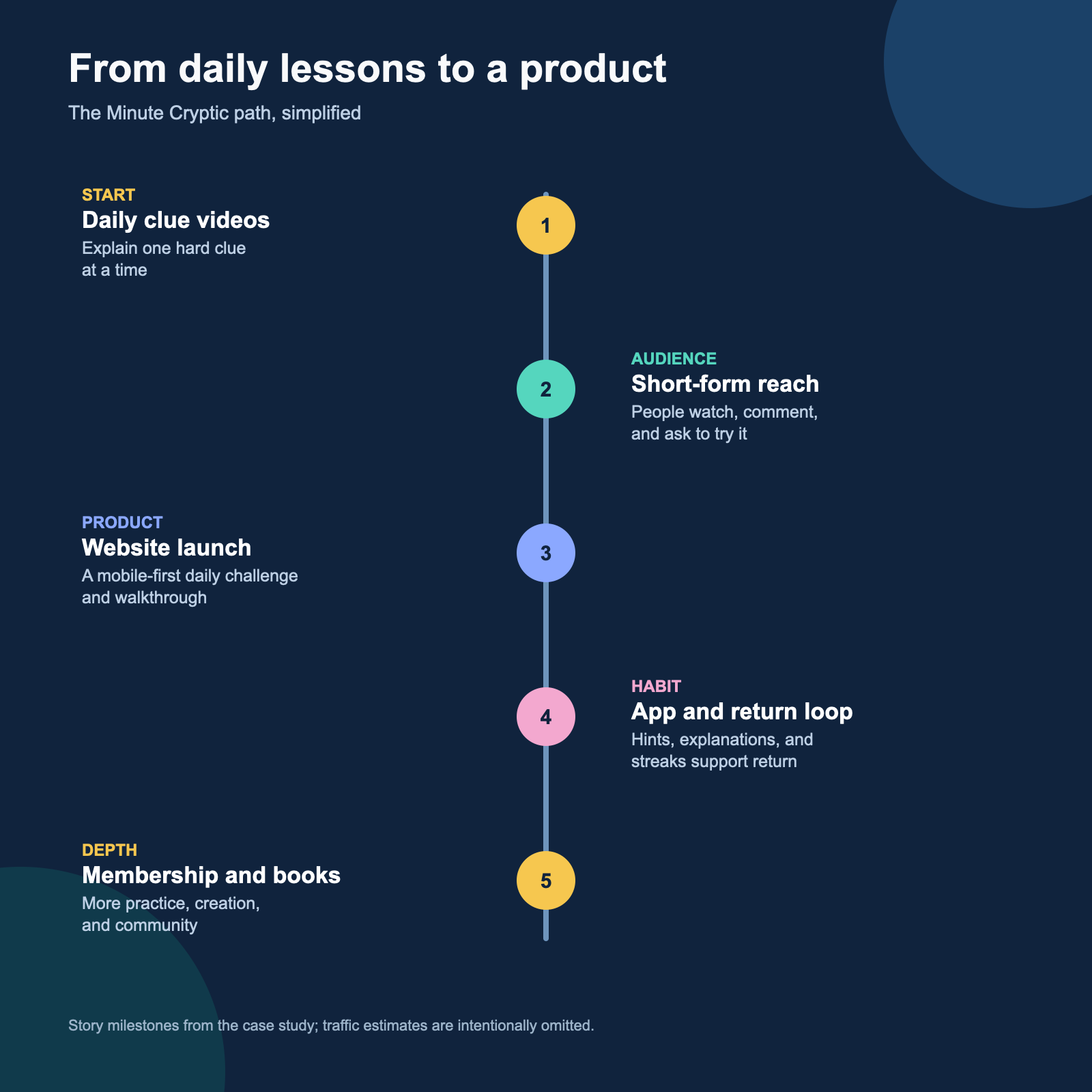
Each video focused on one clue. It did not try to teach a full theory of cryptic crossword construction. It walked through the clue, showed the wordplay, and made the answer feel possible.
The first attempts were ordinary. The supplied case study reports that he posted to YouTube every two days and gained only around 20 subscribers after several weeks. That was not a viral launch. It was still useful information: a small lesson format could exist, but the distribution channel was not right yet.
In April 2024, he moved the format to TikTok. The same small lesson became much easier to discover. The case study reports roughly 22,000 followers within two weeks, followed by rapid growth on Instagram as well. Within a few months, the project had built a large cross-platform audience around the simple habit of explaining one clue at a time.
The platform change was important, but the real advantage was the format. A newcomer could understand one tiny idea in under a minute. They did not need to become a crossword expert before enjoying the content.
What this part of the story teaches
Before building software, test whether you can make the problem understandable.
For some ideas, a search keyword is a poor first test. People may not know the name of the problem, or they may not know that a better way exists. A short lesson, example, or demo can do more than a landing page because it lets the audience experience the value before they are asked to sign up.
The useful signals were not only views. People watched repeatedly, asked questions, and wanted the next step. That is stronger evidence than a one-off viral post.
The Audience Asked for a Place to Play
The turning point came through feedback.
Viewers did not only want more explanations. They wanted to try the clues themselves. They wanted the lessons to become an experience.
That difference is easy to miss:
- A video answers: “Now I understand it.”
- A product answers: “Now I can do it myself.”
According to the case study, Tiernan registered the Minute Cryptic domain in May 2024 and worked with developer Madisyn Freeman. The first website launched about a month later.
It did not attempt to become a giant crossword platform. The first experience was narrow: play a daily clue and watch earlier explanation videos.
The site was also designed for the real discovery context. People were finding the project on phones through short video, so the product was mobile-first. On a desktop screen, the experience still appeared as a narrow, phone-shaped column. That was not an accident. It reflected the path a new user had just taken.
What this part of the story teaches
Treat repeated audience requests as product requirements.
Many early founders write a long list of features based on imagination. A better early roadmap starts with sentences people actually say:
| Audience request | User job | First product response |
|---|---|---|
| “Can I try one myself?” | I want to practice, not only watch | A playable daily challenge |
| “I am stuck.” | I need help without losing the learning moment | Hints and progressive reveals |
| “Where are the older lessons?” | I want to learn at my own pace | A searchable archive |
| “Can I make my own?” | I want to move from learner to creator | Simple creation and sharing tools |
The key is to build the smallest product response first. If people ask to practice, do not immediately build a community, a marketplace, and ten game modes. Make practice work well.
One Daily Action Became the Product’s Center
The first version was simple because the core action was simple:
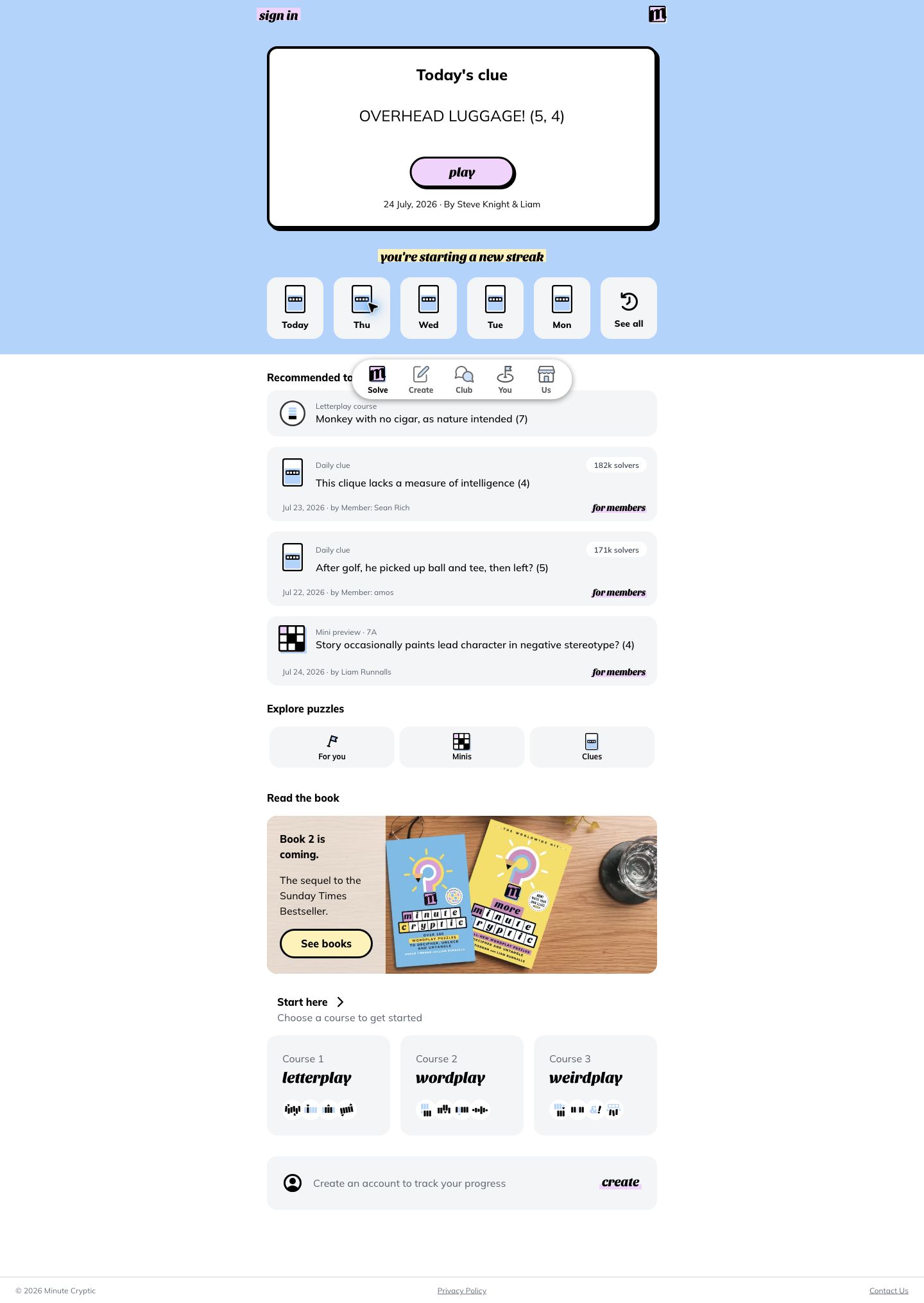
Come today. Solve one clue. Get help if you need it. See why the answer works. Come back tomorrow.
That is a powerful product loop. It takes only a few minutes, gives the user a visible finish line, and creates a natural reason to return.
After the web launch, the product grew around this same loop. The case study describes the addition of accounts, access to past clues, and an iOS app in late 2024, followed later by Android support. The current app still centers on one clue a day, adjustable hints, revealed letters, and a video explanation after the solve.
The product did not lose focus as it grew. The extra features were not random additions. They helped a new user begin, helped a stuck user continue, or helped a regular user return.
What this part of the story teaches
Do not begin with a heavy platform. Find one small action that is useful enough to repeat.
For another niche, that action could be:
- one language phrase practiced each day;
- one design exercise with feedback;
- one client note turned into a useful summary;
- one safety rule explained before an exam;
- one repetitive work task completed without a spreadsheet.
Ask four questions before you add features:
- What is the smallest useful action?
- Can a new user complete it on a phone?
- What happens when they get stuck?
- What makes the next visit feel worthwhile?
If you cannot answer those questions, the product is probably still too broad.
Membership Came From Depth, Not From Hiding the First Win
Once the daily loop had an audience, Minute Cryptic had a clearer path to paid value.
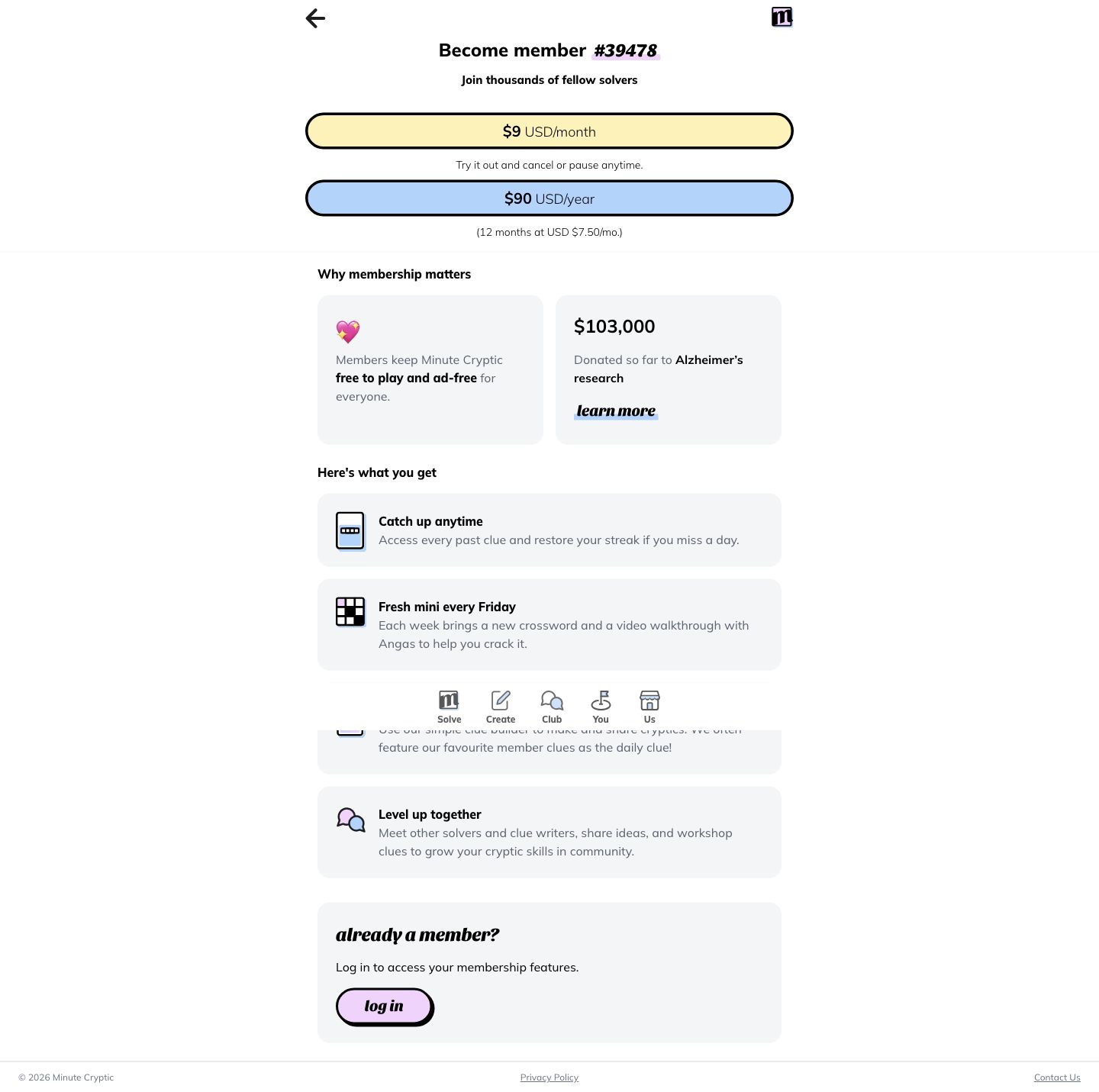
The public membership offer is built around going deeper: access to past clues, weekly mini crosswords, creation tools, and a place for solvers and clue writers to share ideas. The daily entry point remains free, so a new user can understand the product before deciding whether it deserves a subscription.
The case study reported around 4,000 subscribers by March 2025 at a monthly price of about $9. That figure should be read as a reported estimate, not a confirmed revenue total. What matters more is the product logic behind it.
Free use builds the habit. Membership serves the people who want more practice, more history, more progress, or a deeper role in the community.
This is a healthier subscription model than locking the first useful action behind a paywall. It asks users to pay for depth, not for permission to discover whether the product is useful.
What this part of the story teaches
Do not add a subscription because “software should have recurring revenue.” Add it when users show a repeated reason to go further.
Possible membership value includes:
- a complete archive;
- deeper practice modes;
- personal progress and history;
- advanced lessons;
- creation tools;
- expert feedback or a community;
- an ad-free experience.
If people visit once and leave, an archive will not fix the business. First make the core action valuable enough to bring them back.
The Brand Expanded Only After the Core Loop Worked
The original case study also shows how the project expanded beyond the website. The app raised the frequency of use. The membership created recurring value. Books gave the brand another format for people who wanted a more physical or structured way to learn and play.
That creates a simple business flywheel:
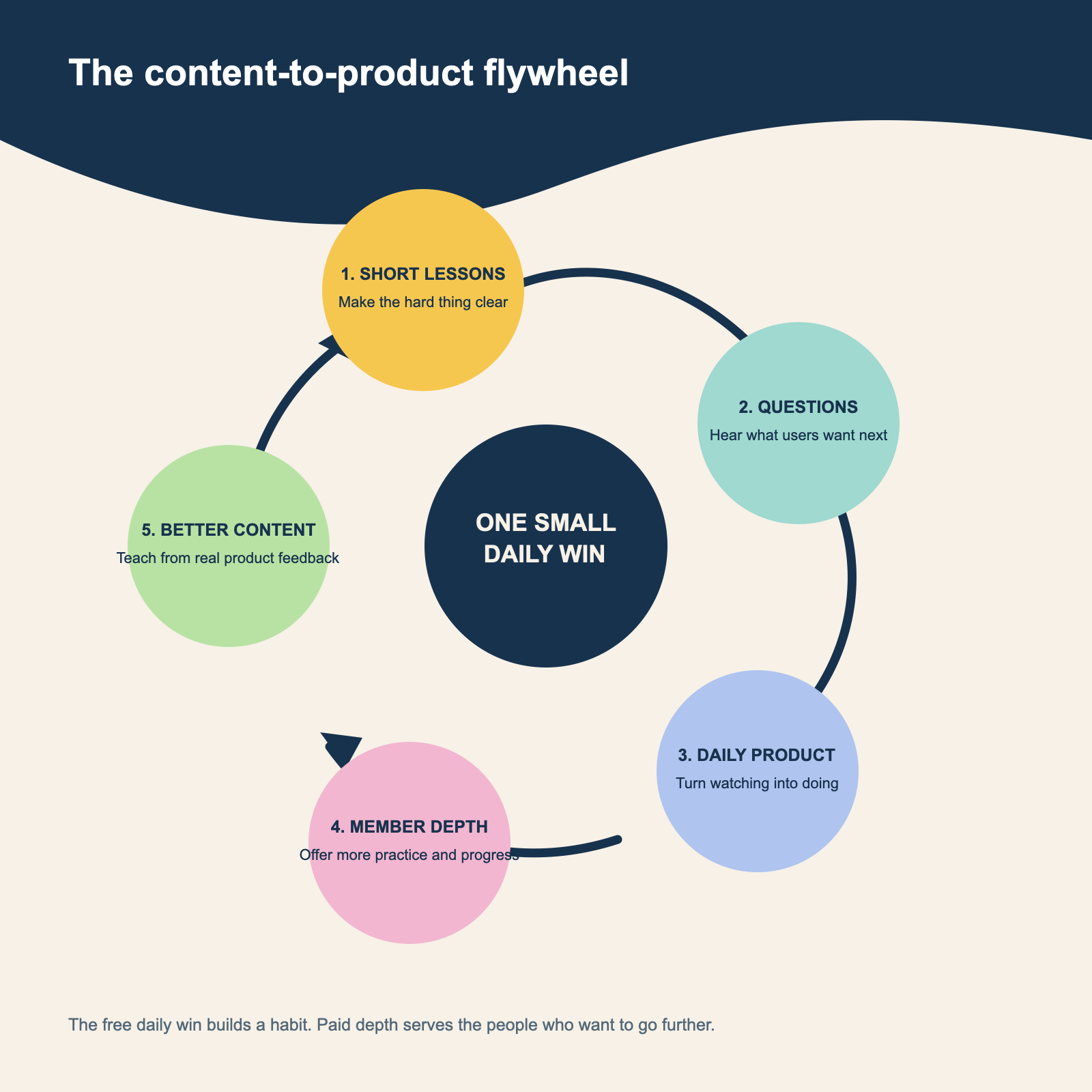
Notice the order. The book, app, community, and membership did not come first. Each layer was added after the earlier layer had a clear purpose.
This is why the story is more useful than a traffic screenshot. The traffic number may rise or fall, and third-party tools can be wrong. The sequence is the durable part:
- Teach a hard thing in a simple way.
- Notice what people ask to do next.
- Build one repeatable action around that request.
- Protect the habit.
- Offer depth to the people who want more.
How to Find a Similar Opportunity
You do not need to find another puzzle. Look for a subject with the same structure:
- It has rules, jargon, or a difficult first step.
- Some people already care deeply about it.
- One small example can be taught in public.
- Users can practice or complete a small task repeatedly.
- The journey can lead to a tool, a library, a course, a community, or a membership.
Possible areas include language learning, professional workflows, specialist software, design exercises, coding drills, exam preparation, industry terminology, and structured hobbies.
The opportunity is not “make a daily app.” The opportunity is to take something people find rewarding but difficult, make the entrance easier, and let their feedback show you what to build.
Run a 7-Day Signal Test Before You Build
You do not need a month to decide whether the idea deserves a small prototype. You need enough focused evidence to see whether people want to move from watching to doing.
- Day 1: Write one clear audience statement and seven tiny lessons that solve the same beginner problem.
- Days 2–5: Publish one short lesson each day. Reply to every useful comment and save the exact questions people ask.
- Day 6: Post a direct invitation to the next action: try a simple version, join a small test, or ask for a feature that would help them practice.
- Day 7: Review the evidence. If the same request appears repeatedly, write the smallest possible product response and show it to the people who asked.
You are not trying to prove that you have a subscription business in seven days. You are trying to prove one thing: a real group of people wants to take the next step.
Once you have that proof, use the next guide to decide whether the opportunity deserves a deeper commitment: 6 Steps to Validate a SaaS Idea Before You Build It.