
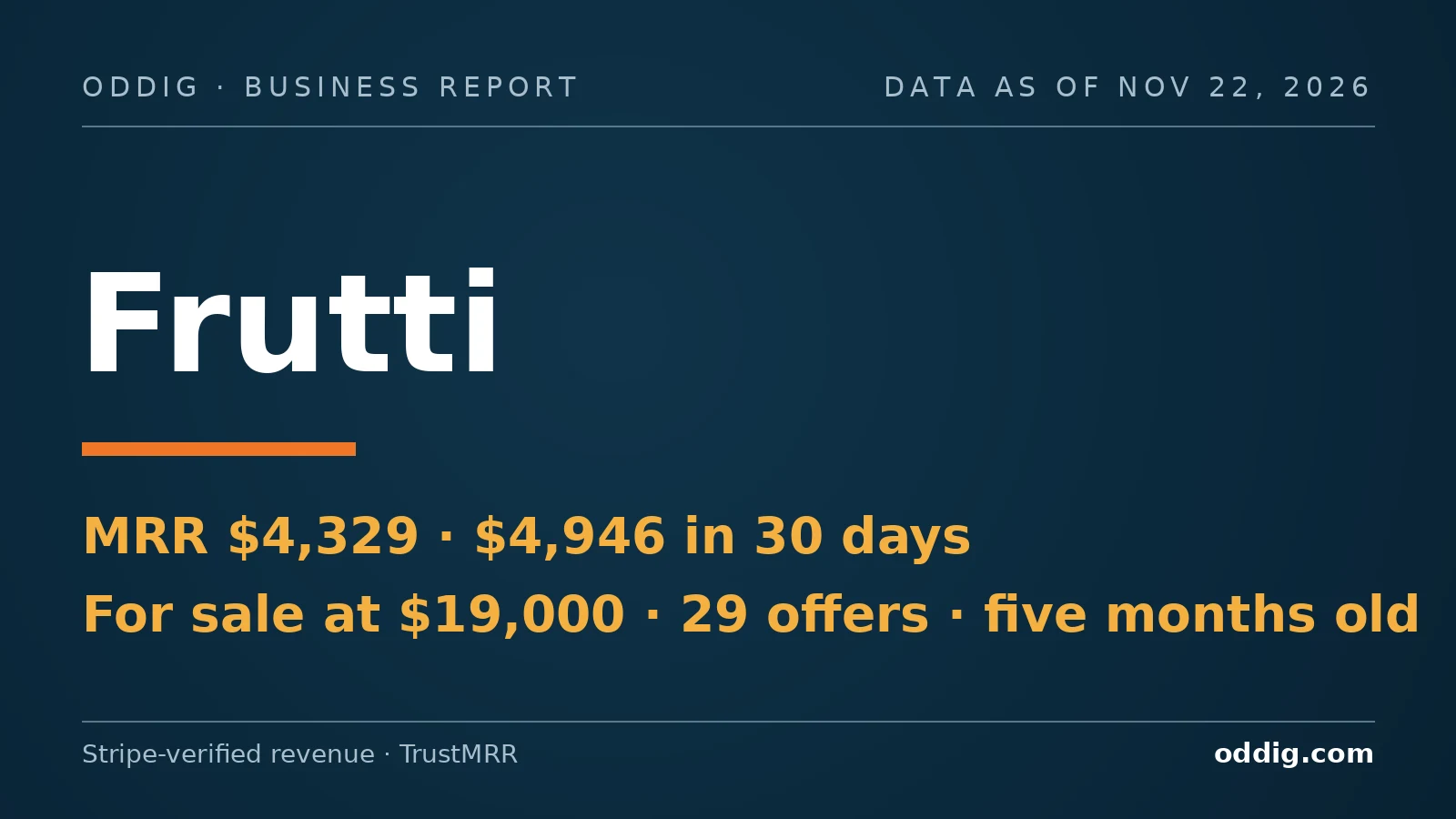

$19,000 buys it outright — an AI fruit-shorts generator doing $4,329 MRR, five months after launch
Frutti turns one line of text into a finished talking-fruit drama episode — script, voices, captions and render. Five months after launch it holds 219 subscriptions and $4,329 of MRR, and the founder has listed the whole business for $19,000, drawing 29 offers. This report reads the Stripe-verified record behind both numbers.
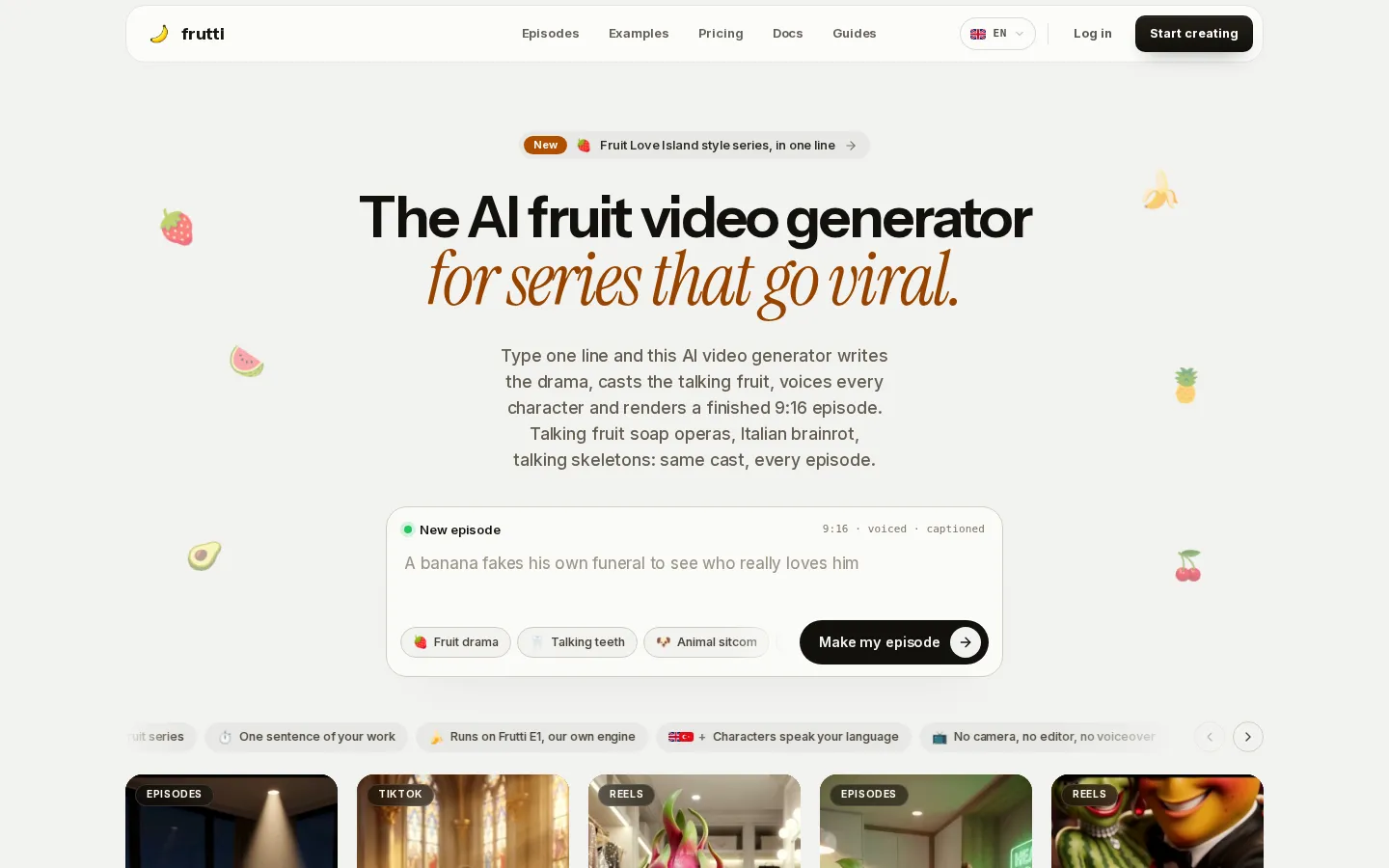
Product at a glance
Summary
What this business is
Frutti sells the current short-video meta as a product: type one line, get a finished talking-fruit soap episode. The Stripe-verified record is the whole life of the business — five monthly rows from $133 (Jul 2026) to a record $3,810 (Oct), summing to the $10,319 all-time total to the dollar, with November pacing past the record at roughly $4,290. MRR is $4,329 on 219 subscriptions. On Nov 5 the founder listed the business at $19,000 — 0.3× annualised revenue, about four months of takings — and drew 29 offers, the most contested listing in this series. The report that follows reads a very young, very clean record, and a price that values the seller’s attention elsewhere over the business’s own growth.
Why these scores? See the reasons in Key takeaways →
Momentum
New. The record holds four complete months — July through October — and every one grew: $133, $455, $2,633, $3,810. There is no earlier three-month window to compare against, so under the standard rule the momentum call is New rather than a growth label the data cannot yet support. The cross-checks agree with the direction if not the label: MRR is up 128.6% in 30 days and November is pacing past the October record.Fact
Best suited for
Buyer (main). Buys a five-month-old niche product at 0.3×: listing math, render-cost questions and the format-durability check that decides the deal.
Builder (second). How metering finished output (episodes) instead of software seats prices a creative tool — and how fast one format can carry a product.
What you need to start. A talking-character format that stays hot long enough to matter, render costs that stay under the credit price, and creators who post series rather than one-off clips.
Key findings
Product
Product overview
One line of text in, a finished fruit soap opera out.
Frutti sells the current short-video meta as a product: anthropomorphic fruit characters acting out soap-opera plots in vertical video — the talking-fruit format that fills TikTok and Shorts feeds. The customer types one line (“a banana fakes his own funeral to see who really loves him”), picks a genre — fruit drama, Italian brainrot, talking teeth, animal stories — and Frutti writes the script, casts consistent characters, voices every line, captions it and renders a finished 9:16 episode. Scripts and previews are free; only the render costs credits, so the meter runs on output, not on drafting.Fact
One line to a finished episode. The pipeline covers writing, casting, voice, captions and render in one pass — no timeline, no editing tools, nothing to assemble by hand.
A cast that persists. The same characters return every episode (“same cast, every episode” is the homepage promise), which is what turns one-off clips into a series viewers follow.
Two episode formats. A Standard episode runs about 60 seconds; a Long episode is three 15-second clips cut as one. The credit price differs — 1,200 vs 1,800 credits.
Series, not clips. The product is framed around recurring series — including a “Fruit Love Island” style template — because the format monetises through episode habit, not single videos.
Frutti is built for the faceless-creator economy: the buyers are not filmmakers but channel operators who need daily episodes in a format the platforms are already rewarding. Its narrowness is the strategy — one genre family, one output shape, one promise.Our read
How it compares
| Business | What it does | MRR or pricing | The difference |
|---|---|---|---|
| StoryShort | Faceless short-form story videos | Subscription | The closest direct rival: general story videos rather than a single character genre. |
| BigMotion | Faceless video automation for channels | Subscription | Broader automation across formats; Frutti bets everything on one viral niche. |
| Revid | AI short-form video maker | Subscription / credits | A general short-video workbench — more formats, less genre specialisation. |
| Frutti | Talking-fruit drama episodes from one line | $18–59/mo · credits per episode | The only one that is a single genre, end to end |
Competitor pricing is each vendor’s published model, read Nov 22, 2026; competitor revenue is not Stripe-verified here and is not quoted.
What the site looks like
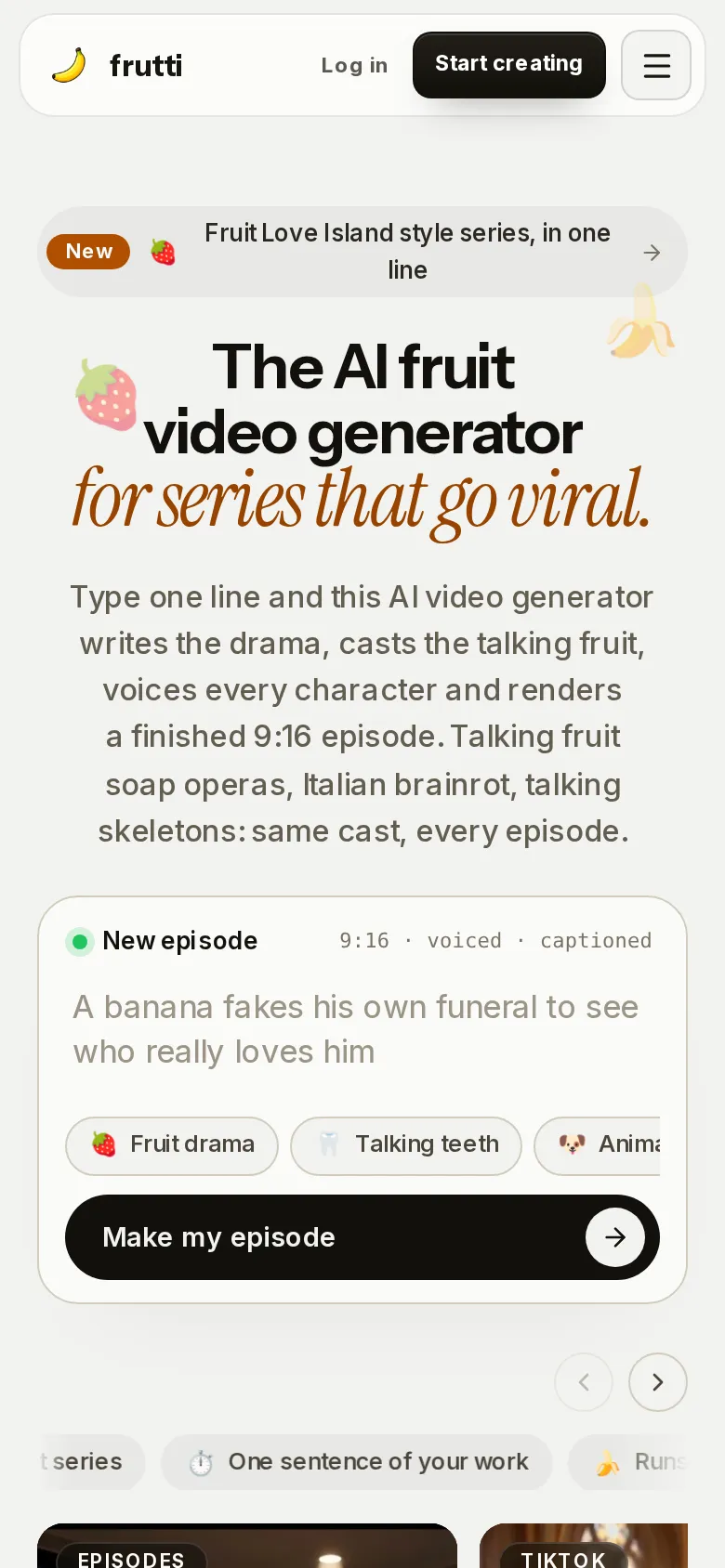
What to look for
- 1The hero is the product working: a prompt box (“A banana fakes his own funeral…”) with genre chips and a “Make my episode” button — the demo is the tool, not a video about it.Fact
- 2The promise is series, not clips: “same cast, every episode”, with a “Fruit Love Island” style template badged as new.Fact
What to look for
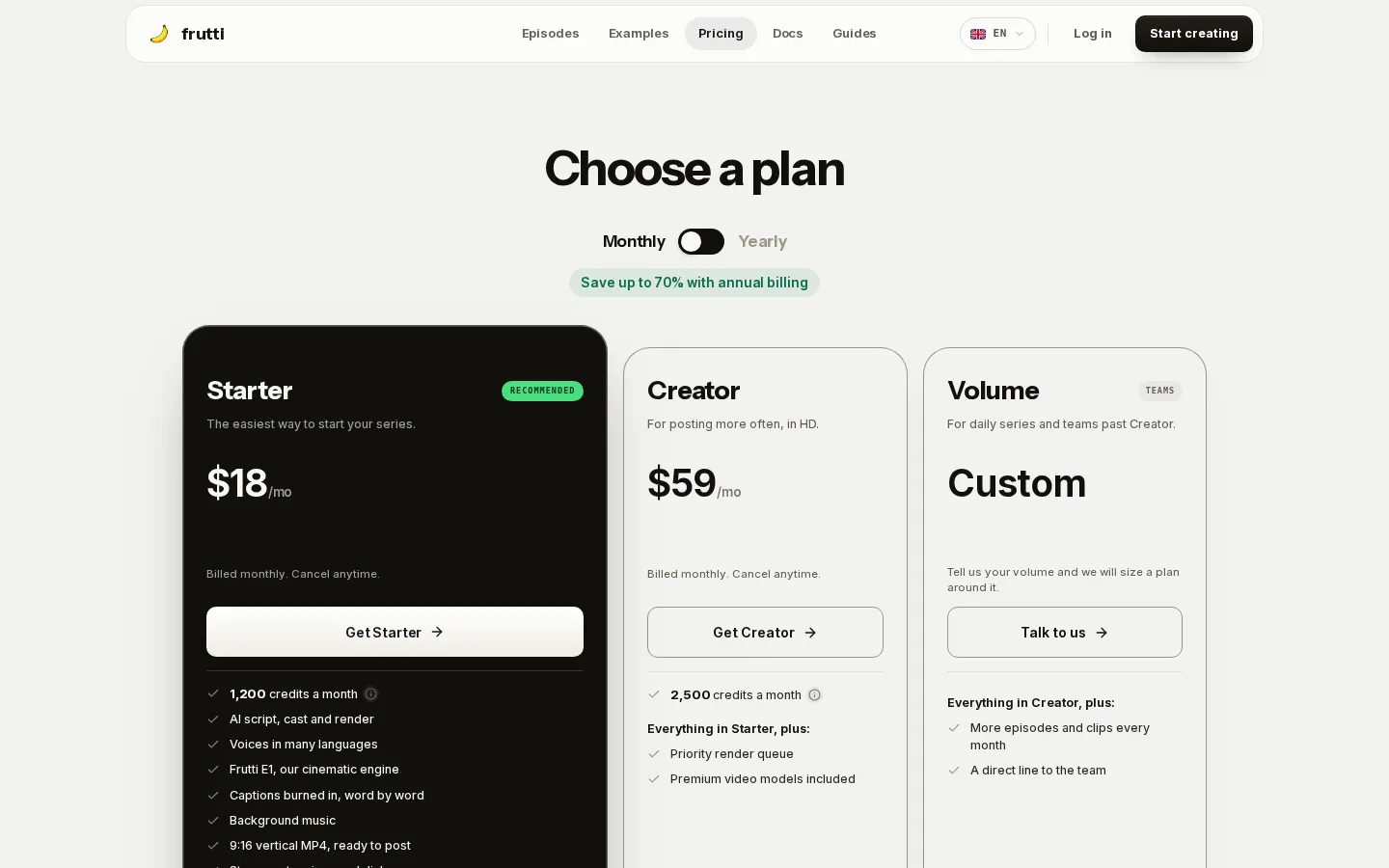
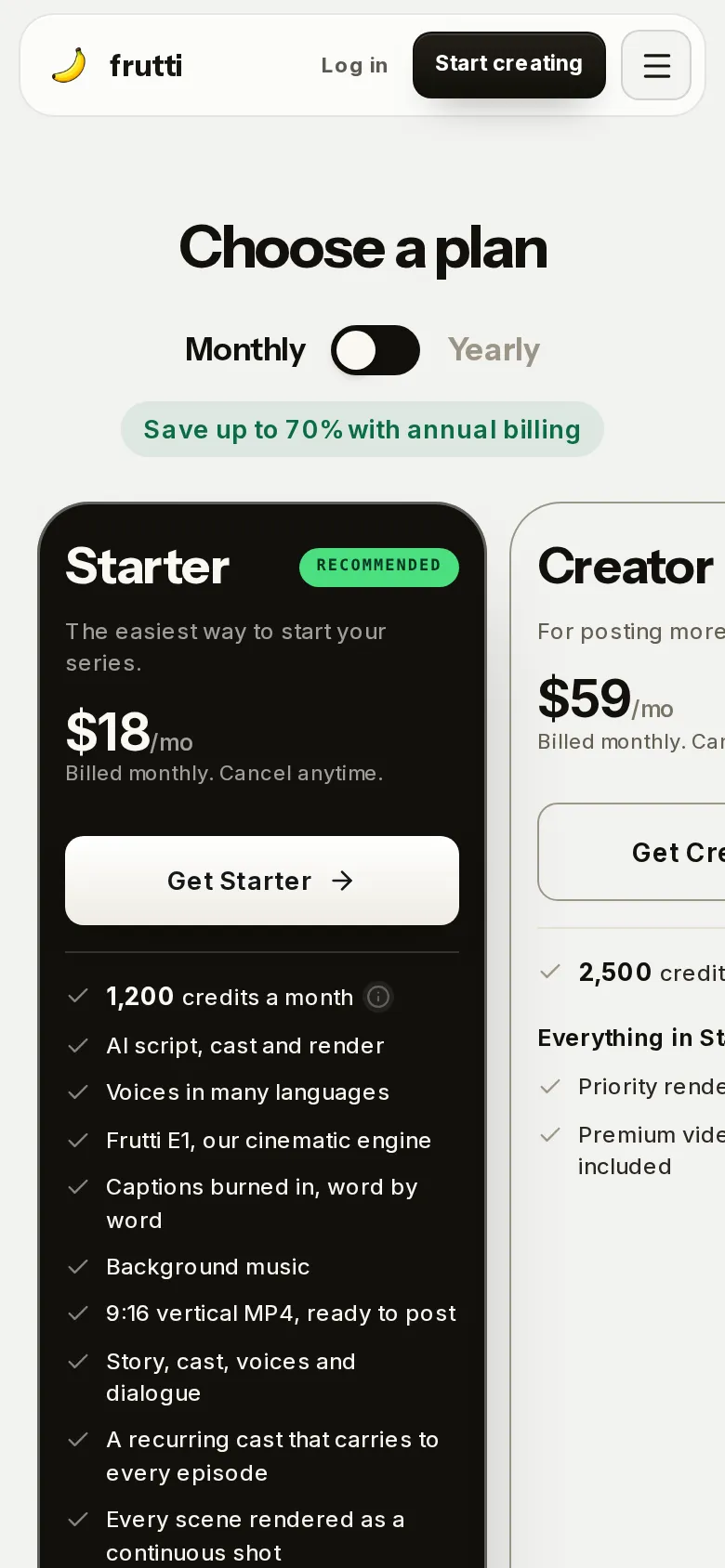
- 1Three tiers with the middle one badged “Recommended”: Starter $18, Creator $59, Volume custom — and the credit counts (1,200 / 2,500) translate directly into episodes.Fact
- 2The yearly toggle is the loudest element on the page: $7 and $18 a month against $18 and $59 — a 61–69% discount for paying a year ahead.Fact
Pricing
The meter is the episode.
| Plan | Price | What it covers |
|---|---|---|
| Starter | $18/mo · $7/mo yearly | 1,200 credits a month — one Standard episode (or most of a Long one); series and character tools included. |
| Creator | $59/mo · $18/mo yearly | 2,500 credits a month — about two Standard episodes; the tier for channels posting on a schedule. |
| Volume | Custom | Team pricing for high-volume producers; priced on contact. |
The meter is the episode. Scripts and previews are free, renders cost credits, and the credit sizes make the tiers legible: Starter buys roughly one finished episode a month, Creator about two. Per-episode, that is $18 on monthly Starter — or about $7 on the yearly plan, where the discount is steep (61% off) — and roughly $29.50 per episode on monthly Creator, about $9 yearly. The yearly discounts are aggressive enough to read as a land-grab: lock creators in for a year while the format is hot.Fact
The gap in the ladder is volume: a channel posting daily needs roughly 30 episodes a month, fifteen times the Creator allowance, and lands on the custom Volume tier. Whether that tier converts is invisible from outside — but it is where the real money in this niche would sit.Our read
Revenue
Revenue analysis
Five months, five rows, no gaps.
Daily revenue for the last 30 days (the partial sync day is excluded). Weekends are marked in blue; the best day in the window is dark navy.
| Reading | MRR | Active subscriptions | MRR per subscription |
|---|---|---|---|
| Nov 23, 2026 | $4,329 | 219 | $19.77 |
Daily revenue
Oct 27, 2026
Nov 1–23, partial month
daily rows summed, to Nov 22
monthly record opens Jul 2026
The shape of the record
The monthly shape is a launch curve with no flat month in it: $133 in July, $455 in August, $2,633 in September, a record $3,810 in October — and November, at $3,288 through the 23rd, is pacing at about $143 a day, which would make it the best month yet at roughly $4,290. Every month of the business’s life is visible, and the months sum to the all-time total to the dollar.Fact
Two cautions keep the curve honest. First, the base is tiny: October’s record is 29 times July’s revenue, so the growth rates (+66.1% revenue, +128.6% MRR in 30 days) describe a business still in its first doubling phase, not a proven trajectory. Second, the best single day — $420 on Oct 27 — is about 3.5 times the daily average, so individual viral episodes move the month. What is genuinely unusual is the completeness: no gaps, no stale sync, and a header that ties to the monthly table exactly.Fact
The subscription engine underneath is mid-priced for the category: 219 subscriptions at $19.77 average sits between the $18 Starter and $59 Creator tiers, which says most paying creators are on Starter or on discounted yearly Starter plans — the Creator tier is not yet carrying the mix.Our read
A note on the numbers
TrustMRR’s header snapshot reports $4,946 for the last 30 days; its daily rows, excluding the partial sync day, sum to $4,862. We use the daily sum for the 30-day figure and the index block, and the header only where labelled. The monthly timeline is canonical for every other figure and sums exactly to the $10,319 all-time total.[1]
Market
Faceless short video is a proven creator economy: channels built on AI-generated series — talking fruit, brainrot characters, story-time animals — pull millions of views with no camera and no cast. The tools market underneath it sells episodes the way stock libraries sell clips, and it is crowded with general generators (StoryShort, BigMotion, Revid and others). Frutti’s bet is that a single genre, productised completely — cast, voices, templates, series structure — beats a general tool for the operators inside that genre. The market’s risk is the genre itself: feed fashions rotate in quarters, not years.[3]
Timeline
- Jun 302026ProductTrustMRR records the founding date; revenue starts the following month. [1]
- Jul2026RevenueThe monthly record opens. [1]
- Sep2026RevenueA 5.8× month — the series format finds its audience. [1]
- Oct2026RevenueBest day Oct 27 at $420. [1]
- Nov 52026Revenue29 offers follow — the most contested listing in this batch. [1]
- Nov 232026RevenueMRR $4,329 on 219 subscriptions; November pacing ≈$4,290. [1]
Customers
Where customers come from
A TikTok-native product whose website mostly collects brand searches.
Panel opens in September (10,031 visits), then 10,685 in October — flat web traffic while revenue grew 45% month on month.
FactAlmost all brand: “frutti.ai” 32.5% of search visits, misspellings another third — people who saw a video and came looking.
FactApp and dashboard returns plus link-in-bio traffic from creator profiles.
FactWith Portugal third at 13.8% — a short-video creator geography, not a SaaS one.
FactOne top search term is a Spanish how-to — “como hacer los videos hay de frutas” (how to make those fruit videos) — the genre itself is the top of funnel.
Our readChannel shares and visit counts are SimilarWeb panel estimates for Aug–Oct 2026; the panel has no August row for frutti.ai, so totals cover Sep–Oct. Discovery on TikTok/Shorts does not appear in web panels at all — read the web numbers as the residue of platform discovery, not the discovery itself.[2]
Growth strategies
Two moves from the format-riding playbook.
For buyers
Frutti is listed for sale on TrustMRR at $19,000, listed Nov 5, 2026, with 29 offers from 1,405 viewers — the most contested listing in this batch. The seller says they need to focus on their main project.
Listed Nov 5, 2026
Ask ÷ annualised 30-day revenue
At $143/day through Nov 23
$19,000 against $10,319 ever earned
The multiple depends entirely on which month you annualise. Against the last 30 days the ask is 0.3× — about four months of revenue. Against the all-time total it is 1.8×: the buyer pays less than twice everything the business has ever taken. Against October, the best complete month, it is five months of revenue. All three framings say the same thing: this is priced as a quick exit, not as a going concern.Fact
This week’s other TrustMRR listings in this series
| Business | What it does | Best month | Latest full month | On sale |
|---|---|---|---|---|
| Frutti (this report) | AI fruit-drama video generator | Oct 2026 · $3,810 | Oct 2026 · $3,810 | $19,000 (0.3×) |
| Chart Scanner AI | AI chart-reading app | Oct 2026 · $1,826 | Oct 2026 · $1,826 | $35,000 (0.8×) |
| CaseTutor | AI voice tutor for case interviews | Jun 2026 · $3,028 | Oct 2026 · $1,850 | $100,000 (2.2×) |
Best month and latest complete month from each listing’s TrustMRR monthly table; multiples as displayed on TrustMRR.
The 29 offers are the market agreeing. Small, young, growing listings at sub-1× multiples are where first-time buyers hunt, and Frutti is the cheapest credible entry in the current TrustMRR listings we track — the next comparable asks in this set start at $35,000.Our read
What running it involves
| Area | What we can see | What a buyer must find out |
|---|---|---|
| Team | TrustMRR names no founder; the seller says they need to focus on their main project. | Who built it, who answers support today, and what handover is included — in writing. |
| Customers | 219 subscriptions at a $19.77 average across three tiers. | Concentration: the top 10 channels’ share of MRR, and churn by cohort since September. |
| Costs | Every episode is a paid AI video render; credit prices are public, render costs are not. | Cost per Standard and Long episode at current model prices, and gross margin by tier. |
| Growth engine | Discovery inside TikTok/Shorts feeds; web traffic is brand-led (20,715 visits, Sep–Oct). | Which channels and templates drive subscriptions — and whether any audience asset (accounts, followers) transfers. |
| Product | One-line-to-episode pipeline with persistent characters and genre templates. | Ownership of characters, templates and any trained assets, and the model providers’ terms. |
Public data cannot show render costs, churn, plan mix or subscriber concentration. None of those are knowable from this page — they are the diligence list below.
Where a new owner could take it
The obvious levers are mix and catalogue: move Starter users to Creator (more episodes per month is the natural upgrade path for a series that works), and keep adding genre templates while the talking-character meta is hot. The risk is symmetric — the same fashion cycle that built $4,329 of MRR in five months can strand it, which is presumably part of why the price is what it is.Our read
Questions to ask the seller
| # | Ask | Why it matters |
|---|---|---|
| 1 | What does one Standard episode cost to render at current model prices? | Gross margin per tier decides whether 219 subscriptions are an asset or a liability. |
| 2 | What share of MRR comes from the top 10 channels? | A genre tool can be one whale deep; concentration sets the real churn risk. |
| 3 | Churn and month-2 retention for the September cohort? | The first big cohort is the first honest retention read. |
| 4 | Are characters, templates and trained assets fully owned and transferable? | The catalogue is the product; unclear ownership voids the deal logic. |
| 5 | Why sell at 0.3× five months in? | What the main project competes for — time or render budget — tells the buyer what they are really replacing. |
Our list, built from what the public data cannot show.
This is information for due diligence, not investment advice. Oddig has no relationship with the seller or TrustMRR and receives nothing from any sale.
Takeaways
A five-month-old business that is simultaneously a growth story and an exit. The numbers are the cleanest in this series; the question they cannot answer is how long a fruit-drama format lives.
Why we scored it this way
Copy
- Price the output, not the tool. Frutti meters finished episodes and gives the drafting away — customers pay for the thing they publish.
- Ride one format completely. One genre, one output shape, one promise took it from $0 to $4,329 MRR in five months.
Avoid
- Mistaking a fashion for a moat. The same genre cycle that built this can strand it; the founder’s exit price already reflects that.
- Do not read +128.6% MRR growth on a five-month-old business as a trajectory — it is a launch curve, and the seller’s 0.3× ask is the more honest signal.
Predictions
Our predictions
Three dated calls, all checkable on TrustMRR.
Track record: the predictions in our earlier reports are still open; the first checks land Dec 1, 2026. We mark each prediction right or wrong on its date and keep the result on the page.
What could prove us wrong
Things that would change our read, and how to check them.
- This read is wrong if the fruit-drama format is a durable genre rather than a fashion cycle — if talking-character series hold audience for years the way some animation formats have, then Frutti is not a quick flip but the early leader of a category, and $19,000 will look absurd in hindsight.Our readCheck: if talking-fruit series are still charting in mid-2027 and Frutti’s MRR has compounded past $15K, the fashion reading was wrong.
- It is also wrong if the render economics are worse than the pricing implies: if each episode costs close to its credit price to generate, the 219 subscriptions are a liability dressed as revenue, and even 0.3× is generous. We cannot see model costs from outside.Our readCheck: ask for render cost per episode in diligence; if gross margin per Creator subscription is under 30%, the liability reading is the right one.
Appendix
Frequently asked
What does Frutti do?
It generates finished talking-fruit drama episodes for TikTok, Shorts and Reels from a one-line prompt: script, characters, voices, captions and render in one pass.
How much money does Frutti make?
MRR is $4,329 on 219 subscriptions as of Nov 23, 2026. The last 30 days brought $4,946 by the header figure, and all-time revenue is $10,319 — the whole five months of the business.
Why is Frutti for sale at only $19,000?
The seller says they need to focus on their main project. At 0.3× annualised revenue the price values the seller’s attention, not the earnings — and it has drawn 29 offers.
Is Frutti growing?
Yes, from a tiny base: revenue rose every month from $133 in July to $3,810 in October 2026, and November is pacing higher. The business is five months old, so there is no long record to judge durability by.
Sources
- [1]Frutti on TrustMRR — Stripe-verified revenue, MRR, subscriptions and the for-sale listing (asking price, offers, listed date), accessed Nov 22, 2026. All revenue figures in this report come from this record unless marked otherwise.
- [2]Frutti — product description, episode formats, genre templates and pricing tiers as published by the vendor, read Nov 22, 2026. Credit-per-episode figures are the vendor’s.
- [3]SimilarWeb — traffic panel for frutti.ai, Aug–Oct 2026: visits, channel shares, countries and search terms are panel estimates, not server logs.
What we could not include: no customer-voice section — Frutti sells through short-video platforms and no independent review pool exists. Render costs, churn and subscriber concentration are not public.
Screenshots © Frutti, used for commentary. Oddig has no business relationship with Frutti. Numbers change daily; check the sources for the latest.
More reports to read

 Url2PinCreator tool · SubscriptionPinterest is the shop window and links are the stock: Url2Pin turns other people's pages into $2,230 MRRRevenue · 30 days$3,541MRR$2,230 SteadyFor sale
 PDF VaultCreator tool · Mostly one-timePDF Vault: $10,412 in 30 days — can the license-drop model keep working?Revenue · 30 days$10,412MRR$2,322 DecliningFor sale
 Vid.AICreator tool · SubscriptionVid.AI makes $51,332 a month generating faceless videos — down from $89,846 at its January peak, and for sale at $1.5MRevenue · 30 days$39,697MRR$51,332 MixedFor sale

 White Glove ContentCreator tool · SubscriptionWhite Glove Content makes $59,391 a month producing faceless videos for other people — and listed itself for sale at $2.5M before its first birthdayRevenue · 30 days$58,961MRR$59,391 DecliningFor sale
 LunchbreakCreator tool · SubscriptionLunchbreak makes $30,743 a month humanizing AI text — and has been for sale at $1.5 million since its peak monthRevenue · 30 days$34,854MRR$30,743 Rising fast

 BazzlyCreator tool · SubscriptionBazzly makes $40,204 a month putting Reddit marketing on autopilot — after a year of nearly nothingRevenue · 30 days$48,241MRR$40,204


Comments are closed for this article.