
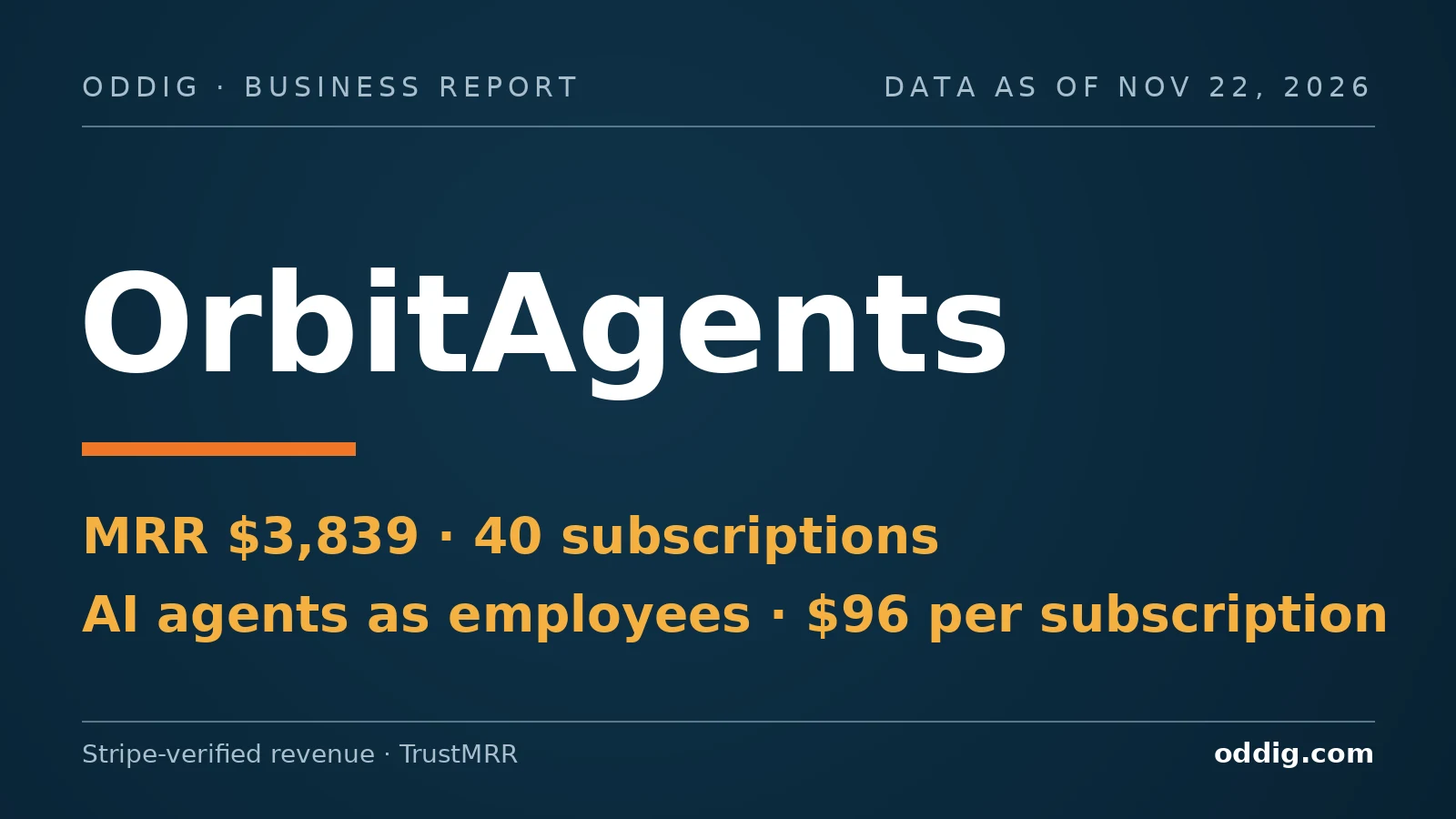

Forty subscriptions, $3,839 MRR — a very small room with a very high cover charge
OrbitAgents sells AI agents as employees: hire them, give them tools, and let them run lead generation, outreach, content and inbox work. Five months after founding it has only 40 subscriptions — but at $95.97 each they add up to $3,839 of MRR, on the lumpiest daily revenue record in this batch. This report reads what the verified numbers can and cannot say about a business this concentrated.
Product at a glance
Summary
What this business is
OrbitAgents sells AI agents as employees: hire them, connect your tools, and let them work the go-to-market surface — leads, outreach, content, meetings. The Stripe-verified record is four monthly rows: $983 in Aug 2026, a dip to $848 in September, then $2,750 in October, with November already past October at $2,887 by the 22nd. MRR is $3,839 — from only 40 subscriptions, a $95.97 average that reflects credit sliders running to $1,999 and a $749 partnership tier. The daily record is the story: Nov 3 ($1,006) and Nov 5 ($961) together make 49% of November’s revenue, and nine of the last 30 days recorded $0. This is high-ticket, concentrated revenue wearing an MRR label — promising, and not yet proven recurring.
Why these scores? See the reasons in Key takeaways →
Momentum
New. Three complete months (Aug–Oct) is below the four-month minimum for a momentum label, so the call is New. The direction is not in doubt — October was 3.2× September, November has already passed October, and MRR is up 42.1% in 30 days — but a label earned on three months, two of which contain most of the revenue in a handful of days, would say more than the record knows.Fact
Best suited for
Builder (main). How headcount pricing (agent caps per tier) and self-demonstrating marketing work in the agent category — the two moves worth studying here.
Operator (second). Anyone evaluating agent-GTM tools: what 40 subscriptions at $96 actually buys, and where the lumpiness comes from.
What you need to start. Platforms that keep tolerating agent activity on LinkedIn, X and email, and buyers willing to supervise agents working in their name.
Key findings
Product
Product overview
Agents hired like employees, aimed at go-to-market work.
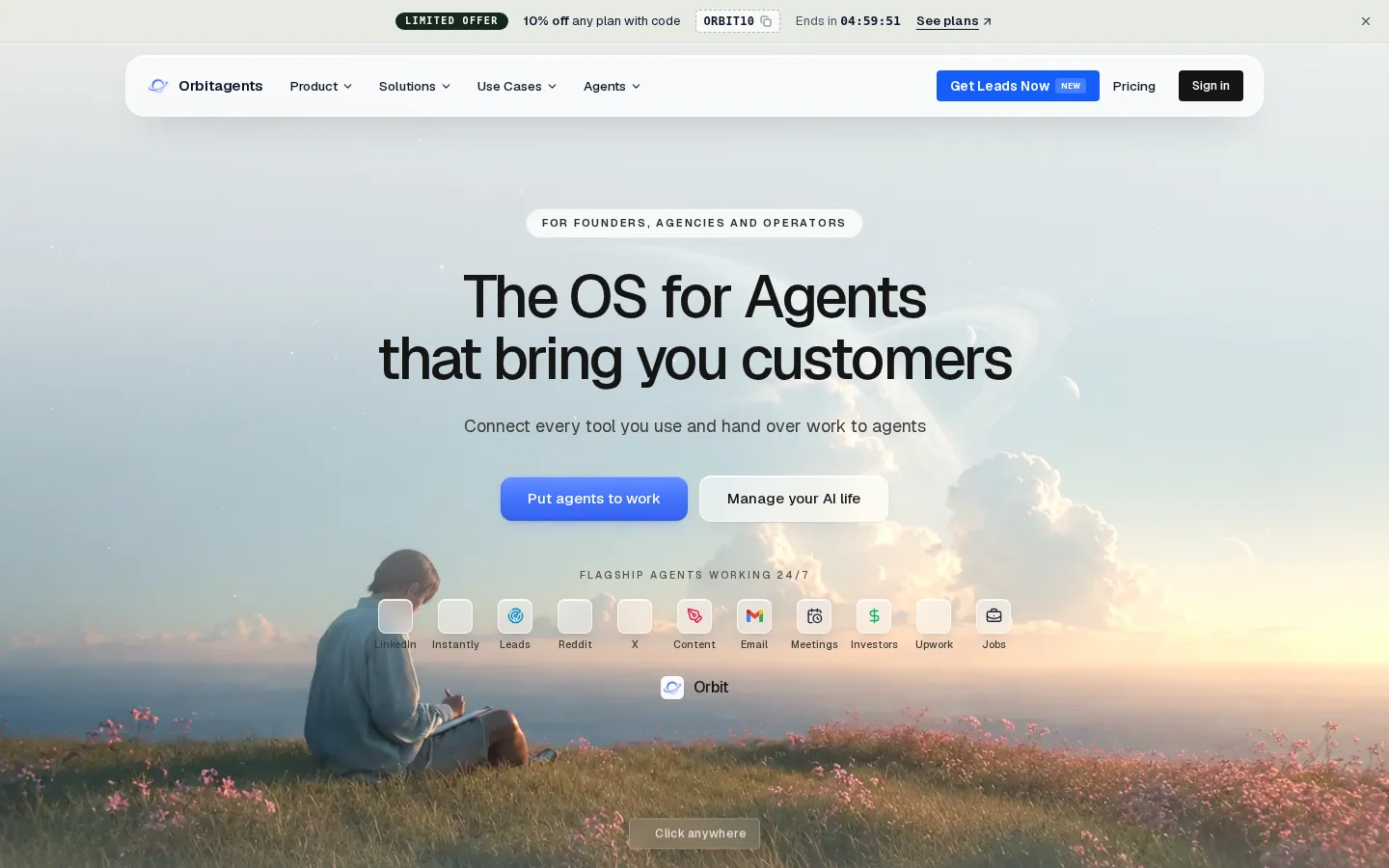
OrbitAgents calls itself “the OS for agents that bring you customers”. The customer connects the tools they already use — the site claims 200+ apps — and puts agents to work across the go-to-market surface: LinkedIn, Instantly, lead sourcing, Reddit, X, content, email, meetings, investor outreach, Upwork and jobs (the flagship row on the homepage). Agents run continuously, report to a dashboard, and are framed throughout as staff: you hire them, manage them, and cap how many you run per plan.Fact
A workforce metaphor, end to end. Plans limit how many agents you can run (3 on Free, 10 on Pro, unlimited on Agency) — headcount as a pricing dimension.
GTM is the whole catalogue. Every flagship agent works a growth surface — leads, outreach, content, meetings — rather than general productivity.
Credits as the meter. Work is billed in credits (a lead lookup, an email, a content piece each cost credits), and plan prices scale on sliders with credit volume.
Done-with-you at the top. The $749/mo GTM Partnership adds priority support, custom agents and training — a service layer on top of the software.
The vendor’s own case studies are the sharpest description of the target buyer: the founder’s personal-brand operation (a claimed 1.7M views), a faceless YouTube channel run by agents, a newsletter grown by agent outreach. Solopreneurs and small agencies who want a growth team they do not have to hire — those claims are the vendor’s, presented on its site, and are not verified here.Fact
How it compares
| Business | What it does | MRR or pricing | The difference |
|---|---|---|---|
| Clay | GTM data and enrichment workflows | Credit-based subscription | Data-first: sells the enrichment layer; OrbitAgents sells the workers on top of the whole stack. |
| Lindy | General-purpose AI employees | Subscription | Horizontal agent workforce; OrbitAgents is narrower — GTM only. |
| Relevance AI | AI workforce builder for teams | Subscription | Build-your-own agents for operations teams; OrbitAgents ships pre-built GTM roles. |
| OrbitAgents | Pre-built GTM agents managed like staff | From $29/mo · sliders to $1,999 | The only one selling the workforce, not the workflow |
Competitor pricing is each vendor’s published model, read Nov 22, 2026; competitor revenue is not Stripe-verified here and is not quoted.
What the site looks like


What to look for
- 1The hero sells staff, not software: “The OS for Agents that bring you customers” over a flagship row of eleven working surfaces — LinkedIn, Instantly, Leads, Reddit, X, Content, Email, Meetings, Investors, Upwork, Jobs.Fact
- 2A 10%-off code (ORBIT10) runs in a banner with a live countdown — discount-led growth posture on a five-month-old business.Fact
What to look for
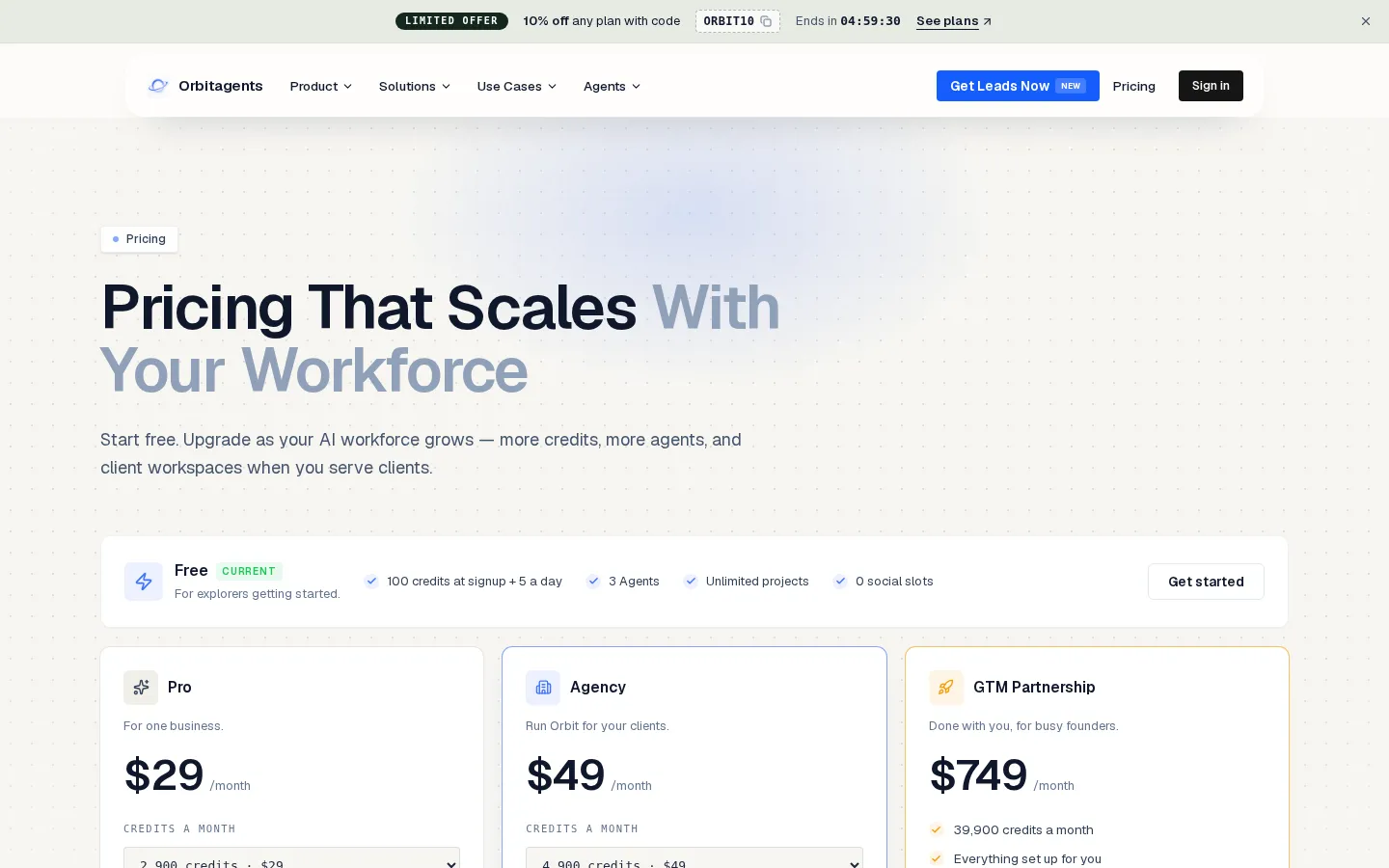
- 1Four tiers — Free, Pro $29, Agency $49, GTM Partnership $749 — with credit sliders on the middle two: Pro runs to $800 at 90,000 credits, Agency to $1,999 at 236,000.Fact
- 2Agent headcount is a pricing dimension: 3 agents on Free, 10 on Pro, unlimited on Agency — the plans read like staffing levels.Fact
Pricing
Headcount and credits, priced on sliders.
| Plan | Price | What it covers |
|---|---|---|
| Free | $0 | 100 credits at signup plus 5 a day; up to 3 agents, unlimited integrations, 2 seats. |
| Pro | from $29/mo | Credit-scaled: 2,900 credits at $29 up to 90,000 at $800. Up to 10 agents, 5 seats, analytics and A/B testing. |
| Agency | from $49/mo | Credit-scaled: 4,900 credits at $49 up to 236,000 at $1,999. Unlimited agents, 10 seats, unlimited sub-accounts. |
| GTM Partnership | $749/mo | 39,900 credits, unlimited agents and sub-accounts, priority support, custom agents and training — the done-with-you tier. |
A correction this report has to make plainly: TrustMRR’s profile still lists OrbitAgents’ older pricing — $8 / $24 / $39 / $129 tiers and a $299 partner plan. The live pricing page, read Nov 22, 2026, shows the ladder in the table above — entry paid pricing roughly 3–4 times higher, with credit-volume sliders on both self-serve tiers. Anyone screening this business from the profile alone would misprice it.Fact
The structure explains the revenue shape. Sliders that run to $800 and $1,999 a month, plus a $749 partnership, mean the 40 subscriptions are not 40 copies of one plan — they are a spread from $29 tinkerers to four-figure operators, and the $96 average hides the spread. A 10%-off code (ORBIT10) was running site-wide at capture — discounting at the top of a five-month-old business is a growth posture, not a margin one.Our read
Revenue
Revenue analysis
A small base with very large days.
Daily revenue for the last 30 days (the partial sync day is excluded). Weekends are marked in blue; the best day in the window is dark navy.
| Reading | MRR | Active subscriptions | MRR per subscription |
|---|---|---|---|
| Nov 22, 2026 | $3,839 | 40 | $95.97 |
Daily revenue
Nov 3, 2026
Nov 1–22, partial month
daily rows summed, to Nov 22
monthly record opens Aug 2026
The shape of the record
The monthly record is four rows: $983 in August, a dip to $848 in September, then $2,750 in October — and November, at $2,887 through the 22nd, has already passed October with eight days to spare. On pace (about $131 a day) November lands near $3,900. Every growth figure on the page (+83.3% revenue, +42.1% MRR in 30 days) is real, and all of it rests on three complete months.Fact
The daily record is where this business shows its shape. November’s two biggest days — $1,006 on the 3rd and $961 on the 5th — together are 49% of the month’s revenue to date, and nine of the last 30 days recorded $0. That is not the texture of 40 subscriptions renewing smoothly; it is the texture of a few large payments — annual plans, partnership fees, project-style charges — landing on single days. With 40 subscriptions at a $96 average, a handful of $749 Partnership payments explains the spikes on its own.Fact
Read the MRR, then, as the floor rather than the business: $3,839 recurs; the rest of the $4,020 the last 30 days actually brought in arrives in lumps whose repeatability is the open question. Nothing in the record contradicts the growth — but three months and 40 customers cannot yet prove it is a subscription business rather than a productised service with a subscription component.Our read
A note on the numbers
TrustMRR’s header snapshot reports $4,044 for the last 30 days; its daily rows, excluding the partial sync day, sum to $4,020. We use the daily sum for the 30-day figure and the index block. The monthly rows sum to $7,468 against a $7,467 all-time total — a $1 rounding difference. Separately: the pricing summary on the TrustMRR profile is outdated (see the pricing chapter).[1]
Market
AI-for-GTM is one of the most contested corners of SaaS: enrichment (Clay), outbound sequencers, agent platforms (Lindy, Relevance AI) and a long tail of point agents all compete for the same operator budget. The category’s promise — growth work without headcount — is aimed at the solo and micro-agency segment that has grown fastest since 2024. Its structural risks are equally clear: the surfaces agents work (LinkedIn, X, email) police automation, and deliverability punishes volume. OrbitAgents’ differentiation is scope and framing — the whole GTM surface, sold as staff — rather than a single superior workflow.[3]
Timeline
- Jun 292026ProductTrustMRR records the founding date. [1]
- Aug2026RevenueThe monthly record opens. [1]
- Sep2026RevenueThe only down month on the record. [1]
- Oct2026RevenueThe step-change month. [1]
- Nov 32026RevenueA quarter of the 30-day revenue in one day; Nov 5 adds $961. [1]
- Nov 222026RevenueMRR $3,839 on 40 subscriptions; November already past October at $2,887. [1]
Customers
Where customers come from
No panel data — and at 40 subscriptions, that is almost the point.
SimilarWeb returns no data at all for orbitagents.com in Aug–Oct 2026 — below the panel’s floor, so this chapter describes the visible surface instead of splits.
FactThe founder (Blumi, 607 X followers on the TrustMRR profile) runs their own personal-brand GTM with the product — the case study and the channel are the same thing.
Our readAn agent platform’s most credible marketing is its agents visibly doing outreach, content and lead work — the flagship row (LinkedIn, X, Reddit, email) is also a distribution list.
Our readPublished cases — a faceless channel, a newsletter, a B2B agency — do the persuading that traffic volume cannot at this size.
FactA done-with-you tier doubles as an acquisition motion: high-touch onboarding for operators who bring their own audiences.
Our readSimilarWeb has no panel data for orbitagents.com in Aug–Oct 2026, so no channel percentages are cited — any split would be invented. Items marked “read” are inference from the product’s public surface (site structure, case studies, the founder’s profile), not measurements.[2]
Growth strategies
Two moves from the agent-category playbook.
Takeaways
The highest ARPU and the lumpiest record in this series, in the same business. OrbitAgents is either an early agent-workforce company or a productised service with a subscription component — three months of data cannot yet say which.
Why we scored it this way
Copy
- Sell headcount, not features. Agent limits per tier (3 / 10 / unlimited) price the workforce metaphor directly.
- Be your own case study. The founder’s personal-brand operation, run by the product, is the marketing — proof instead of claims.
Avoid
- Reading lumpy revenue as recurring. Two days at 49% of the month means the MRR is a floor, not the business.
- Do not annualise a three-month record with two spike days — the honest statement is the range, not the run-rate.
Predictions
Our predictions
Three dated calls, all checkable on TrustMRR.
Track record: the predictions in our earlier reports are still open; the first checks land Dec 1, 2026. We mark each prediction right or wrong on its date and keep the result on the page.
What could prove us wrong
Things that would change our read, and how to check them.
- This read is wrong if the spikes are annual-plan prepayments from ordinary subscribers — in that case the lumpiness is a billing artefact, the underlying base is smoother than the daily record suggests, and the business is a healthier subscription story than we credit.Our readCheck: if Stripe billing detail (in diligence) shows the spikes as annual renewals spread across many accounts, upgrade the revenue-quality read.
- It is also wrong if the Partnership tier is quietly becoming the business: a done-with-you agency at $749 a seat, productised by the agent stack, could be more durable than the self-serve tiers — and would make the 40-subscription count the wrong denominator entirely.Our readCheck: if Partnership-tier revenue exceeds self-serve by Mar 2027, the agency reading is the business — judge it on agency metrics.
Appendix
Frequently asked
What does OrbitAgents do?
It provides AI agents that run go-to-market work — lead sourcing, LinkedIn and email outreach, content, meetings, investor and job outreach — connected to the tools a business already uses, and managed like employees from one dashboard.
How much money does OrbitAgents make?
MRR is $3,839 on 40 subscriptions as of Nov 22, 2026 — $95.97 per subscription. The last 30 days brought $4,044 by the header figure, and all-time revenue is $7,467.
Why is its revenue so uneven day to day?
Two November days ($1,006 and $961) account for about half the month’s revenue, and nine recent days recorded $0. With high-priced tiers (sliders to $1,999, a $749 partnership), a few large payments landing on single days produce exactly this pattern.
Is OrbitAgents for sale?
No — it is not listed for sale on TrustMRR. It is five months old and still founder-led.
Sources
- [1]OrbitAgents on TrustMRR — Stripe-verified revenue, MRR and subscriptions, accessed Nov 22, 2026. Note: the pricing summary on this profile is outdated; this report uses the live site pricing and flags the difference.
- [2]OrbitAgents — product description, agent catalogue, case studies and current pricing tiers as published by the vendor, read Nov 22, 2026. Case-study results (views, revenue) are the vendor’s claims.
- [3]SimilarWeb — traffic panel for orbitagents.com, Aug–Oct 2026: no data returned; the channels chapter says so rather than estimating.
What we could not include: no customer-voice section — the product is five months old and no independent review pool exists; the vendor’s on-site case studies are used as vendor claims, not as customer voice. No channel percentages: SimilarWeb has no panel data for this domain. Billing mix (annual vs monthly vs one-off) is not public.
Screenshots © OrbitAgents, used for commentary. Oddig has no business relationship with OrbitAgents. Numbers change daily; check the sources for the latest.
More reports to read
 Comp AIVertical B2BComp AI took in $1,053,962 in 30 days against $18,262 MRR — a venture-backed compliance company, not an indie subscriptionRevenue · 30 days$1,053,962MRR$18,262 SteadyFor sale
 Launch ClubVertical B2B · SubscriptionLaunch Club: $50,324 in 30 days from a service whose delivery matters more than its dashboardRevenue · 30 days$50,324MRR$26,644 Rising
 Rank PromptVertical B2B · SubscriptionRank Prompt went from $9,062 to $54,580 a month selling AI-search visibility to agenciesRevenue · 30 days$54,194MRR$49,981 SteadyFor sale
 Get FunneledVertical B2B · SubscriptionGet Funneled makes $17,695 a month from just 21 customers — and is listed at 1.1× revenueRevenue · 30 days$18,363MRR$17,695 Steady

 CometlyVertical B2B · SubscriptionCometly makes $196,525 a month from 273 attribution customers — $10.2M verified all-timeRevenue · 30 days$200,886MRR$196,525 Steady
 ConvertLabsVertical B2B · SubscriptionConvertLabs makes $28,024 a month running home-service businesses — eight years in, sliding gentlyRevenue · 30 days$27,332MRR$28,024


Comments are closed for this article.