

A job board is easy to dismiss as an old idea. Career Hound is more interesting when you ask which part of job search it changes. The site says it collects jobs from company career pages and lets users find openings they might miss on large aggregators. Its founder Roman says the product grew through repeatable short-form content aimed at a particular searcher's frustration: seeing the same heavily promoted listings and wondering where else employers post roles. In a Starter Story interview, he reports more than $25,000 in sales in a recent month. The more revealing figures are different: about $12,000 in monthly recurring revenue, 779 active subscriptions, and high churn attributed to the temporary nature of job seeking.
This case matters to anyone building a simple directory, data product, or small website in a crowded category. Product originality was not the whole story. Career Hound gave its audience a different starting point, packaged that promise in content people already wanted to watch, and made creator production repeatable. At the same time, the details warn against equating millions of social views with durable subscriber value or treating any scraped list as automatically useful.
Watch the founder's explanation of how he studies job-search questions, turns one recurring need into a creator-friendly video format, and distinguishes last month's sales from MRR. These are founder statements, not audited financial results.
The product promise is narrower than “all jobs”
n
n
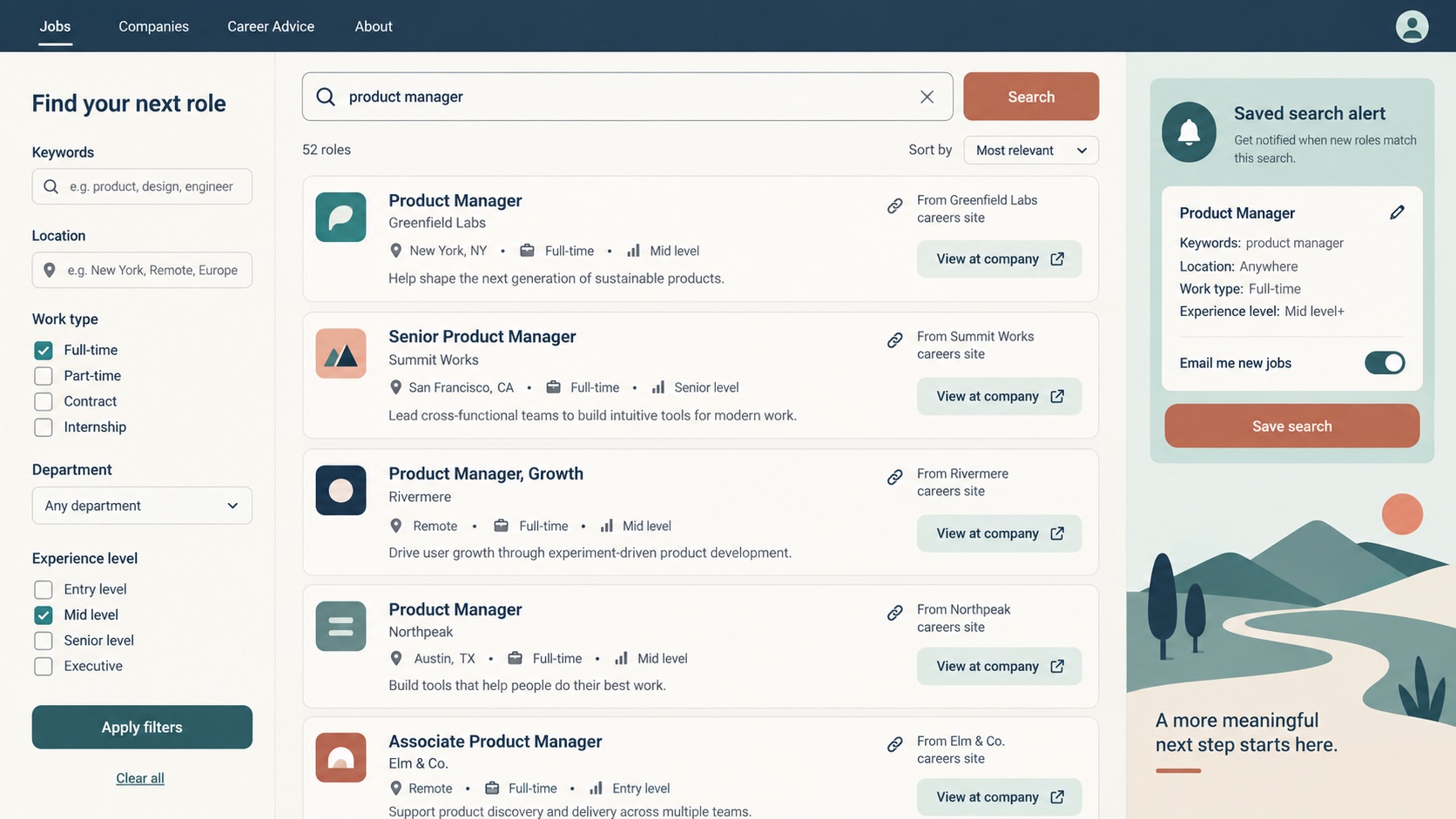
Career Hound's public homepage says it finds openings on company websites rather than only displaying listings from major job platforms. It offers a preview and directs a searcher toward applications at the employer source. Its terms say it links to external sites and does not operate the employer's application process. The founder describes the product as a job board that collects postings directly from company career pages. This is a specific supply strategy: use the employer's own publishing surface as the input, then make those jobs searchable for a user.
That strategy addresses a real uncertainty. A job seeker may not know which companies to check, may repeat the same broad search every day, and may see highly promoted jobs with substantial visible competition. A useful product can reduce the work of assembling employer career pages and checking whether relevant roles have appeared. The promise should be tested against actual jobs, however. “Found on a company website” does not automatically mean the job is absent from LinkedIn, is still open, is legitimate, or has fewer applicants. Career Hound's homepage makes strong comparative claims on these points. Oddig has not run a matched-listing or hiring-outcome study, so this analysis treats them as positioning, not established performance.
The interviewer calls the product a “simple website,” but even a focused board has operational complexity. Sources need to be collected, normalized, deduplicated, updated, filtered, and linked to the right employer page. A job that was live yesterday may be closed today. A company might change the structure of its careers site. A role can be remote only within one region. Misclassifying it wastes the user's time. Those are not back-end details for their own sake; they are part of the value proposition. If the data is stale, the marketing can only win a one-time visit.
The interview's financial numbers need separate labels
Roman reports more than 8,000 users, 779 active subscriptions, roughly $50 average lifetime value, and 31% churn. He gives interview-era prices of $7 weekly, $20 monthly, and $50 annually. He says the last month brought in $28,000 in total sales while the MRR figure was about $12,000. He attributes the gap to a mix of weekly, monthly, and annual payments. The episode title simplifies this to $25,000 a month. Each number has a different meaning and none proves profit.
The founder does not specify whether the 31% churn is monthly, cohort-specific, or calculated on a particular customer base. That makes it unsuitable for precise retention forecasting. Nor does the interview say whether $50 lifetime value is gross sales, net revenue, or contribution after acquisition and service costs. If 779 active subscribers and $12,000 MRR referred to the same instant and definition, the implied average is roughly $15.40 MRR per active subscription. That is a useful arithmetic check, not a new company disclosure. Annual and weekly plans complicate the comparison because cash received in a month and recurring revenue recognized over time differ.
| Reported figure | Better interpretation | Missing detail |
|---|---|---|
| $28K total sales in the prior month | Cash or gross sales volume reported for one period | Fees, refunds, taxes, plan mix, and recurring share |
| $12K MRR | Founder-reported recurring run rate at a point in time | Cohort trend, expansion, cancellations, and definition |
| 779 active subscriptions | Paid subscriptions reported as active | Whether trials, weekly plans, and annual plans are counted alike |
| 31% churn | A warning that the job-search use case turns over quickly | Time period and exact calculation |
| $50 average lifetime value | A reported summary of customer spend or value | Gross versus net and cohort maturity |
There is no independent dashboard access in this analysis. The founder displays figures during the interview, and the company homepage reports thousands of users, but neither source supplies audited accounts or an acquisition-cost schedule. The disciplined conclusion is that the interview describes a paid job-search product with meaningful recent sales and a retention challenge, not a proven $28,000-per-month profit engine.
Why the content worked as a product demonstration
Roman says he spends time studying what job seekers repeatedly ask and watching content across TikTok, Instagram, Reddit, and other formats. He distinguishes short-lived trend posts from topics that remain useful. One recurring format he describes is a list of companies hiring remotely across regions, followed by a pointer to the website for more openings. The audience gets a small amount of immediate value even if they do not click. The product then offers the next step: a larger, searchable supply of similar openings.
That is the important mechanism. The video is not an ad about a generic database. It demonstrates the same search path the product sells. If a viewer wants jobs at company sources, a list of actual companies can earn attention; a well-labeled database of current openings can earn a visit. The content and the product share an underlying unit of value. A competitor could imitate the format, so Career Hound still needs the listings to be timely and the search experience to make the move from video to website worthwhile.
The founder reports 11.7 million social views over one 30-day period. Views show distribution, not customer acquisition. The interview does not disclose how many unique people saw the content, how many clicked, how many paid, or how those subscribers retained. A creator network may include overlapping audiences. A repeated format can create familiarity but eventually lose attention. The proper unit for a business review is qualified visits and paid subscribers per piece of content, plus their contribution after the cost of production. Views are a leading signal, not the end state.
One subtle aspect of the approach is choosing a credible messenger for the audience. Roman says he often works with older creators because a person discussing employment with experience may be more credible to some job seekers than a teenager reading a script. That is his audience hypothesis, not a universal rule about age. The real principle is to choose a presenter whose experience, tone, and audience fit the problem. Test that fit using watch behavior, comments that show understanding, site visits, and paid conversions—not appearance-based assumptions alone.
The creator system behind the apparent simplicity
The interview says Roman finds creators through marketplaces and direct messages to people already making content. He says many videos should cost no more than about $20 because he removes research work from the creator: the team provides formats, examples, and instructions in a sheet. That number is a founder-reported target, not a market rate that every creator should accept. It also omits the founder's time spent researching formats, recruiting people, reviewing work, tracking links, and dealing with revisions.
The system separates scarce and repeatable work. Roman does the audience research and determines which kind of job-related information is worth publishing. Creators deliver many executions of a known format. If every creator had to discover the niche anew, costs and quality variance would rise. If the instructions were so rigid that every post felt identical, performance might deteriorate. The production sheet is valuable only if the underlying topic is genuinely useful and the team updates it as platforms and job-market conditions change.
A builder can map this as a chain:
| Stage | Work to do | Quality check |
|---|---|---|
| Audience research | Collect repeated questions and frustrations | Can a job seeker describe the problem without prompting? |
| Source research | Find current roles at employer pages | Is each example live, accurately labeled, and relevant? |
| Format design | Give one answer in a short video | Does a viewer receive value before the call to action? |
| Creator production | Make variants with a credible presenter | Is the claim clear, true, and natural in the creator's voice? |
| Attribution | Route interest to a relevant search result | Can the team connect content to qualified visits and payment? |
| Retention | Keep delivering fresh, suitable opportunities | Are subscribers still finding useful jobs after the first week? |
This is an Oddig framework, not a claim that Career Hound tracks every field in this table. Its purpose is to show that scaling content production and scaling user value are different tasks.
The hard part of a job-search subscription
Job seekers are not expected to remain subscribers forever. A successful customer may find work and cancel. A discouraged customer may also cancel after a few weeks. Those outcomes look similar in a subscription dashboard but imply very different product quality. The interview's high churn claim should therefore prompt two separate questions: are customers completing the job they came for, and is the acquisition cost low enough for a naturally short relationship?
At the interview-era $7 weekly price, a four-week customer might pay about $28 before fees and refunds. A $20 monthly plan may be more appealing to a longer searcher. A $50 annual plan brings cash sooner but implies a low monthly equivalent and a long service commitment. These are illustrative price arithmetic, not evidence of Career Hound's actual plan mix. A founder would need to know first-payment conversion, refund rate, paid lifetime by plan, support cost, and acquisition cost per channel. If the stated $50 lifetime value is gross revenue, paying $20 for a creator video is attractive only if that video reliably generates enough additional paid customers after all other costs.
There may be non-subscription opportunities—employer partnerships, career tools, or paid placement—but this interview does not establish their existence or economics. Adding them in the analysis as if they explained current revenue would be speculation. The model being evaluated here is paid access to a differentiated search source supported by content distribution.
The product also carries user-trust obligations. A job seeker may share a résumé, browse sensitive career interests, or spend hours applying through links. Career Hound's terms explain that applications happen on external sites. The service still needs to be clear about what it collects, how recent a listing is, whether a role is remote in the reader's location, and what it can and cannot guarantee. Claims that a job is “hidden” or “real” should have an operational definition. A stale or duplicate role is not a harmless database error when a customer paid to find opportunities quickly.
A small test for a different niche directory
You do not need to build a broad job board to test the same mechanism. Choose one group with a repeated search problem: entry-level remote support roles, clinical trial operations jobs, grants for local nonprofit groups, or public procurement notices for small contractors. Then perform a narrow supply audit. Collect 100 candidate opportunities from authoritative sources. Record the source, timestamp, eligibility, closing status, and whether the item also appears in the obvious large directory. Have five target users attempt a real search. Observe whether they find at least one opportunity they would act on and what information is missing.
Next, publish a small set of useful content pieces that demonstrate the same search method. A good post might show three freshly verified opportunities and explain eligibility. It should not claim they are unseen everywhere unless you checked. Track which posts lead to relevant searches, saved items, and paid or committed users. The first paid offer might be a bounded weekly alert rather than a full platform. The decision is whether the audience values the better search path enough to use it repeatedly and pay for it—not whether the videos collect views.
Set a budget and a stopping rule before scaling creators. For instance, if ten pieces generate large view counts but almost no qualified visits, change the promise or audience. If people visit and search but cannot find suitable items, improve the source coverage and filters before producing more posts. If they find good items but cancel after succeeding, model the expected short lifetime honestly instead of treating all churn as product failure. These are decision rules, not universal thresholds.
The transferable lesson
Career Hound's reported revenue is striking for a small website, but its more useful lesson is the alignment between a precise audience question, a differentiated data source, and content that answers part of that question immediately. Distribution created a path into the product; data quality and search usefulness must keep the promise after the click. The financial story remains incomplete without acquisition cost, cohort retention, refunds, and a definition of churn. A builder should borrow the discipline of studying the audience and making repeatable, useful demonstrations. They should not borrow an unverified sales number or assume that a job list becomes valuable merely because it is scraped from a different place.
Sources & further reading
- Starter Story interview with Career Hound founder Roman, published September 6, 2026 in YouTube's Pacific timestamp. Historical pricing, revenue, subscriber, churn, and marketing details are from his account.
- Career Hound's official homepage, accessed September 24, 2026. Used to corroborate company-career-page positioning and preview offer; its testimonials and comparisons are the company's own claims.
- Career Hound terms and conditions, accessed September 24, 2026. Used to clarify that employer applications take place off-site.
Reporting note: Oddig did not independently verify the founder's sales dashboard, churn period, conversion, acquisition costs, social attribution, or the completeness and freshness of the job database.