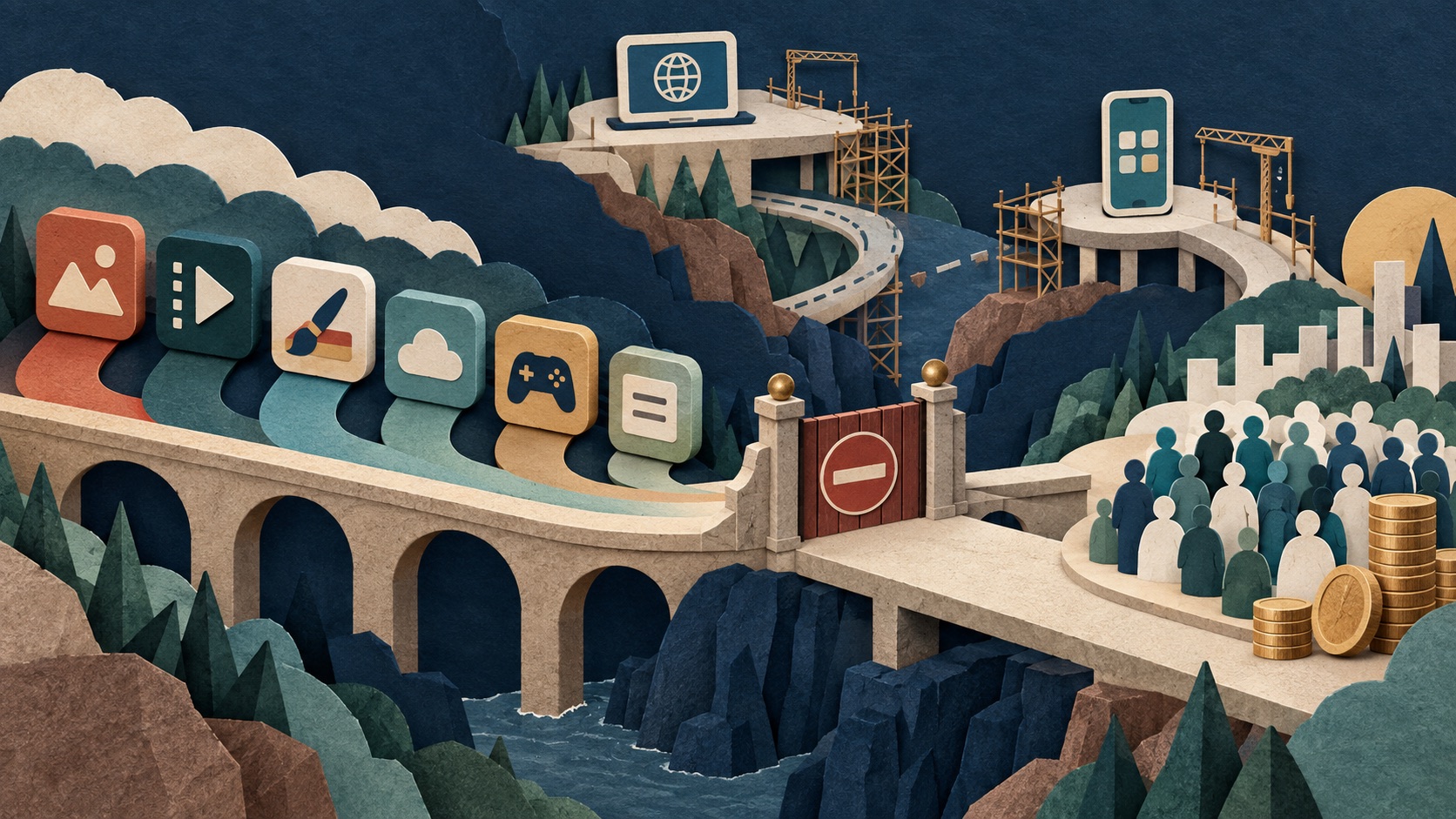
A founder can own thirty products and still have one point of failure. That is the uncomfortable lesson in Viktor Seraleev's account of building, losing, and rebuilding a mobile-app business. His apps served different use cases, but distribution, subscription payments, and access to customers were still concentrated in a platform account. A portfolio reduced dependence on any one app. It did not automatically reduce dependence on the store that carried them.
Seraleev told Indie Hackers that he had shipped more than thirty iOS and Android apps since 2020, sold several, and reached more than $60,000 in December 2025 proceeds after Apple's commission across his current portfolio. In the same first-person interview, he described an earlier Apple developer-account termination, the near-disappearance of revenue from Russia, and a bank disruption. Those are founder-reported events, not independently verified accounts. The useful question for a reader is not whether to copy his app count. It is whether the business would continue to operate if its largest distribution account, payment route, or customer-contact channel stopped working tomorrow. Source: Seraleev's Indie Hackers interview.
This case is for developers with a small portfolio, a successful single app they hope to expand, or a product whose entire purchase and renewal relationship lives inside one marketplace. It provides a way to distinguish product diversification from actual operating resilience, without pretending that a checklist can eliminate platform risk.
One useful app came before the portfolio
The original customer problem was small and visible. Seraleev said his wife, who ran a manicure salon with him, needed a way to make a before-and-after Instagram video with a slider effect. He searched the App Store and did not find a satisfactory app. A friend helped build an imperfect first version; after redesign and updates, the app grew. He reported monthly net proceeds rising from $200 to $34,000 within eight months and a later sale for $410,000. The interview does not provide transaction documents, acquisition cost, retention, or profit, so the sale price cannot be treated as a typical multiple for similar apps. Source: Indie Hackers interview.
The origin matters because it is unlike a generic instruction to "build ten apps." A specific job—making a salon's comparison video—gave the first app a buyer, context, and observable output. The later portfolio was an operating strategy built on product discovery, not a substitute for finding a problem. Seraleev said he subsequently challenged himself to build ten small, useful, high-quality apps in a year to learn which ideas deserved more investment. A fixed output challenge can increase learning speed, but if a developer ships ten undifferentiated products with no route to discovery or retention, the count alone carries little value.
His public portfolio lists creative and utility apps. That supports the broad product-category description in the interview, although a portfolio page cannot substantiate revenue or the number of profitable products. Source: Seraleev's portfolio site. The right transferable mechanism is small products tied to a repeatable use case, tested through a real distribution channel. The wrong shortcut is to assume more app icons equal a safer business.
The interruption was broader than one unsuccessful product
Seraleev dates his relocation from Russia to Chile to 2022 and says roughly three quarters of his revenue had previously come from Russia. He reports that this share fell close to zero after the market shock. He also says Apple terminated his developer account and that banking sanctions caused his main bank to close a company account and freeze funds. The interview contains his explanation for the termination—an association with a company name used by former partners—and says he challenged Apple's decision in court. Without the underlying platform correspondence or court record, that explanation must remain his account, not an Oddig finding about Apple's motives or contractual obligations. Source: Indie Hackers interview.
Those three shocks are analytically distinct. Geography concentrated demand. A developer account concentrated distribution and subscription infrastructure. A banking relationship concentrated access to cash. They also compound: losing market demand makes an account interruption harder to absorb, and frozen cash makes a rebuild slower. This is why "diversify" is too vague to be useful advice. A founder needs to identify which dependency is shared and what remains accessible if it fails.
The reported $60,000-plus December 2025 figure is proceeds after a platform commission, not company profit, cash in the bank, or independently confirmed monthly recurring revenue. The profile headline uses a monthly-revenue shorthand, but the interview's precise wording is proceeds for one month. We cannot infer gross consumer spending by applying one assumed commission rate: commission rates and subscription histories vary, and the interview does not supply the mix. Likewise, the figure does not reveal how many apps contributed, their acquisition costs, or churn. A reader assessing the business should keep those unknowns visible.
App diversification and platform diversification are different
Consider a developer with five subscription apps. If one app stops converting, four may continue paying the bills. That is product-level diversification. If all five apps use the same account for storefront access, billing, customer reviews, and updates, an account-level interruption can affect all five. If all sales depend on one country, the five products may also share a geographic risk. If proceeds settle through one bank, they share a cash-access risk.
| Layer | What owning more apps can improve | What may remain shared |
|---|---|---|
| Product | One failed use case need not sink every product | Similar users, code, subscriptions, and support load |
| Discovery | Different app keywords may attract different searches | A single store's ranking and policy decisions |
| Distribution | Some products may exist on more than one platform | One developer account per platform and its review process |
| Payment | Separate products can create several revenue streams | Store billing, payout setup, tax setup, and one settlement bank |
| Relationship | Each app can build its own user trust | Limited direct contact with customers unless an appropriate, consented channel exists |
This table is an analysis tool, not a claim that every Sarafan app had the exact same setup. The public interview does not document the account architecture app by app. It does demonstrate why the owner describes the account termination as a business-level event despite having built many products.
The same logic applies beyond mobile apps. A creator may run six newsletters but rely on one email-service account. A seller may have twenty products but all checkout through one marketplace. A software studio may have several clients but host every deployment and domain with one vendor. The number of assets and the number of independent failure domains are different numbers.
Oddig's platform-continuity map
Before building a second product as a "hedge," map the dependencies of the current one. Complete one row for each important system. Record both concentration and a legal, tested recovery route. A backup that requires violating platform rules, using someone else's identity, or moving customer data without permission is not a recovery route.
| Dependency | Today's owner and access | Failure effect | Evidence of a workable alternative |
|---|---|---|---|
| Developer account | Legal entity, Account Holder, two-factor authentication, team roles | Publishing and account administration may stop | Current documentation, named responsible people, permitted support/escalation route |
| Source and build system | Repository, signing keys, assets, build process | Updates or rebuilds become impossible | Restorable backup and a second person able to produce a build |
| Product data | Entitlements, settings, analytics exports, support history | Existing users cannot be served or diagnosed | Export and restore test, subject to privacy and platform rules |
| Billing and payout | Store contracts, subscription records, settlement bank | Sales or access to proceeds may stop | Reconciled reports, cash buffer, valid banking contingency |
| Distribution | Store search, paid ads, website, partner traffic | New users cannot discover the product | A measured second channel with its own economics |
| Customer relationship | In-app messages, support address, permissioned email list | No reliable way to explain an interruption | Consent records and a current, accessible contact route |
Give each row three tags: impact (how much revenue or service it affects), recovery time (how long a realistic restoration might take), and owner (who can act). If an untested row has high impact and no owner, it is the next operational risk to address. The point is not to fill a perfect spreadsheet. It is to reveal where the business only appears diversified.
For a small app, a one-hour exercise is enough to find the worst concentration. For example, if the developer is the only Account Holder, holds the sole signing-key backup, and also receives every security code, adding a second app does not solve the immediate continuity problem. A documented role structure and tested code backup may be a higher-value next move.
What Apple's transfer documents actually allow
An obvious-sounding response to account risk is "just transfer the apps." Apple's documentation is more conditional. It says an eligible app can be transferred between accounts while remaining available for download and retaining ratings and reviews. It also tells the seller to back up app information beforehand. The Account Holder initiates the transfer; for an app with auto-renewable subscriptions, the parties must handle an app-specific shared secret as part of the process. Source: Apple, overview of app transfer.
The eligibility rules matter just as much. Apple says both accounts must not be pending or changing state and must have accepted the required agreements, among other app and in-app-purchase criteria. Therefore transfer is a planned ownership process for an eligible app, not a guaranteed emergency escape hatch after an account has already been restricted or terminated. We cannot infer from these documents whether Seraleev's earlier apps were eligible at any particular moment. A developer considering a legitimate sale or organizational move should review the current rules with the actual account holder before taking action. Source: Apple, app-transfer criteria.
Apple's role documentation also shows why administrative access should be deliberately assigned. The Account Holder and invited users have different abilities, and role permissions control what a colleague can do. For a business with employees or partners, document who holds the account, which entity owns it, who can access reports, and who can respond to urgent platform messages. This does not guarantee a favorable platform decision. It reduces avoidable confusion and single-person dependency. Source: Apple, accounts and roles.
There is no recommendation here to create shadow accounts or to route around a platform enforcement decision. That could breach terms and make a recovery harder. The safer preparation is ordinary operational hygiene: accurate account identity, documented ownership, current agreements, properly backed-up assets, and an authorized escalation route.
A recovery drill for an independent app business
The continuity map becomes useful when rehearsed. Pick the largest realistic interruption—store account unavailable, settlement delayed, or main acquisition channel paused—and run a short tabletop exercise with no account changes.
Step 1: define the scenario. Example: "For seven days we cannot release an iOS update or access one App Store Connect role." Do not stack every disaster into one fictional event. The point is to make decision ownership and dependencies visible.
Step 2: describe the user effect. Which features remain available to existing users? Which purchases or renewals might be affected? Could support answer questions with the information it already has? If you cannot answer, record the uncertainty rather than assuming a worst-case or a best-case outcome.
Step 3: identify the records needed. Confirm where build artifacts, source, subscription logic, public status messages, support history, and financial reports live. Check that a second authorized person can find them. A backup that has never been restored is an intention, not evidence of recoverability.
Step 4: choose the first communication. Prepare a factual, non-speculative support or status note that says what users can currently do, what is being investigated, and when the next update will arrive. Use only communication routes for which users granted permission. Do not claim a platform or bank caused something before you know.
Step 5: estimate runway. Determine the cash needed to support users and staff during the assumed disruption. Separate money shown as proceeds from money actually available in a bank account. The runway number should be based on the business's actual costs; the Sarafan interview does not provide a universal buffer target.
Step 6: record a trigger. If a channel remains unavailable beyond a chosen number of days, who contacts platform support, pauses acquisition, changes public messaging, or activates another compliant distribution channel? Agree on triggers in advance so the team is not improvising under stress.
The drill's output is a short action sheet: named owner, required records, first customer message, cash estimate, and next decision time. It is more useful than a vague promise to "be more diversified."
Why Seraleev's later acquisition mix matters
The interview says App Store search represented around a quarter of his traffic and visibility on competitor pages another roughly tenth. He also described a personal blog and social posts, Google Ads, short-form video experiments, and occasional Product Hunt launches. These are his reported channel shares and activities, not a universal acquisition mix. The essential distinction is between a channel that can bring users to an existing store listing and a channel that could continue serving customers if that store or account were unavailable. Social reach may help regain attention, but it cannot by itself restore an app, subscriptions, or payout access. Source: Indie Hackers interview.
Seraleev said he wanted a business spread across the App Store, Google Play, and web products, and mentioned early web experiments. That is a direction, not proof that the current $60,000 month was insulated across platforms. For another founder, the relevant test is operational: has the second platform actually acquired users, made sales, and supported those users? A website with no traffic or payment history is an option, not yet a functioning second business.
This also affects decisions about technology. Seraleev favors native Swift for video-heavy apps and said he has experimented with cross-platform approaches. A web or Android version is not always worth building: the user workflow, technical constraints, market demand, and maintenance cost differ. Build a second distribution route when there is both a user reason and a measurable continuity or growth case, not solely because "multi-platform" sounds safer. Source: Indie Hackers interview.
A decision card before adding the next app
If you are choosing between another app, a second distribution channel, and operational cleanup, ask these questions in order:
- What job does the next product solve? Name the user, the moment of need, and the observable result. Seraleev's salon video use case is a stronger starting point than an arbitrary target number of launches.
- Which dependency would the new app truly separate? If it shares the same account, country, payout route, and audience, it diversifies product demand but not those other risks.
- What evidence shows the current app works? Retention, paid conversion, support load, and contribution after acquisition costs matter more than download count.
- Which high-impact continuity row remains untested? If the account owner, build backup, or payout reconciliation is unknown, fix that before adding complexity.
- Can the team support another product? More apps mean more updates, policy reviews, subscription changes, customer requests, and potential vulnerabilities. Count that burden explicitly.
For example, a developer with one profitable iOS photo app may discover an adjacent editing task and reasonably launch a second app. The portfolio could reduce exposure to a single feature becoming obsolete. But if the same developer account, one acquisition campaign, and one bank still connect both products, the business must label those risks as shared. A tested Android version or a permissioned web customer relationship might change one layer; neither automatically changes all of them.
The practical decision is sometimes to build another product, sometimes to improve the current one, and sometimes to spend a week on account records, backups, and payout visibility. The Sarafan story does not prescribe a single answer. It makes the cost of ignoring the dependency map easier to see.
What the case cannot prove
Seraleev's interview offers unusually concrete milestones and operating details, but it remains a founder narrative. Oddig has not verified the reported December proceeds, the earlier $410,000 sale, the account-termination explanation, or the precise sequence and financial impact of the bank event. We also do not know portfolio-wide profit, cohort retention, paid acquisition efficiency, or how much revenue came from each app and platform. These gaps prevent a claim that shipping thirty apps is a reliable route to a $60,000 month.
Apple's public documentation explains normal account roles and eligible transfers. It does not establish that any past dispute was right or wrong, nor does it promise that a particular recovery action would work in a terminated account. Platform rules can change; verify current documentation for any real transfer or account decision.
The defensible conclusion is narrower and more useful: a product portfolio can spread product risk while leaving a common platform, geography, bank, or customer-access dependency untouched. Map those layers, test the ones you can, and make the next product decision with the full system in view.
If you are still deciding what to launch, Oddig's idea-validation case covers an earlier decision: whether a proposed product solves an urgent enough problem to merit a build. If you have already launched, the post-launch strategy analysis addresses the work after initial attention fades.
Source notes
- Viktor Seraleev's first-person interview with Indie Hackers, January 26, 2026: founder-reported business history, product and channel figures, and future plans.
- Viktor Seraleev's public portfolio: public product context; not independent financial verification.
- Apple's app-transfer overview, transfer criteria, and accounts-and-roles documentation: current platform-process references, not evidence about this founder's dispute.