
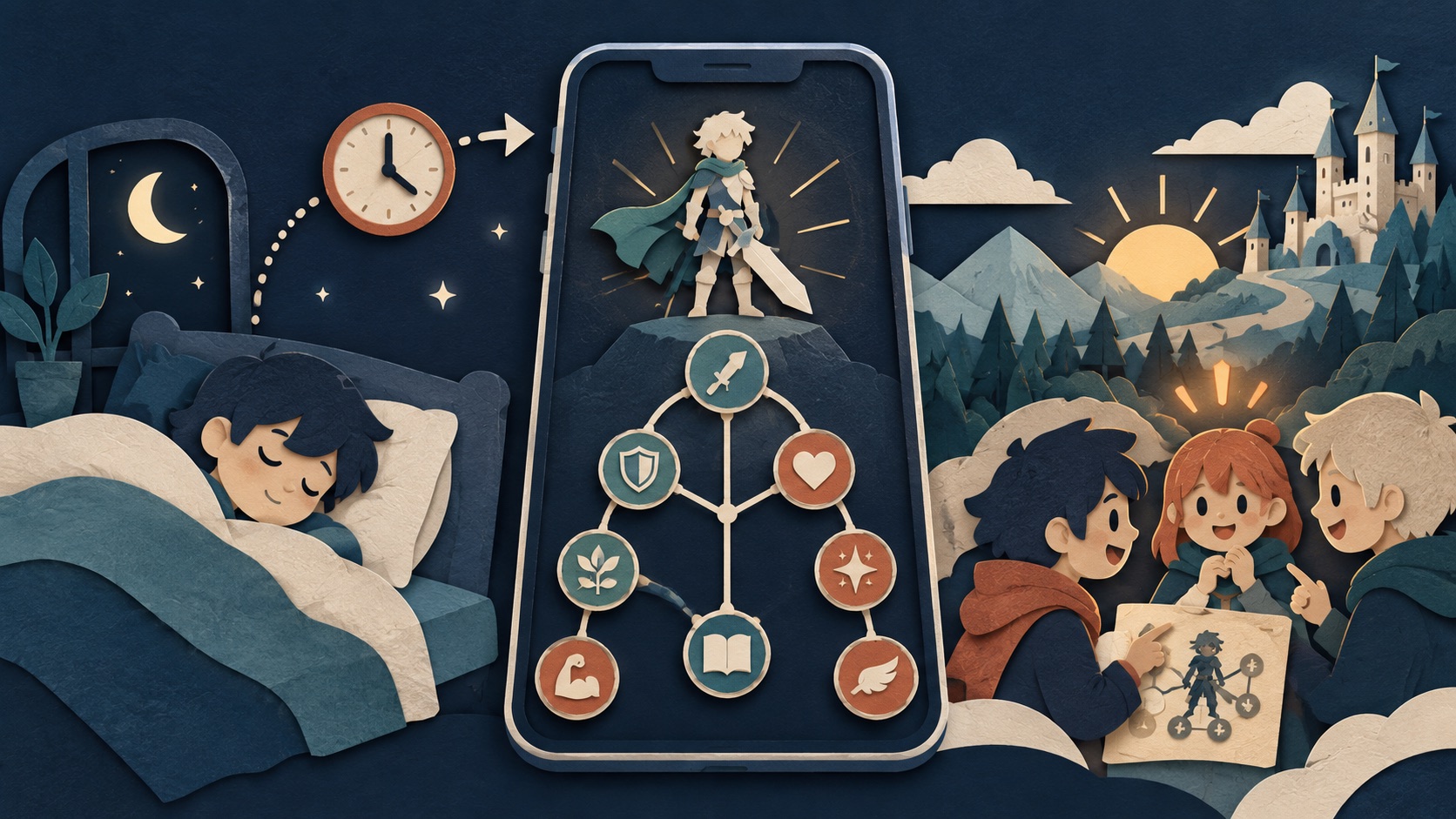
The useful question in this case is not whether every solo developer can earn six figures from a game. It is how a small, deliberately deep game found a specific audience, converted a few of those players into buyers, and survived without buying installs.
Kenneth Law built Harpagia, a text-based idle role-playing game for people who enjoy slow, cumulative progress. In a September 2026 Starter Story interview, he said the game averaged roughly $13,000 in monthly revenue over the preceding year, or more than $150,000 annually. The interview's headline rounds this to $155,000 per year. He also reported more than 50,000 combined iOS and Android downloads, about 3,500–4,000 monthly active players, and around 500–600 daily active players. Those are founder-reported figures shown in the interview, not independently audited accounts.
The opening lesson is easy to miss: the game was not an overnight hit. Ken launched while employed, earned about $150 in his first month and $1,500 in total sales by the end of the second, then saw slow growth. About six months later, a Reddit post produced a spike in awareness and lifted monthly revenue from around $1,000 to roughly $10,000. The post drew substantial criticism. For a niche game with an active community, disagreement was still useful distribution and product feedback.
Watch the product and revenue discussion from about 1:48, and the origin of the Reddit spike from about 6:33. The video is the primary source for Ken's business figures; the official Harpagia site independently confirms the product's positioning and features.
The demand was specific, not broad
Harpagia is not trying to beat a mass-market action game on graphics. Its promise is progress that continues while the player is away. The game's official site describes 16 skills, more than 100 monsters, combat, loot, pets, trading, and permanent progression without forced resets. That combination matters more than any one feature. It offers fans of incremental games a long-running set of decisions: what to train, which equipment to pursue, and when to return. The interface can be light because the depth lives in the systems.
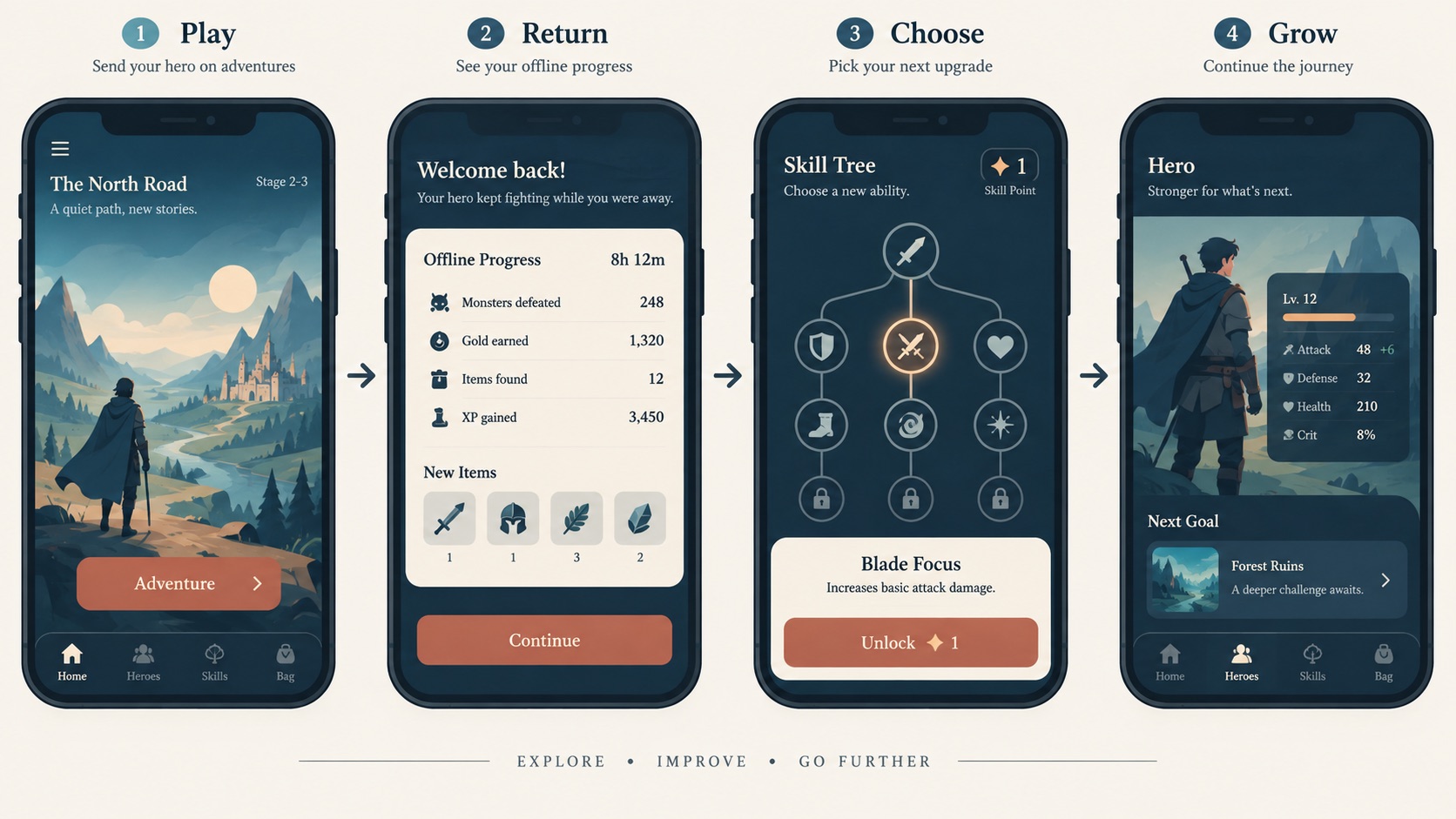
The buyer's job is partly entertainment and partly the satisfaction of optimization. A player can check in briefly, collect offline gains, make the next meaningful choice, and leave again. This makes the game compatible with a busy day. It also gives the developer repeat opportunities to show value without requiring a long, uninterrupted play session.
This is a niche, but it is not necessarily a tiny market. A founder needs enough people who strongly prefer this rhythm to sustain a small studio, not all mobile gamers. The official site makes the niche easy to recognize by naming the mechanics plainly. A visitor who wants instant action can self-select out; a visitor who likes long-term skill progression can immediately see why the game exists.
For someone studying an opportunity, the distinction is practical. “A game for everyone” is hard to build and harder to market. “An offline idle RPG with persistent, interconnected skills” is a claim that can be tested with real players. You can ask whether they already spend time with comparable games, what bothers them there, and whether a different progression system would make them switch.
What the revenue numbers do and do not say
Ken told Starter Story that Harpagia is free to play on iOS and Android and earns from optional in-app purchases, generally in the $2–$10 range. He said the game has generated over $3 in revenue per active user over a year and that roughly 6% of users convert. The interview does not disclose a cohort table, retention curve, lifetime value, payer definition, refunds, store commissions, or what share of the reported $13,000 per month came from one-time purchases versus recurring purchases. We should not infer those missing measures from the headline.
| Figure in interview | What it supports | What it does not prove |
|---|---|---|
| About $13K average monthly revenue over a year | A meaningful small-game business existed during the reported period | Profit, stability of each future month, or take-home pay |
| 50K+ combined downloads | Reach across iOS and Android | 50K retained players |
| 3.5K–4K monthly active users | A recurring player base at interview time | How long each cohort stays active |
| Around 6% conversion | Some free players buy optional items | The acquisition channel or denominator behind the rate |
| Around $500 monthly operating expenses | Relatively low direct tools, assets, and freelance costs as reported | Full cost after store fees, tax, labor, or opportunity cost |
Two calculations are worth doing carefully. Dividing $13,000 by 4,000 monthly active players gives about $3.25 revenue per monthly active player for a particular month, broadly consistent with his statement, but this is not customer lifetime value. Dividing 50,000 downloads by 4,000 monthly active users gives 8%; that is not retention, because downloads arrived at different times and may include multiple devices or reinstallations. Ratios can suggest questions; they are not a substitute for the underlying cohort data.
Ken also mentioned roughly $500 a month in ongoing costs for assets, freelance art, subscriptions, and similar items, with no paid advertising. Treat that as a partial operating-cost account. Apple and Google fees, taxes, refunds, payment processing, and the founder's time are not captured by simply subtracting $500 from $13,000. A founder considering a similar game should build an actual contribution margin model rather than repeat a “near-pure profit” story.
The product is more than a loop of waiting
n
n
The official game site provides a useful map of its feature architecture. Players train skills, gather materials, craft and equip items, battle monsters, find loot and pets, and use a player marketplace. Each mechanic feeds another. Gathering has a reason because materials matter for crafting; crafting has a reason because equipment changes combat; combat creates rewards that make the next skill investment meaningful. Offline progression keeps the cycle moving between visits.
That architecture creates a clear design constraint: every new mechanic should make an existing choice richer, not simply lengthen a list of chores. A player should understand what changed when they return. If offline progress is opaque, they will feel as if a timer ran; if it changes a decision, the return visit becomes rewarding. Harpagia's “no forced prestige resets” position also signals that time spent is not casually erased. For a certain group of players, that is a retention promise.
None of these observations prove which feature drives revenue. The video does not isolate whether combat, collectible loot, the marketplace, or the no-reset promise caused purchases. The safe conclusion is that these features form a coherent progression system, and the founder's reported metrics suggest the system found a paying audience. An imitator should test that system-level promise with users rather than cloning a feature checklist.
How a critical Reddit post became distribution
Ken's growth story is not “post once and go viral.” He said he had no audience and no publisher, did little marketing during the game's early months, then wrote a Reddit post showing screenshots and explaining the game. The response was critical, yet the discussion exposed Harpagia to thousands of likely players. He attributed a jump from about $1,000 to about $10,000 in monthly revenue to that exposure. Later posts about substantive updates also created spikes, although the results were inconsistent and subreddit rules limited how often he could self-promote.
The mechanism is plausible: a specialist community can evaluate a specialist product quickly. Members can argue about interface choices, monetization, or progression balance because they understand the genre. That attention is not automatically positive, and discussion alone is not a sale. But it gives a developer a sharper signal than generic social reach: which complaints repeat, which players install despite those complaints, and which features they ask for after using it.
There are limits. A one-off post is not a reliable customer-acquisition system. A community can reject a founder who treats it as a free advertising slot. Ken's experience suggests a better sequence: build something people in the community can actually try, state what it is, disclose the developer's connection, invite criticism, and return only when there is a substantial update. Measure installs and paid conversion from that burst; then determine whether ordinary retention supports the business once the spike fades.
A founder-friendly way to test the same pattern
You do not need to quit your job or make a full RPG before learning something useful. Ken first made a small card game partly to learn the complete shipping process. That prior release did not become Harpagia's business, but it reduced uncertainty about coding, app-store review, and shipping. Harpagia itself launched before it was polished. A small group of players found it and one made an early $10 purchase. That first payment did not prove a six-figure market, but it did show that a real person valued a rough product enough to pay.
For another niche game or specialist consumer app, a disciplined version of the experiment would look like this:
- Name one repeat behavior. “Users return to collect progress and choose the next skill” is testable. “Users will love my game” is not.
- Map the minimum connected loop. Sketch a resource, a decision, a reward, and a reason to come back. A landing-page mockup cannot validate that loop; a playable prototype can.
- Recruit from a relevant community without spamming it. Invite a small group to test, ask what they already play, and watch for the moments where your product differs enough to matter.
- Instrument cohorts. Record installation date, first meaningful action, day-1/day-7/day-30 return, purchase, refund, and support issues. Separate an acquisition spike from durable use.
- Test an optional purchase honestly. A purchase should add value without making the free experience deceptive. Check whether players understand exactly what they buy and whether they later regret it.
- Only then scale reach. If players do not return, another large post simply buys a bigger leaking bucket—whether the “payment” is ad spend or your reputation in a community.
The sequence can be compressed or extended depending on the game. The point is not a fixed seven-day schedule. It is to resolve demand and retention uncertainty before treating one promising spike as a business model.
The risks behind the attractive headline
Harpagia's reported numbers are encouraging, but the case has at least four risks that a serious builder should model. First, the annual figure and a recent $10K-plus month are different measures. Revenue can fluctuate with releases, community attention, or purchases by a small number of highly engaged players. Without a distribution of payer spending, you cannot assess concentration. Second, a niche community is a distribution advantage only while the founder behaves as a member. Self-promotion limits make repeat reach uncertain.
Third, optional purchases can change the feel of an idle game. If progress becomes painfully slow unless users pay, the monetization design may damage trust. The official site advertises a “respectful” free-to-play approach, but that is a product claim. Player feedback, refund rate, and long-term retention are the tests. Fourth, a solo developer's labor is not free. Balancing progression, handling support, creating new content, maintaining two mobile platforms, and moderating a marketplace are substantial ongoing work even if the cloud bill is low.
Ken's decision to leave Meta was a personal threshold: he said he would go full-time if the game reached $10,000 monthly revenue organically, and he did so after the Reddit-driven jump. That is not a rule for readers. A safer decision model would compare several months of net cash flow with personal expenses, include a reserve for volatility, and account for the opportunity cost of leaving employment. His reported $13,000 monthly average is a business observation, not a universal salary replacement threshold.
What this case is actually useful for
Harpagia shows that a small app can generate meaningful revenue by satisfying a narrow, recurring need and finding the right community. It does not show that any simple game can be released to Reddit and earn $10,000 a month. The replicable method is more modest: choose a recognizable user, build a coherent core loop, ship early enough to observe behavior, treat criticism as data, and separate traffic from retention and profit.
The next research step for a founder is to interview at least a handful of people who already enjoy the target genre, then design a playable loop around a behavior they repeat voluntarily. Ask what would make them return after a day away. Track that answer in product usage, not just in survey enthusiasm. If the loop survives a quiet week without a viral post, you may have the beginning of a durable game business.
Sources & further reading
- Starter Story interview with Kenneth Law, September 2026 — primary source for founder-reported timeline, revenue, audience, monetization, and Reddit distribution.
- Harpagia / Kayelle Apps official site — first-party description of game mechanics, platforms, optional purchases, and 50K+ downloads.
- YouTube original interview — embedded above; the current video title is “This app replaced my 9-5 ($155K/year).” An earlier working list called it a $13K/month case; both refer to the same reported business at different levels of rounding.