

New game opportunities usually appear as several small signals before they look obvious in search data.
A game website does not always begin with a big game idea.
Sometimes it begins with a small signal: a new puzzle format appears on a browser game portal. A Steam title starts gaining followers. Players keep asking for a map, a calculator, or a better guide. A new game name appears in a few places before Google Trends has enough data to make it look important.
That is the window this article is about.
You can use those signals to build two very different kinds of sites:
- A playable game site, built around an original version of a rising mechanic, such as a daily puzzle, idle game, simulator, or word game.
- A game companion site, built around one growing game or genre, with useful guides, builds, codes, maps, tier lists, calculators, or strategy tools.
The goal is not to copy a game or rush to register every new name. The goal is to notice real attention early, understand what players need next, and build the smallest useful site before search results become crowded.
Why New Game Buzz Creates Website Opportunities
New games create more than a launch-day spike. They create questions.
Players search for the game name. Then they search for the rules, the best build, the fastest route, the codes, the answer to a puzzle, or a way to play something similar in a browser. If the game has a strong loop, people also start looking for more games with the same feeling.
That turns one new release into several possible website opportunities:
| What is growing? | What a useful site could be |
|---|---|
| A simple game mechanic | An original playable browser game built around that mechanic |
| One fast-growing game | A guide, strategy, map, codes, or calculator site |
| A recurring player problem | A tool that saves time or explains a hard part of the game |
| A popular genre with weak search results | A curated guide or a focused content site |
The important word is useful. A page that repeats a game name is rarely enough. A site earns traffic when it helps someone play, decide, learn, or solve something.
Choose the Right Game Site Model First
Before you collect keywords, decide what you are trying to build. The same signal can lead to the wrong site if you choose the wrong model.
Model 1: A playable game site
This is a good fit when the signal is a mechanic, not a protected game name.
For example, you may notice that short daily word puzzles, cozy shop simulators, idle collection loops, or simple social deduction games are appearing across several platforms. The opportunity is not to recreate one specific game. It is to build an original experience around the part players enjoy.
Choose this model when:
- the core loop is easy to explain in one sentence;
- a first session can be finished in a few minutes;
- the game works well on a phone or in a browser;
- users have a reason to return tomorrow.
Model 2: A companion content or tool site
This is a better fit when a specific game is gaining attention, and players need help around it.
The useful page may be a beginner guide, a build planner, a code tracker, a map, a quest checklist, a crafting calculator, or a daily answer page. The best companion sites do not try to cover everything on day one. They solve the first repeated question well.
Choose this model when:
- people are searching for a named game, not only a broad genre;
- players ask the same practical questions in comments and forums;
- the current results are thin, old, confusing, or mostly video-only;
- you can add real help beyond a rewritten wiki entry.
Model 3: A genre or mechanic content site
This sits between the first two models. It can cover a growing category, such as cozy farming games, browser survival games, incremental games, or daily word puzzles.
It is slower to build, but it is less dependent on one game staying popular. Use it when you see the same need across several titles.
Signal 1: Watch New Pages, Not Just Keywords
The original shortcut is still useful: follow strong game sites and watch what they add.
Game portals often reveal a new title or a new subgenre before it has enough search history to look impressive in keyword tools. Look at their New Games, Updated, Popular, and category pages. If a portal has a sitemap, it can also be a clean way to spot newly added URLs.
Good places to watch include CrazyGames, Poki, Coolmath Games, and Y8. Do not treat one new page as proof. Treat it as a lead.
For every new page, write down:
- the game name;
- the mechanic in plain language;
- the category it appears in;
- whether similar pages appeared on other sites;
- what a player might search for after playing it.
The last question matters most. A title is often temporary. A mechanic can have a much longer life.
For example, “a new merge game” may not be interesting by itself. But if several portals start adding merge-and-decorate games, and players are asking for tips or similar games, you may have found a broader opportunity.
Signal 2: Track Rising Releases, Not Just Big Hits
The biggest games are usually too late for a small site to chase. Rising games are more useful.
On Steam, look beyond the front-page blockbuster. Watch New & Trending, genre tags, upcoming releases, and games that are building interest before launch. Steam itself uses New & Trending and related discovery surfaces to show titles that are gaining visibility. Steam’s visibility documentation explains the role of these surfaces.
SteamDB’s wishlist activity page is useful because it shows which upcoming games are gaining attention, not only which ones already have a large player base. It is a third-party data source, so use it as a signal rather than a fact about total demand.
For smaller and stranger ideas, watch itch.io’s New & Popular games and its game jams. A game jam is especially useful for spotting mechanics early. When many entries interpret a theme in a similar way, that can reveal a direction worth exploring.
When you find a rising release, do not ask only, “Can I make a page about this?” Ask:
What will a new player need after the first 30 minutes?
That question often leads to a better site idea than the game name itself.
Signal 3: Use Browser-Game Portals as a Genre Radar
Browser-game portals are different from Steam. They are not mainly useful for finding the next prestige indie title. They are useful for finding loops that are easy to understand and easy to replay.
This makes them a strong source for playable game-site ideas.
Look for patterns across portals:
- several new games built around the same loop;
- a category that keeps getting fresh releases;
- a simple mechanic appearing in both mobile-style and browser-style games;
- games that get updated instead of disappearing after launch;
- formats that work in a short session without a tutorial.
Then break the game down into components:
| Question | Why it matters |
|---|---|
| What does the player do every 10 seconds? | This is the real core loop. |
| What makes the player return? | It shows whether a daily or progression system is possible. |
| What is hard for a new player? | It may create a guide or tool opportunity. |
| What can be changed without losing the fun? | It helps you build an original version instead of a copy. |
A browser game that is fun because of one clear loop is often a better starting point than a complicated hit with years of content behind it.
Signal 4: Read the Conversations Before You Build
Platforms show what is being released. Communities show what people still want.
Start with public communities where people discuss new games, share demos, or ask for recommendations:
- r/IndieGaming for new demos, trailers, player reactions, and early indie projects;
- r/incremental_games for idle and number-driven game loops;
- r/CozyGamers for low-pressure, cozy, and life-sim preferences;
- ResetEra’s Gaming Forum for larger PC and console conversation;
- Steam Community Hub discussions for questions around one specific game.
Do not count mentions. Read the wording.
The strongest comments usually contain a job the player is trying to do:
- “Is there another game like this, but with co-op?”
- “I like the idea, but the early game is confusing.”
- “Where can I find all the codes?”
- “Does anyone have a simple build for beginners?”
- “I wish there was a map for this.”
Those are not just comments. They are product briefs written in the user’s own words.
Save the exact language. It can become a page title, an FAQ section, a tool feature, or a test prompt later.
Signal 5: Use Google Trends as a Filter, Not a Judge
Google Trends is useful, but it is often misunderstood.
It can help you see whether interest is rising, whether a game is growing in the United States or the UK, and whether a title has a short spike or a longer pattern. It can also help you compare a specific search term with a broader topic.
It should not decide whether an early idea is dead.
Google says Trends uses sampled, normalized data. Low-volume terms can show as zero, and small spikes can be noise. That makes it a good filter, but a weak single source of truth. Google’s Trends data FAQ explains the limits.
For a candidate game or mechanic, check:
- Past 7 days: Is there a fresh event or sudden spike?
- Past 90 days: Is attention returning after the first mention?
- Past 12 months: Is this seasonal, stable, or fading?
- Location: Does it matter in the country you want to serve?
- Related searches: Are people searching for how-to questions, codes, builds, maps, or alternatives?
If Trends is quiet but Steam followers, forum questions, and portal releases all point in the same direction, do not discard the idea. You may simply be early.
Signal 6: Find the Gap in the Search Results
An interesting game is not automatically a good website opportunity. You still need a gap.
Search the game name and the practical phrases players use. Then look at the first page as a user would.
Good gaps include:
- mostly news articles, but no useful beginner guide;
- long YouTube videos, but no quick written answer;
- scattered Reddit posts, but no clean code list or checklist;
- an old wiki with missing information;
- no simple calculator, planner, map, or tracker;
- playable results that are slow, broken on mobile, or filled with ads.
Weak gaps include:
- a page where the official site already solves the problem perfectly;
- a query dominated by strong, regularly updated guides;
- a game name with no evidence that players need help beyond the official page.
This step protects you from building a site that has traffic potential but no reason to exist.
Signal 7: Require Three Signals Before You Commit
You do not need perfect data. You need several independent signals pointing in the same direction.
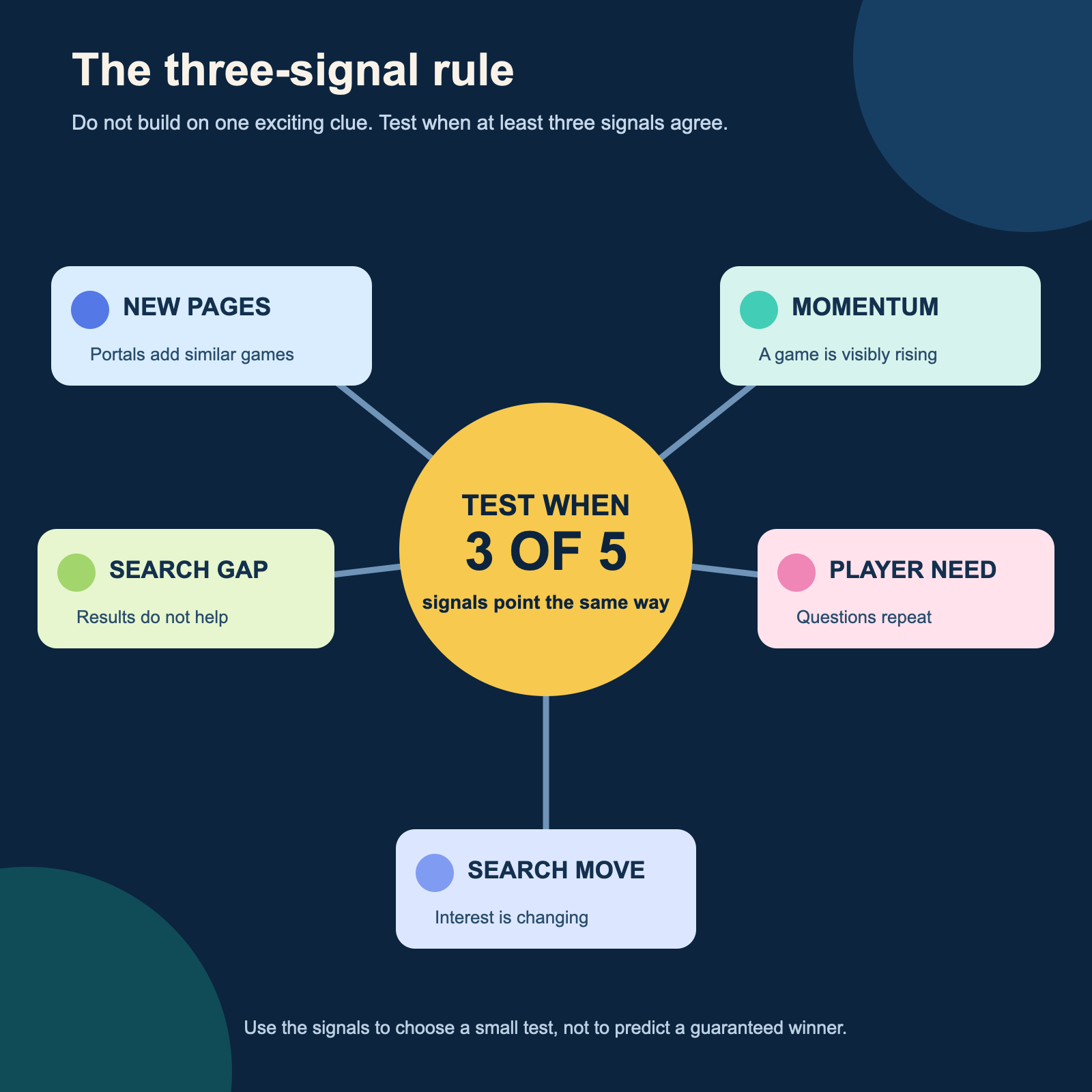
Use this simple rule: do not build a real site until a candidate has at least three of these five signals.
| Signal | What counts as evidence |
|---|---|
| New pages | Several relevant portals or competitors add similar games or topics. |
| Platform momentum | A game is rising on Steam, itch.io, Roblox, or a browser portal. |
| Player need | People repeatedly ask for help, tools, guides, or similar games. |
| Search movement | Trends, related searches, or YouTube interest show a real change. |
| Search gap | Existing results do not solve the player’s job well. |
Three signals do not guarantee success. They do give you a better reason to test than one exciting screenshot or a single viral post.
Run a 7-Day Proof Test
Do not buy ten domains or publish fifty thin pages. Run a small test first.
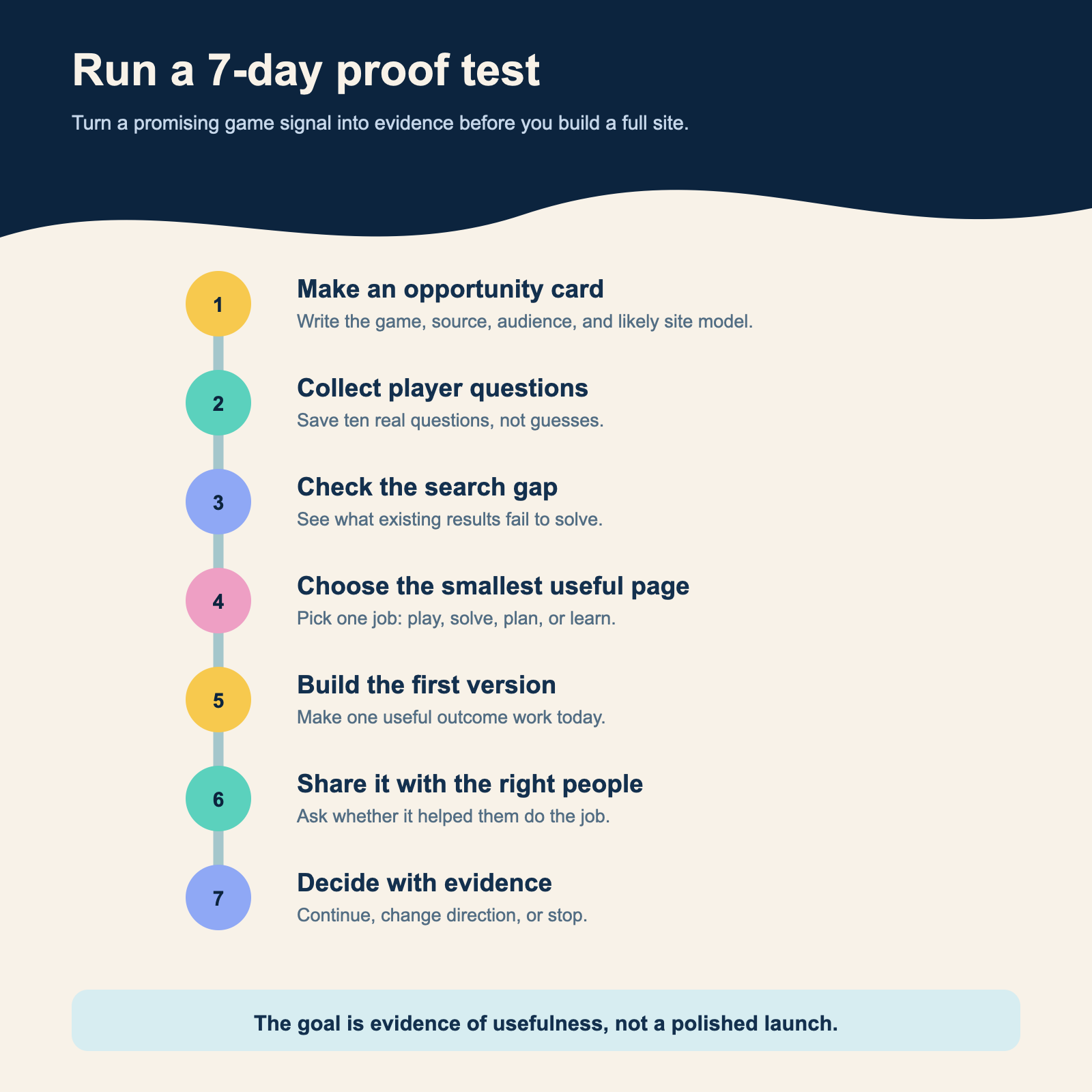
Day 1: Make an opportunity card
Write the game, mechanic, audience, source links, player quotes, likely queries, and the site model you would build.
Day 2: Collect ten real player questions
Use Reddit, Steam discussions, comments, and search suggestions. If you cannot find ten useful questions, the need may not be clear enough yet.
Day 3: Check the search gap
Open the first page of results for the main query and two or three practical follow-up queries. Write down what is missing.
Day 4: Pick the smallest useful page
For a playable site, make one complete loop. For a companion site, make one excellent guide, calculator, checklist, or map page.
Day 5: Build the first useful version
The goal is not polish. The goal is a real outcome for one user.
Day 6: Put it in front of the right people
Share it where discussion already exists. Ask one concrete question: “Did this help you do the thing you came here to do?”
Day 7: Decide with evidence
Continue if people use it, return to it, share it, or ask for the next feature. Change direction if the traffic comes, but nobody finds it useful.
Do Not Turn Signals Into Thin Pages
There is a bad version of this strategy: scrape new game names, create hundreds of nearly identical pages, and hope one ranks.
That is not a durable game site. It also creates the kind of scaled, low-value content Google warns against. Google’s guidance is clear: pages should help people, not exist mainly to manipulate rankings. Google’s people-first content guidance and its spam policies are worth reading before you scale anything.
The better approach is slower at the start and faster later:
Notice the signal early. Learn the player’s real job. Build one useful answer. Expand only after people show you what they need next.
That is how new game buzz becomes lasting website traffic.
If you want a broader framework for deciding whether a signal deserves a bigger commitment, read 6 Steps to Validate a SaaS Idea Before You Build It.