
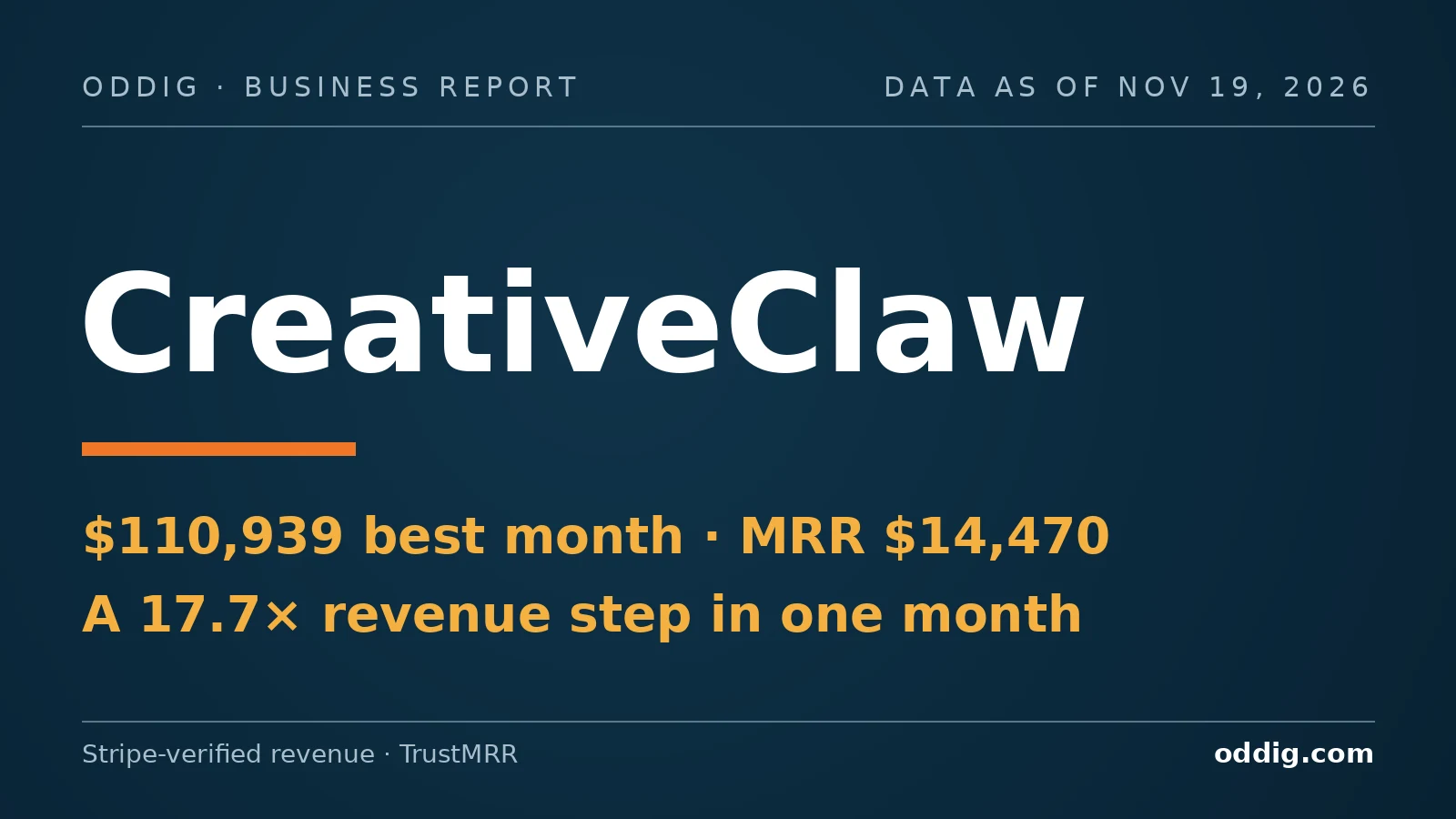

$110,939 in October — earned from inside someone else’s product, which is both CreativeClaw’s genius and its risk
CreativeClaw generates marketing creatives and videos from inside AI assistants — Claude via MCP, and Grok Bot, which its homepage currently leads with — rather than from its own destination site. Its verified record has a cliff in it: $5,254 in August 2026, then $92,894 in September and $110,939 in October, while MRR reads just $14,470 — because the money is credit packs, not subscriptions.

Product at a glance
Summary
What this business is
CreativeClaw is a distribution experiment with revenue attached: instead of building a destination studio, it lives inside the assistants — an MCP tool in Claude, a bot in Grok — and lets users generate marketing creatives where they already work. The verified record shows the moment the experiment caught — $365 in May 2026, $5,254 by August, then a step-change to $92,894 in September and $110,939 in October. It also shows the model’s accounting oddity: MRR is only $14,470 from 263 subscriptions, because buyers mostly purchase credits ($10 per 1,000) rather than plans. A quarter of the site’s traffic now arrives from generative-AI referrals. The channel is the platform; so is the risk.
Why these scores? See the reasons in Key takeaways →
Momentum
Rising fast. The last three complete months total $209,087 against $4,815 for the prior three — the formula gives +4,242.4%, which is another way of saying the business changed category in September. MRR growth (+45.6%) confirms direction, not scale.Derived
Best suited for
Builder (main). Built a distribution-first tool: the insight is where the users are (inside the assistant), not a better generator.
Operator (second). A live case of MCP economics — platform referrals, credit pricing, and total dependence on a landlord’s directory.
What you need to start. A second channel it owns before the platform changes the terms, and credit pricing that survives model-cost swings.
Key findings
Product
Product overview
A creative studio that lives inside the chat window.
CreativeClaw plugs creative generation into the assistants people already use — Claude through MCP, and Grok, whose bot its homepage currently leads with. The user describes the Instagram carousel, ad creative or video they need inside a normal chat session, and CreativeClaw’s tools do the production. There is no separate studio interface to adopt — the chat is the interface.[1]
That choice explains the traffic signature better than any marketing could: a quarter of visits arrive from generative-AI referrals, and the organic keywords are people searching for what Claude can be made to do (“create video with claude”, “claude video 2.0”). The product is discovered at the moment of intent, inside the workflow it serves.Fact
The contrast with this batch’s other creative tools is the strategy in one line: GoMotion and Kolbo built destination products and then had to find audiences; CreativeClaw rented an audience that already had intent, at the price of owning neither the user relationship nor the shelf it sits on.Our read
How it compares
| Business | What it does | MRR or pricing | The difference |
|---|---|---|---|
| Kolbo.AI | All-in-one creative platform (own destination) | MRR $48,197 | Owns its workspace and users; CreativeClaw rents the assistants’ |
| GoMotion AI | Long-form documentary generator (own destination) | MRR $73,992 | Deep single-format product vs an in-chat generalist tool |
| CreativeClaw | Creative generation inside Claude via MCP | MRR $14,470 · cash $105,899/30d | Distribution inside the assistant; credits, not plans |
Competitor MRR figures are Stripe-verified on TrustMRR, read Nov 19, 2026; both are covered in their own reports in this series. The table’s real subject is distribution: same models underneath, three different answers to where the user is met.[1][3][4]
What the site looks like

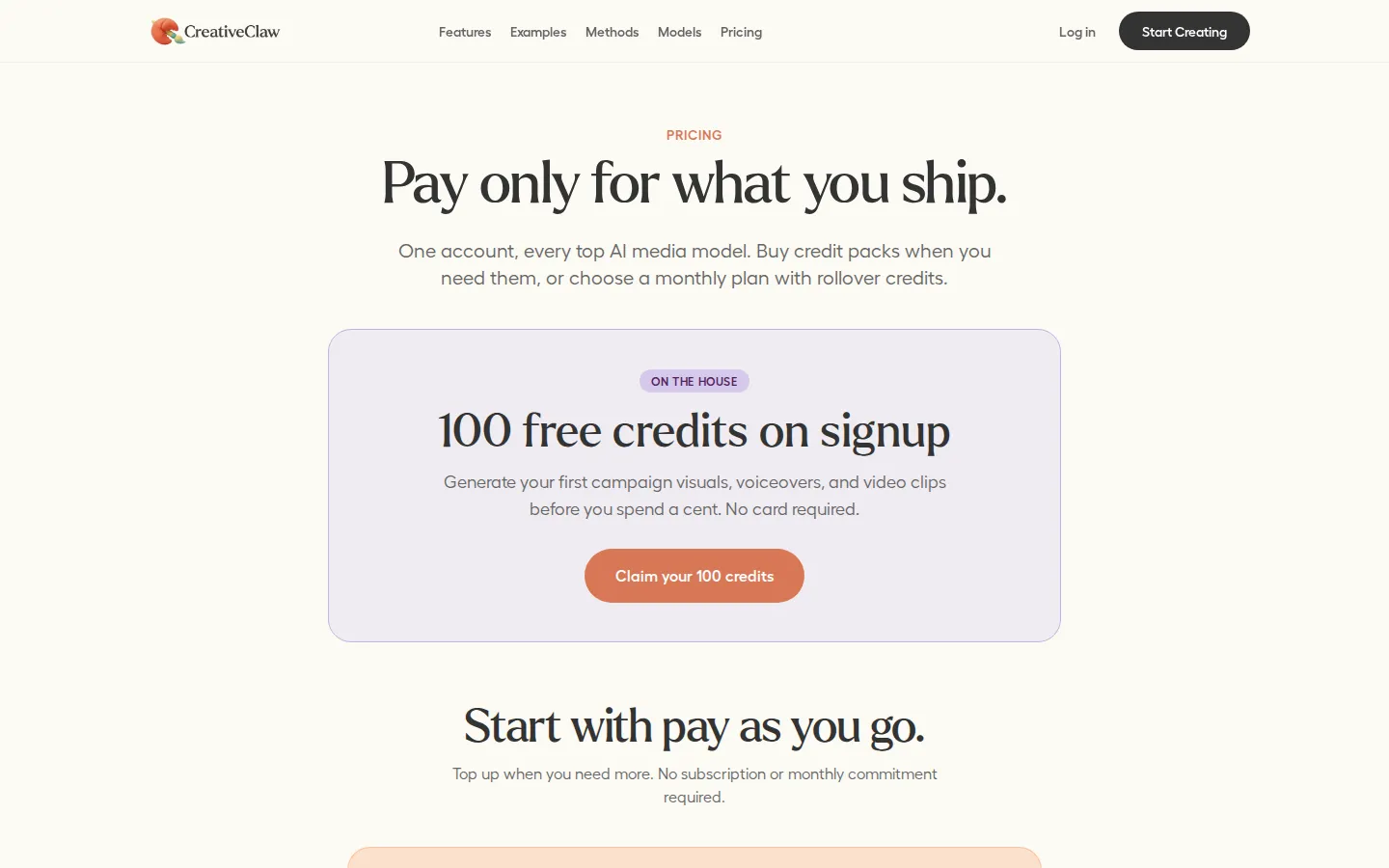

What to look for
- 1The homepage currently leads with Grok Bot — “Generate Images, Video & Audio, Inside Grok Bot” — a reminder that the shelf it rents can change its signage faster than the product changes.Fact
- 2The call to action is 100 free credits, no card required — priced like a top-up, not a commitment.Fact
What to look for
- 1“Pay only for what you ship”: credit packs lead ($10 per 1,000 credits), with 100 free credits on signup.Fact
- 2A monthly plan with rollover credits sits beside the packs, but pay-as-you-go gets the headline — which explains the revenue shape: cash spikes, thin MRR.Fact
Pricing
Credits lead; plans follow.
| Plan | Price | What it covers |
|---|---|---|
| Credit pack | $10 per 1,000 credits | The whole public offer — generation priced by usage |
| Monthly plans | Rollover credits | Present but secondary: 263 subscriptions, $14,470 MRR against $105,899 of 30-day cash |
At $10 per 1,000 credits, a credit costs a cent — pricing set for impulse top-ups inside a chat session, not procurement. Against Kolbo’s tiers ($27–$89) or GoMotion’s ($27–$107), CreativeClaw leads with credits and takes cash at the moment of intent; monthly plans with rollover credits sit behind the packs, not in front of them. The cost of that refusal is the MRR line: there is almost nothing to compound.Derived
Revenue
Revenue analysis
Four quiet months, then a different business.
Daily revenue for the last 30 days (the partial sync day is excluded). Weekends are marked in blue; the best day in the window is dark navy.
| Reading | MRR | Active subscriptions | MRR per subscription |
|---|---|---|---|
| Nov 19, 2026 | $14,470 | 263 | $55.02 |
Daily revenue
Nov 3, 2026
Nov 1–19, partial month
daily rows summed, to Nov 19
record opens May 2026
The shape of the record
Read the monthly line as two businesses: May–August totals $10,069 across four months of quiet building; September–October totals $203,833. The step coincides with traffic tripling (14,341 visits in August to 48,358 in October) and with AI-referral traffic becoming a quarter of the mix — a discovery event inside the AI ecosystem, not an advertising ramp.Derived
The daily line at the new level is comparatively smooth — best day $5,929 (Nov 3), no single-day spikes of the agency kind — which fits many small credit purchases rather than a few whales. Small tickets, platform channel, prepaid cash: the model is coherent. Its fragility is equally coherent: one directory decision sits upstream of everything.Our read
A note on the numbers
TrustMRR’s header snapshot reports $112,925 for the last 30 days; its daily rows sum to $105,899, a 6.2% gap — the widest in this batch, consistent with bursty credit purchases closing on different days in the two tables. We use the daily sum throughout; the monthly timeline is canonical for every other figure.[1]
Market
MCP turned AI assistants into distribution shelves, and CreativeClaw is early evidence that the shelf converts: 25.53% AI-referral traffic is a channel that did not exist two years ago. The category question is the landlord’s roadmap — assistants keep absorbing popular tool categories natively, and directories reshuffle. Tools that use the shelf to build an owned audience (emails, brand, a destination worth bookmarking) keep the arbitrage; tools that don’t, rent their revenue month to month.[2]
Timeline
Customers
Where customers come from
The first business in this library whose main channel is an AI assistant.
25.53% of traffic arrives from AI assistants — users clicking through from Claude/ChatGPT sessions. No other report in this library is above 3%. This is the MCP distribution thesis, measured.[2]
FactOrganic search is 30.03%, and the top terms are intents, not brands: “claude prompt instagram carousel” (7.27%), “create video with claude” (3.74%), “claude video 2.0” (3.42%). Brand share of keywords is only 52% — discovery is generic, which is both the opportunity and the exposure.[2]
FactVisits tripled across the step — 14,341 (Aug) → 35,779 (Sep) → 48,358 (Oct) — in the same months revenue went $5,254 → $92,894 → $110,939. Channel and cash moved together; whatever opened in September opened both.[2]
FactTraffic figures are SimilarWeb estimates for Aug–Oct 2026, read Nov 19, 2026 — modelled data, not the company’s analytics. SimilarWeb attributes assistant click-throughs to the Generative AI channel; in-product MCP usage that never touches the website is invisible to it.[2]
Growth strategies
Two moves from the platform-shelf playbook.
Takeaways
CreativeClaw proves the AI-assistant shelf sells — and prices the proof: platform distribution in exchange for platform dependence, cash in exchange for recurrence.
Why we scored it this way
Copy
- Be early on a new shelf. MCP distribution produced a 17.7× step that no ad budget buys at this scale.
- Price for the moment of intent. One credit price, no tiers — inside a chat session, simplicity is the funnel.
- Watch the referral mix as a metric. 25.5% AI-referral traffic is the earliest public signal of the assistant-as-channel era.
Avoid
- Do not mistake rented distribution for a moat. A directory reshuffle or a native feature ends the arbitrage; convert shelf users into an owned audience.
- Do not judge a credits business by MRR — or by cash. $14,470 MRR and $105,899 cash are both true and both incomplete.
Predictions
Our predictions
Three dated calls, all checkable on TrustMRR.
Track record: the predictions in our earlier reports are still open; the first checks land Dec 1, 2026. We mark each prediction right or wrong on its date and keep the result on the page.
What could prove us wrong
Things that would change our read, and how to check them.
- September was a one-off wave. If the step was a single viral moment or a temporary directory feature, December revenue decays back toward the pre-step trend.Check: December verified revenue below $50,000.
- A subscription base is quietly forming. If credit buyers are converting to plans, subscriptions will outgrow our band and the revenue-quality read is too harsh.Check: subscriptions above 450 by Jan 31, 2027.
Appendix
Frequently asked
How much does CreativeClaw make?
$105,899 in the 30 days to Nov 19, 2026, summed from TrustMRR’s daily rows (its header snapshot reads $112,925). MRR is $14,470 from 263 subscriptions — most revenue is credit packs, not plans. All-time verified revenue is $286,590.
What does CreativeClaw do?
CreativeClaw generates marketing creatives, carousels and videos from inside AI assistants — Claude via MCP and Grok Bot — you prompt in a chat session and get finished creative assets back.
How much does CreativeClaw cost?
Credits: $10 buys 1,000. There are also 263 subscriptions on the books, but credit packs produce most of the revenue.
Who founded CreativeClaw?
Itay Dressler, in Israel. CreativeClaw’s founding date on TrustMRR is April 2026.
Sources
- [1]TrustMRR: CreativeClaw — revenue, MRR, subscriptions, daily and monthly data. Verified through a Stripe API key. Synced 2026-11-19.
- [2]SimilarWeb: creativeclaw.co — traffic estimates for Aug–Oct 2026 (98,478 visits, channels incl. 25.53% generative-AI referrals, countries, keywords), read Nov 19, 2026. Modelled estimates, not measured analytics.
- [3]TrustMRR: Kolbo.AI — competitor MRR $48,197, read Nov 19, 2026.
- [4]TrustMRR: GoMotion AI — competitor MRR $73,992, read Nov 19, 2026.
- [5]CreativeClaw — product description, credit pricing and positioning as shown on the site, Nov 2026.
What we could not include: no customer-voice section — we found no review-platform pool with enough CreativeClaw reviews to summarise honestly. What triggered the September step (a directory placement, a launch, a viral demo) is not documented in public sources we could verify, so the report describes the step and its traffic signature without naming a cause.
Screenshots © CreativeClaw, used for commentary. Oddig has no business relationship with CreativeClaw. Numbers change daily; check the sources for the latest.
More reports to read

 Kolbo.AICreator tool · SubscriptionNot one down month on the record: Kolbo.AI's streak is worth $48,197 a month and countingRevenue · 30 days$110,770MRR$48,197 New

 GoMotion AICreator tool · SubscriptionNo camera, no host, no studio: GoMotion AI turns a topic into a finished documentary and takes $73,992 a month for itRevenue · 30 days$93,497MRR$73,992 Rising fast

 Url2PinCreator tool · SubscriptionPinterest is the shop window and links are the stock: Url2Pin turns other people's pages into $2,230 MRRRevenue · 30 days$3,541MRR$2,230 NewFor sale

 FruttiCreator tool · Subscription$19,000 buys it outright — an AI fruit-shorts generator doing $4,329 MRR, five months after launchRevenue · 30 days$4,862MRR$4,329 SteadyFor sale
 PDF VaultCreator tool · Mostly one-timePDF Vault: $10,412 in 30 days — can the license-drop model keep working?Revenue · 30 days$10,412MRR$2,322 DecliningFor sale

 Vid.AICreator tool · SubscriptionVid.AI makes $51,332 a month generating faceless videos — down from $89,846 at its January peak, and for sale at $1.5MRevenue · 30 days$39,697MRR$51,332


Comments are closed for this article.