
Get Funneled makes $17,695 a month from just 21 customers — and is listed at 1.1× revenue
Get Funneled (with a page-builder brand, PageDeck, alongside) sells post-click funnels to Shopify brands: AI does the building, performance marketers do the testing. It has 21 subscriptions. They average $843 a month. And the whole business is listed for sale at $250,000 — 1.1 times revenue, the cheapest multiple in this library — because, the seller says, his partner is pregnant and family comes first.
Product at a glance
Summary
What this business is
Get Funneled builds post-click funnels for Shopify brands — landing pages and split tests generated mostly by AI, sold as a $1,450-a-month productised service alongside $299–$599 platform plans and a page-builder brand (PageDeck). The verified record is small and lumpy: revenue between $2,625 and $20,146 a month, MRR of $17,695 carried by just 21 subscriptions at a derived $842.62 average. There is no public review record anywhere — no rating on its Shopify listing, no G2 or Trustpilot presence — so what its 21 customers think is a diligence question, not a public fact. The listing, live since October 28 at $250,000 (1.1×), gives a family reason for selling; at 21 customers, the founder is most of the business either way.
Why these scores? See the reasons in Key takeaways →
Momentum
Steady. Revenue is up 40.9% over the last three complete months — Rising on the base rule — but MRR is essentially flat (−3.8% over 30 days), so the v2 cross-check downgrades one step to Steady. On 21 subscriptions, both readings are a handful of invoices apart.Derived
Best suited for
Operator (main). A productised-service-to-SaaS transition caught mid-metamorphosis: service revenue, app ambitions, and a founder-shaped hole in both.
Builder (second). What 1.1× pricing says about micro-business exits: at this scale the multiple is about the seller’s life, not the market’s model.
Key findings
Product overview
Funnels as fast as ads — built by AI, sold by hand.
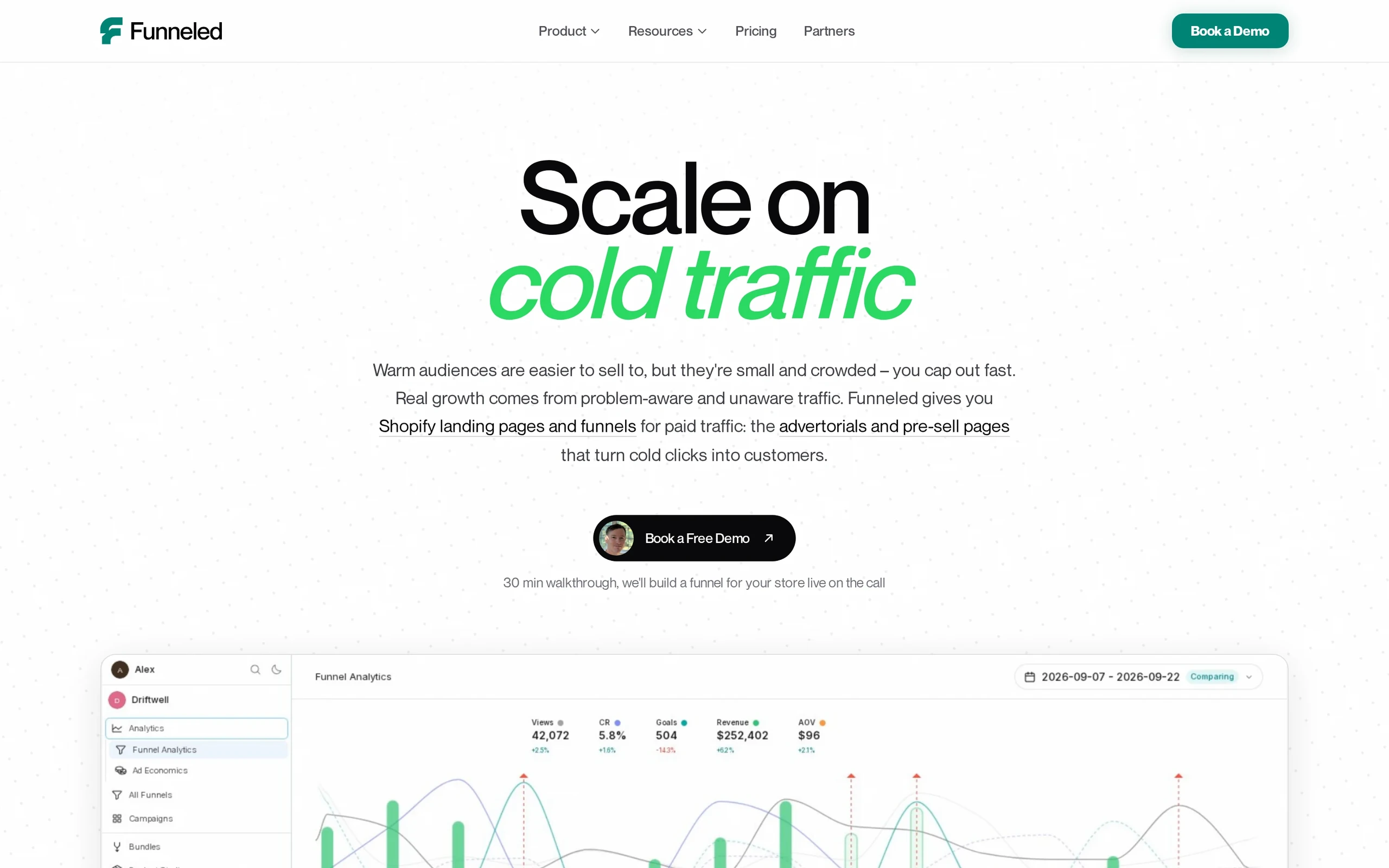
Funneled’s promise is speed: brands spin up post-click funnels and split-test them in minutes, with AI doing — by the profile’s count — 97% of the work. The homepage headline is a media buyer’s sentence: “Scale on cold traffic”. Alongside the service now sit public platform plans ($299–$599) and PageDeck, its page-builder brand — though the homepage itself leads with the Funneled platform and a demo call.[1][2]
The customers are Shopify brands and the agencies who serve them. It is a small room — performance marketing for DTC — where reputations travel by name, which matches everything else in this record: a named reason for selling and a business run on first names.Our read
How it compares
| Business | What it does | MRR or pricing | The difference |
|---|---|---|---|
| Get Funneled | AI funnel builder + productised service | $1,450/mo service · avg sub $842.62 · MRR $17,695 | The service-led, founder-sold end of the shelf |
| Funnelish | Sales funnels and upsells for Shopify | $49–$249/mo | Self-serve, app-store scale, a tenth of the price |
| GemPages | Shopify page builder (funnels, landing pages) | $29–$199/mo | Template-led builder with a large installed base |
Competitor pricing as published on their pricing pages, Nov 2026; Get Funneled’s figures from TrustMRR.[1][9][4] The comparison is almost unfair by design: Funnelish sells software at $49–$249, Funneled sells an outcome at $843 average. They share a shelf and nothing else.
What the site looks like
What to look for
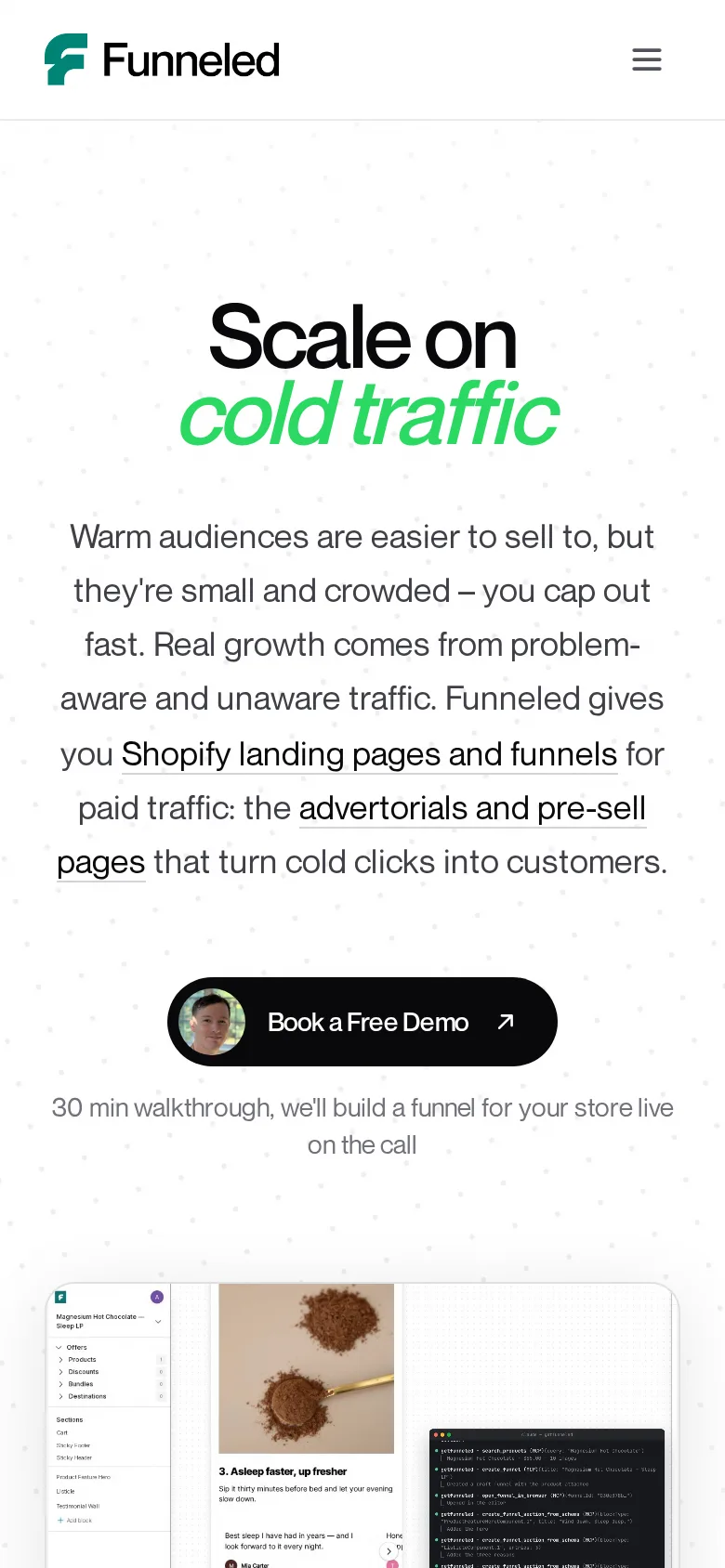
- 1The headline speaks media buyer, not merchant: “Scale on cold traffic” — the customer is whoever buys the ads, not whoever owns the store.Fact
- 2The hero shows the platform itself — a funnel analytics dashboard with an AI builder window beside it. Software is presented first; the service sits underneath.Fact
What to look for
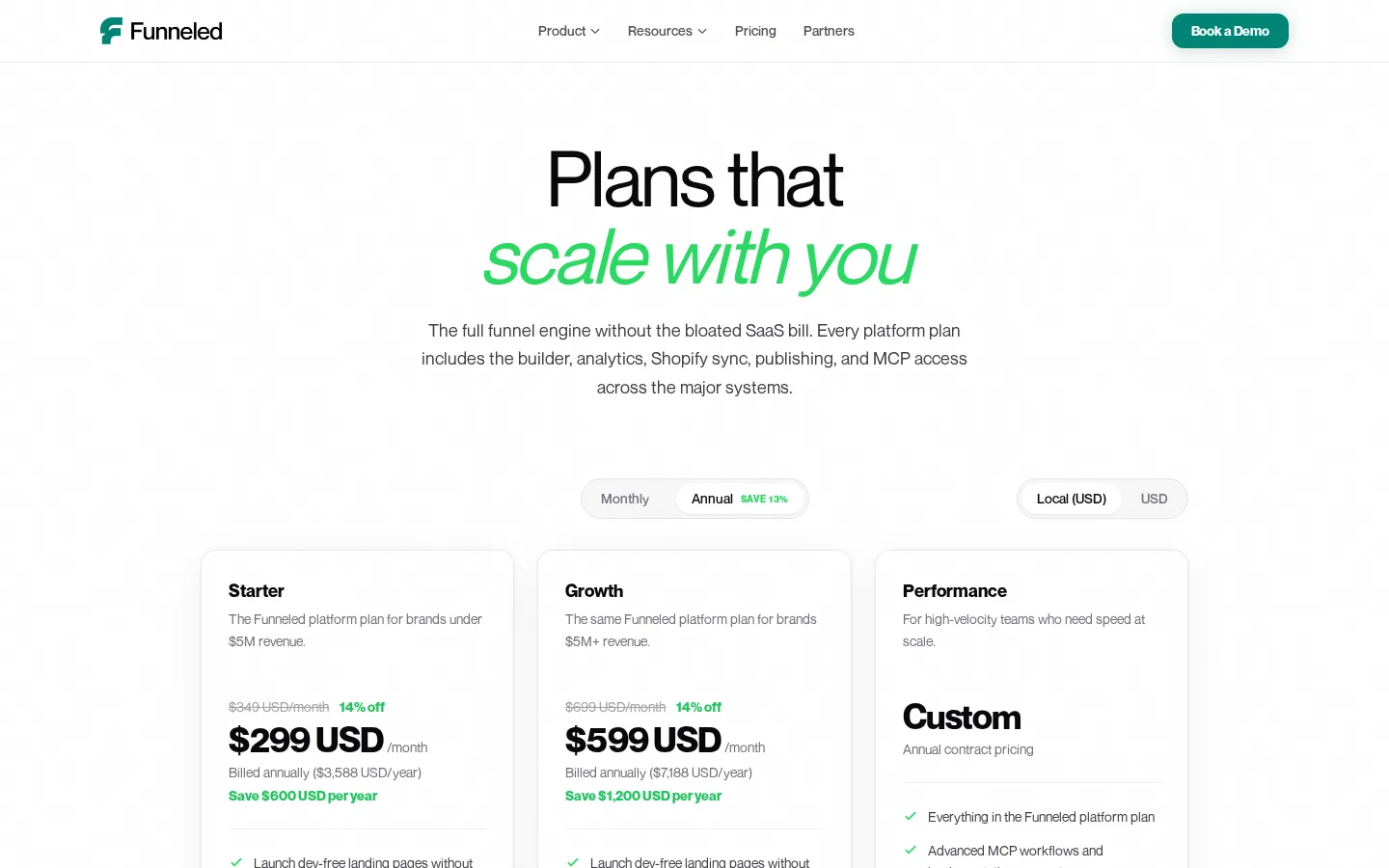
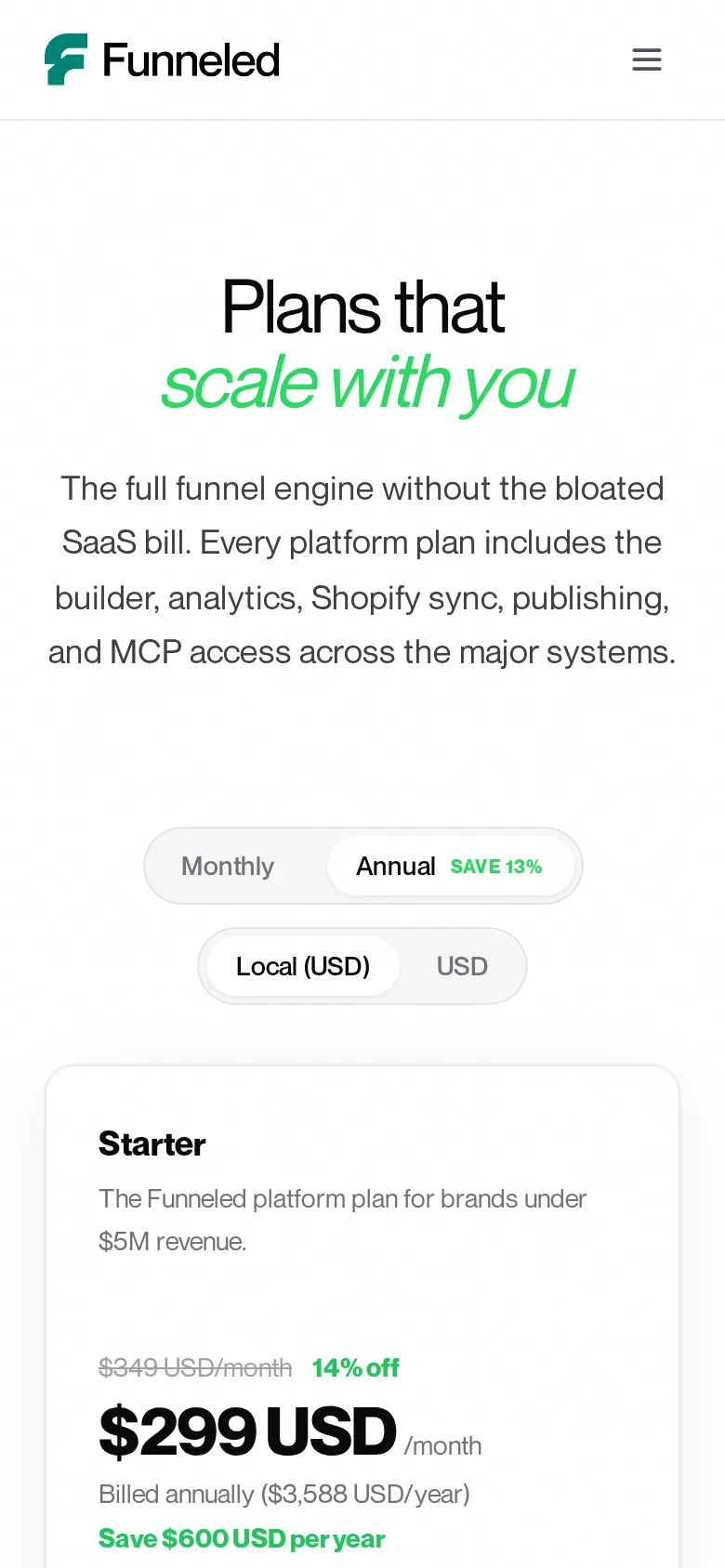
- 1The plans as captured: Starter $299/mo · Growth $599/mo · Performance Custom · Done-For-You $1,450/mo — the same lineup the pricing chapter below works through.Fact
Revenue analysis
Small, lumpy, and carried by a handful of invoices.
The daily series is sparse by design: 14 of the last 29 complete days show $0, and the best day ($4,730, Oct 21) is a quarter of the month’s MRR in one invoice. With 21 subscriptions, the daily chart is a billing calendar, not a demand curve — read the monthly series instead.Derived
| Reading | MRR | Active subscriptions | MRR per subscription |
|---|---|---|---|
| Nov 12, 2026 | $17,695 | 21 | $842.62 |
Daily revenue
TrustMRR snapshot.Fact
October 2026.Fact
Of the last 29 complete days — normal at 21 subscriptions.Fact
The shape of the record
The monthly shape is a sawtooth climbing a hill: $4,064 last December, a $2,625 dip in January, then $12,492 by June, $8,018 in August, $15,393 in September and a best month of $20,146 in October. The last three complete months are up 40.9% on the three before — real growth, on a base small enough that two customers either way would rewrite it.Derived
That is the analytical problem with micro-MRR: every metric in this report is within a few invoices of a different conclusion. The honest way to read Get Funneled is as 21 relationships with a revenue series attached, which is also exactly how a buyer should diligence it.Our read
A note on the numbers
The founding date on the profile is January 1, 2025 — a round date that reads as a profile default rather than a registry fact; treat the age as approximate. Revenue mixes a productised service and a Shopify app in one Stripe account; the split is not visible in the public record, and the $842.62 average blends both. The monthly series sums to $99,511 against a stated all-time $113,783 — the difference predates the visible series (the business reports activity from early 2025).
Market
Post-click tooling for Shopify is a mature shelf where the giants (ClickFunnels) and the app-store natives (Funnelish, GemPages) own distribution. The space left for an indie is the one Funneled occupies: fewer, richer customers who pay for outcomes and answer support by first name.Our read
For buyers: the listing, checked
The cheapest multiple in this library — 1.1× — for a business that is 21 relationships deep.
For calibration: White Glove Content asks 3.5×, Vid.AI 3.1×, Laper 2.2× — all in this same batch of reports. Get Funneled asks 1.1× with the smallest and least documented customer base of the four. The discount is not about quality; it is about transferability. A $1,450-a-month service sold and supported by its founder is worth a software multiple only if the 21 customers stay when he leaves.Derived
Other listings in this batch
| Business | What it does | Subscriptions | MRR | On sale |
|---|---|---|---|---|
| Get Funneled | AI funnel builder / service | 21 | $17,695 | $250,000 · 1.1× |
| White Glove Content | Done-for-you faceless video studio | 482 | $59,391 | $2,500,000 · 3.5× |
| Vid.AI | AI video generator | 750 | $51,332 | $1,500,000 · 3.1× |
| Laper | AI screenwriting software | 1,632 | $53,109 | $1,470,500 · 2.2× |
| Penmo | AI essay writing tool | 6 | $6,725 | $300,000 · 4.4× |
Listing and subscription data from each TrustMRR page, read Nov 12, 2026. Multiples as TrustMRR shows them (ask ÷ 30-day revenue × 12).[1][6][7][8][10]
Penmo makes the point from the other direction: six subscriptions and a 4.4× ask — the market does sometimes pay software multiples for tiny bases. The difference is product type: Penmo is self-serve software, Funneled is a service wearing software’s clothes, and services trade on the founder staying or the customers forgiving the change.Derived
What running it involves
| Area | What we can see | What a buyer must find out |
|---|---|---|
| Team | 2–5 people, bootstrapped[1] | Who actually delivers the service day to day — and whether they stay after the sale |
| Customer list | 21 subscriptions at $843 average | The top 5 customers by revenue, their contract terms, and who their relationship is with |
| Product split | Platform plans ($299–$599), the $1,450/mo service and the PageDeck builder | Revenue and margin split between service and self-serve — they are different businesses to run |
| Reason for sale | Seller cites family (partner’s pregnancy)Founder | Corroborate the timeline pressure — it explains the 1.1× and the negotiation room |
From the TrustMRR listing and profile[1]; the seller’s reason is quoted from the listing message.
Where a new owner could take it
Finish the productisation. The platform plans are already public at $299–$599 and demo-led. Converting service clients onto them — even at lower ARPU — converts founder hours into transferable software revenue, which is precisely what the 1.1× multiple says is missing.Our read
Document the proof. There is no public review record to sell from — no rating on the Shopify listing, no G2 or Trustpilot presence. Turning 21 private relationships into written case studies is the cheapest multiple repair available to this listing.Our read
Questions to ask the seller
| # | Ask | Why it matters |
|---|---|---|
| 1 | Which five customers make up the top half of MRR, and who owns each relationship? | At 21 subscriptions, the customer list is the balance sheet |
| 2 | What exactly does the $1,450 service include, and how many founder hours a month does it consume? | The answer converts the ask into an hourly rate — or into a business |
| 3 | How much revenue is PageDeck app vs service today, and what is the trend? | The split decides whether you are buying software with a service tail or a service with a software hope |
| 4 | Will you stay through a transition, and for how long? | Customers bought a person as much as a product; retention through the handover is the whole deal |
Our list, built from what the public data cannot show.
This is information for due diligence, not investment advice. Oddig has no relationship with the seller or TrustMRR and receives nothing from any sale.
Pricing: $299 platform plans under a $1,450 service
Two price stories in one Stripe account.
| Plan | Price | What it covers |
|---|---|---|
| Starter | $299/mo | Platform plan for brands under $5M revenue (billed annually; $349 monthly) |
| Growth | $599/mo | Same platform for $5M+ brands (billed annually; $699 monthly) |
| Performance | Custom | Annual contract for high-velocity teams |
| Done-For-You | $1,450/mo | The productised service, per the TrustMRR profile |
The public page prices the platform: $299 and $599 a month billed annually, a custom tier above, every plan gated behind a demo call. Underneath sits the Done-For-You plan that the TrustMRR profile states plainly at $1,450 per month. The public record merges all of it: 21 subscriptions averaging a derived $842.62 — above Growth, below the service — so the base blends platform clients with full-service ones.[1][2]
The seam is the page itself: a platform ladder in front, a $1,450 service behind it, and no explanation of which buyer belongs where. For a product sold on trust and first names, the price page is the one place the clarity drops.Our read
Where customers come from
Relationships, not reach.
Semrush counts 2,934 visits in October 2026 and 69 organic keywords — measurable, and still negligible: there is no traffic engine to analyse; customers arrive by outreach and reputation.[3]
FactThe App Store listing (live since May 2026) is the public shopfront — and it carries no rating and no reviews. Inside the exact room where the buyers are, there is no social proof on the wall.[5]
FactTraffic figures are Semrush estimates for October 2026, read Nov 12–13, 2026 — at this domain’s level (2,934 visits) they establish scale rather than precise shares, and its modelled channel split sums loosely. The TrustMRR profile connects no analytics.[3]
Growth strategies
Two moves from the micro end of the B2B playbook.
Timeline
- Jan 12025ProductFounding date on the TrustMRR profile (a round date — treat as approximate).[1]
- Dec2025RevenuePublic series opens at $4,064.[1]
- Jun2026RevenueJune revenue $12,492 — the service finds its level.[1]
- Oct 282026RevenueListed for sale at $250,000 (1.1×), the seller citing family reasons.[1]
- Oct2026RevenueBest month of the record in the same month as the listing: $20,146.[1]
Key takeaways
Get Funneled is a reminder that the exit multiple is a verdict on transferability: the least documented product in this batch carries the cheapest price, because its value lives in 21 relationships and one founder’s calendar.
Why we scored it this way
Copy
- Productise the service before you sell it. Subscription billing, a named offer, an app on the roadmap — the form of SaaS at service prices.
- Document the relationships. In closed ecosystems the listing page is the storefront — and this one is bare: no rating, no reviews, nothing a buyer can underwrite from outside.
Avoid
- Letting the price story blur. Two offers sharing one domain produced the only recurring complaint in a perfect review record.
- Pricing your exit on your best month’s feelings. 1.1× is what haste costs; the same business with a productised base and a transition plan asks differently.
Our predictions
Three dated calls. The third replaces the usual MRR check with the question this listing actually poses.
Track record: the predictions in our earlier reports are still open; the first checks land Dec 1, 2026. We mark each prediction right or wrong on its date and keep the result on the page.
What could prove us wrong
Things that would change our read, and how to check them.
- The app may already be the business. If PageDeck subscriptions are quietly overtaking service clients, the transferability discount is stale and 1.1× is simply mispricing.Check: subscription counts and revenue on Jan 31, 2027.
- A strategic buyer may pay for the relationships, not the multiple. An agency or platform rolling up Shopify services could value 21 happy, named merchants far above 1.1× — the offers count (6 in two weeks) hints at the interest.Check: the listing’s status and terms reported by Mar 31, 2027.
- The review engine may outgrow the founder. If five-star reviews keep arriving through a transition period, the delight was a system, not a person — and this report’s key-person discount was too harsh.Check: Shopify App Store review count and rating in early 2027.
Appendix
Frequently asked
How much does Get Funneled make?
$18,363 in the 30 days to Nov 12, 2026, verified through Stripe on TrustMRR. MRR is $17,695 from just 21 subscriptions — an average of $842.62 each.
Why is Get Funneled for sale so cheaply?
The ask is $250,000 — 1.1 times revenue, the lowest multiple in our library. The seller’s stated reason is family (“my partners pregnant and I want to spend time with my family”). The discount also prices a real risk: at 21 service customers, the founder is most of the business.
What do Get Funneled customers say?
There is no public record to quote: the Shopify listing shows no rating and no reviews, and the business has no G2, Capterra or Trustpilot presence. At 21 subscriptions, customer satisfaction can only be diligenced directly, customer by customer.
Is Get Funneled growing?
The last three complete months are up 40.9%, and October 2026 was its best month ($20,146). With 21 subscriptions, though, a couple of invoices either way rewrite the trend.
Sources
- [1]TrustMRR: Get Funneled — revenue, MRR, subscriptions, daily and monthly data, listing details. Verified through a Stripe API key. Synced 2026-11-12.
- [2]Get Funneled / PageDeck — product description, offer and pricing as shown on the site, Nov 2026.
- [3]Semrush: getfunneled.com — traffic estimates for October 2026 (visits 2,934, channels, keywords), read Nov 12–13, 2026. Modelled estimates at small-domain scale.
- [4]GemPages pricing — competitor pricing as shown on the page, Nov 2026.
- [5]Shopify App Store: Funneled — listing live since May 14, 2026; shows no rating and no reviews, read Nov 2026.
- [6]TrustMRR: White Glove Content — comparable listing data. Verified through a Stripe API key. Synced 2026-11-12.
- [7]TrustMRR: Vid.AI — comparable listing data. Verified through a Stripe API key. Synced 2026-11-12.
- [8]TrustMRR: Penmo — comparable listing data. Verified through a Stripe API key. Synced 2026-11-12.
- [9]Funnelish pricing — competitor pricing as shown on the page, Nov 2026.
- [10]TrustMRR: Laper — comparable listing data. Verified through a Stripe API key. Synced 2026-11-12.
What we could not verify: the revenue split between the $1,450/mo service and the PageDeck app is not visible in the public record, and the founding date (Jan 1, 2025) reads as a profile default. There is also no public review record for this business — its Shopify listing shows no rating and no reviews, and it has no G2, Capterra or Trustpilot presence — so this report has no customer-voice section. The seller’s reason for selling is quoted from the listing and taken at face value; a buyer should corroborate it.
Screenshots © Get Funneled, used for commentary. Oddig has no business relationship with Get Funneled. Numbers change daily; check the sources for the latest.


Comments are closed for this article.