

No camera, no host, no studio: GoMotion AI turns a topic into a finished documentary and takes $73,992 a month for it
GoMotion AI sells the whole long-form faceless pipeline — scripting, voiceover, footage research and editing — as one click for YouTube automation channels. Its verified record is three months long and steep: $18,411 in August, $47,663 in September, $87,405 in October, with MRR of $73,992 across 1,613 subscriptions.
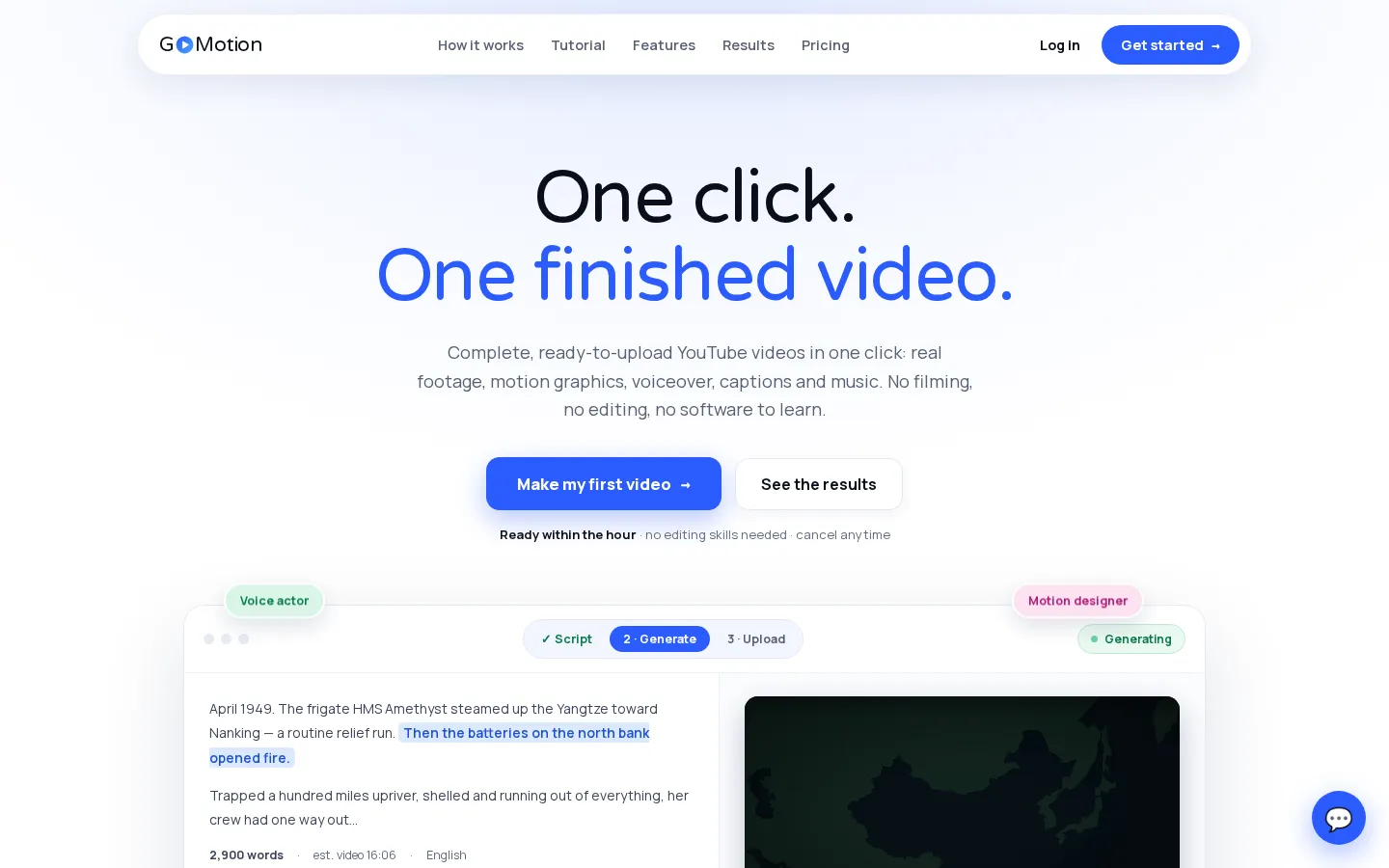
Product at a glance
Summary
What this business is
GoMotion AI is a one-click documentary machine for faceless YouTube: it cuts the days of scripting, voiceover, footage research and editing that every long-form video takes down to a single generation run. The verified record is short and steep — revenue of $18,411 in August 2026, $47,663 in September and $87,405 in October, with 1,613 subscriptions paying a derived $45.87 a month against a $27/$59/$107 ladder. The discovery story is written in its traffic: 112,149 visits in Aug–Oct 2026, spiking to 62,031 in September — then halving in October while revenue doubled. Its top search terms are misspellings of its own name, and 99% of its social traffic is YouTube. Buyers hear about it from other creators, then come and pay.
Why these scores? See the reasons in Key takeaways →
Momentum
New. Only three complete months on record (Aug–Oct 2026), each far above the last, with November pacing level. Under our rules a record this young is labelled New whatever the slope.Derived
Best suited for
Builder (main). Chaining script, voice, footage and edit into one reliable long-form pipeline is the product — and the hard part.
Operator (second). A live experiment in whether long-form automation out-earns the shorts factories crowding the same buyers.
What you need to start. Margins that survive model costs at $27 entry pricing, and a channel the founder controls before the shorts tools add a long-form mode.
Key findings
Product
Product overview
The long-form end of a shorts market.
GoMotion AI generates complete documentary-style videos for faceless YouTube channels: topic in, finished long-form video out. The TrustMRR profile describes the saving plainly — it cuts the days of scripting, voiceover, footage research and editing that every long-form video takes.[1]
That positioning is the whole strategy. The verified AI-video money in this library sits in short-form tools — StoryShort, Zebracat, Revid all sell clips measured in seconds. GoMotion sells the format those tools structurally cannot: a 15–30 minute documentary whose economics (watch time, mid-roll ads) are entirely different from a Short’s.[1][3][4]
The buyer is the faceless-channel operator: no camera, no voice, a publishing schedule. The Agency tier at $107 a month is aimed at operators running several channels or client work — the derived average subscription of $45.87 says the base is still mostly solo creators on Creator and Studio.[1]
How it compares
| Business | What it does | MRR or pricing | The difference |
|---|---|---|---|
| StoryShort | AI short-form video generator (faceless shorts) | MRR $22,386 | Shorts only; GoMotion sells long-form documentaries |
| Zebracat | Text-to-short-video for marketing and social | $39–$199/mo | Short marketing clips and avatars, not documentaries |
| Revid | Short-form generator with a viral-format library | $39–$199/mo | Built around trends and shorts; no long-form pipeline |
StoryShort’s MRR is Stripe-verified on TrustMRR (read Nov 19, 2026); Zebracat and Revid prices are from their public pricing pages, Nov 2026. GoMotion’s own ladder ($27–$107) undercuts all three at entry.[1][3][4][5]
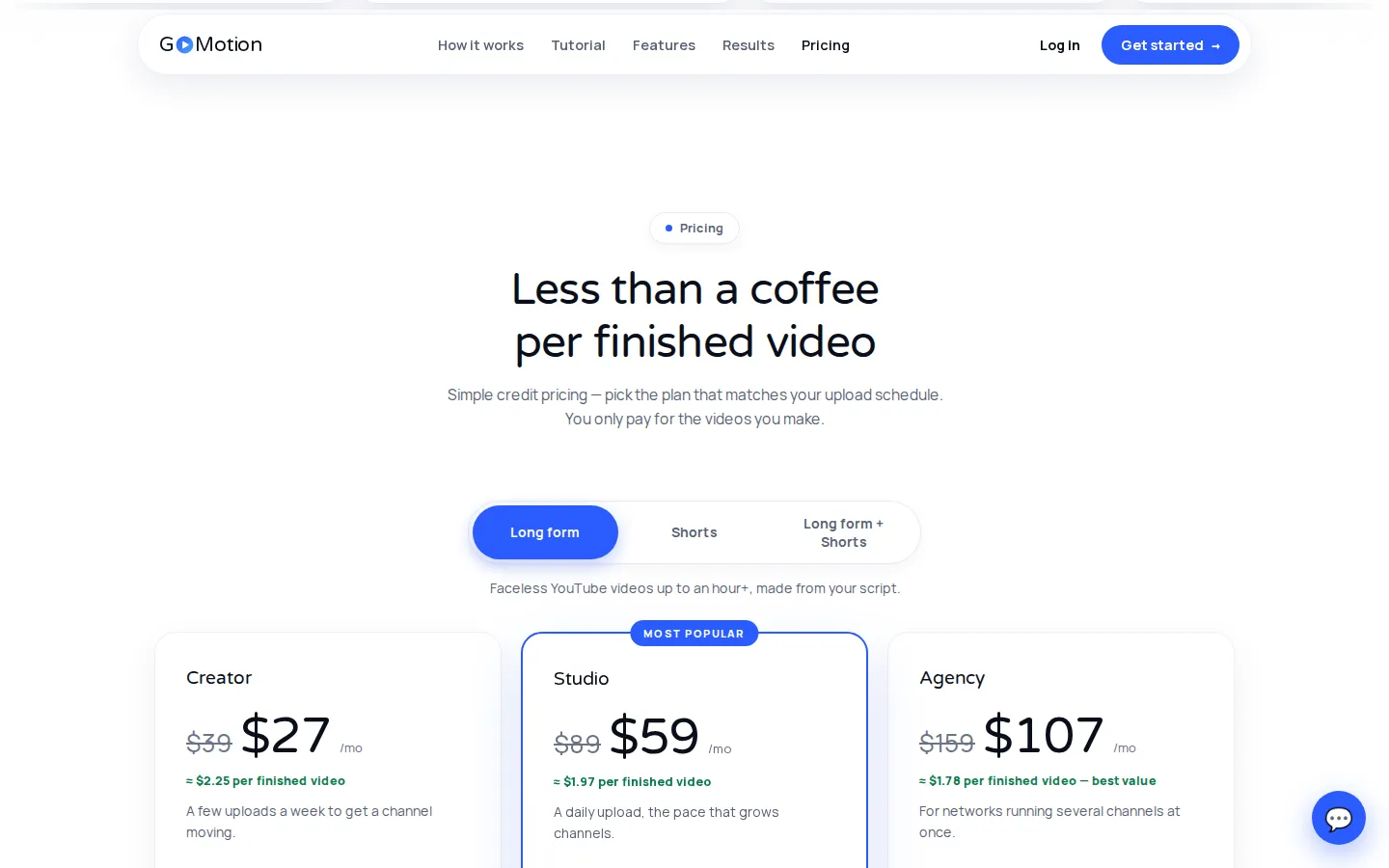
What the site looks like

What to look for
- 1The promise is the pipeline itself — documentary out, no filming, no editing timeline.Fact
- 2Output examples do the persuading: the buyer is shown finished long-form videos, not feature lists.Fact
What to look for
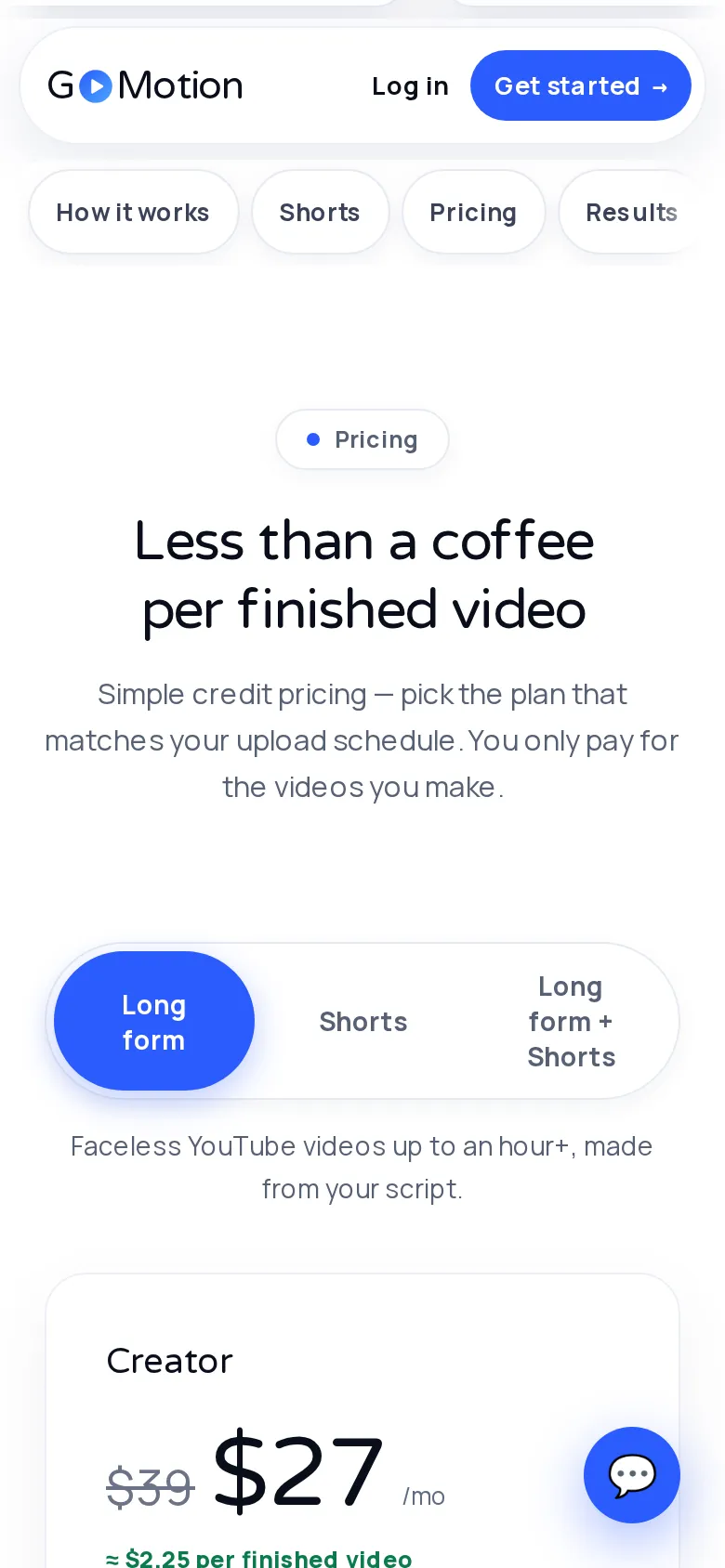
- 1Three tiers named for the buyer’s scale — Creator, Studio, Agency — not for features.Fact
- 2The tiers are sold on cost per finished video (≈$2.25 Creator, ≈$1.97 Studio, ≈$1.78 Agency) under strikethrough anchors ($39/$89/$159) — the documentary priced like a coffee.Fact
Pricing
Three tiers named after the size of the operation, not the feature list.
| Plan | Price | What it covers |
|---|---|---|
| Creator | $27/mo | Entry tier for a solo channel |
| Studio | $59/mo | Mid tier — where the derived $45.87 average says the base clusters |
| Agency | $107/mo | Multi-channel and client-work tier |
The ladder is priced against short-form rivals, not against the value of the output: Zebracat charges $39–$199 for clips, Revid $39–$199 for shorts, and GoMotion’s finished documentaries start at $27. Either GoMotion’s generation costs are structurally lower, or the entry tier is a land-grab that gets repriced once the base is built. The same pricing block now tabs in Shorts and bundle plans beside Long form — the pure long-form wedge is diluting in public, in the founder’s own pricing page.Our read
Revenue
Revenue analysis
A three-month record with no flat month in it.
Daily revenue for the last 30 days (the partial sync day is excluded). Weekends are marked in blue; the best day in the window is dark navy.
| Reading | MRR | Active subscriptions | MRR per subscription |
|---|---|---|---|
| Nov 19, 2026 | $73,992 | 1,613 | $45.87 |
Daily revenue
Oct 22, 2026
Nov 1–19, partial month
daily rows summed, to Nov 19
record opens Aug 2026
The shape of the record
The monthly shape is a staircase: $18,411 → $47,663 → $87,405. Growth of that shape is usually a launch, a viral demo or an affiliate push rather than compounding subscriptions — and the MRR line supports the suspicion: at $73,992 it sits below October’s cash, meaning some of the billings are longer plans or one-off upgrades rather than new monthly subscribers.Derived
The daily line cooled after Oct 22’s $4,639 peak but has not collapsed: November’s $58,085 in 19 days is a ~$3,060 daily pace, close to October’s ~$2,820 daily average. The business is holding its new level while we wait to see if it can grow from it.Derived
A note on the numbers
Two figures disagree slightly. TrustMRR’s header snapshot reports $96,962 for the last 30 days; its own daily rows sum to $93,497 over the same window. We use the daily sum throughout this report — it is the figure a reader can recompute from the chart. The profile’s “MRR growth +38.8%” snapshot likewise does not match the level path of the monthly line, so we rely on levels, not the snapshot’s growth field.[1]
Market
Faceless YouTube automation is a proven, crowded spend: StoryShort verifies $22,386 MRR in shorts alone, and Zebracat and Revid both sustain $39–$199 ladders. Long-form is the under-served end — higher revenue per video for the channel owner, higher generation cost per video for the tool. GoMotion’s three months suggest operators will pay documentary prices; its generation costs at a $27 entry tier are the number nobody outside can see.[1][4][5]
Timeline
- Jul 162026ProductFounding date on TrustMRR; founder Iker, based in Spain.[1]
- Aug2026
- Sep2026RevenueRevenue reaches $47,663 — 2.6× August.[1]
- Oct2026RevenueBest month of the record: $87,405, with the best single day on Oct 22 ($4,639).[1]
- Nov 192026RevenueNovember at $58,085 with 12 days left; MRR $73,992 on 1,613 subscriptions.[1]
Customers
Where customers come from
YouTube and word of mouth do the selling — the website is the till.
Direct is 58.63% of 112,149 quarterly visits, and sessions average 4:08 across 2.46 pages — intent or work, not browsing. September spiked to 62,031 visits; October fell back to 30,012 while revenue doubled. Reach is not the constraint; conversion is.[2]
FactOrganic social is 13.22% of traffic and 99.06% of that is YouTube. The product is discovered on the platform it serves — tutorials, channel-economy videos, creator conversation — a channel that fits the buyer exactly and that GoMotion does not own.[2]
FactOrganic search is 22.45% with a 70% branded share — and the “non-branded” leaders are the brand’s own misspellings (“go motion” 72.94% of clicks, “gomotaion”, “gomotiom”). Paid search is 0.01%. Nobody buys or SEO-ranks the category here; the name travels by voice.[2]
FactTraffic figures are SimilarWeb estimates for gomotionai.com, Aug–Oct 2026 (112,149 visits: Aug 20,106, Sep 62,031, Oct 30,012), read Nov 19, 2026 — modelled data, not the company’s analytics. Geography is the faceless-automation map: India 32.94%, United States 25.53%, Mexico 9.40%, Brazil 9.13% — operators in lower-cost markets producing for English-language ad rates.[2]
Growth strategies
Two moves define the play so far.
Takeaways
A format bet that is winning its first quarter — with the two numbers that matter (what generation costs, whether October’s buyers renew) still invisible from outside.
Why we scored it this way
Copy
- Take the format seat the crowd leaves open. Every verified rival sells shorts; GoMotion sells documentaries, and tripled into the gap.
- Price the ladder by operation size. Creator/Studio/Agency names turn upgrades into business growth, and the average subscription already sits mid-ladder.
- Word of mouth leaves typos. When your top search terms are misspellings of your own name, discovery is people telling people — feed that, and do not mistake it for SEO.
Avoid
- Do not mistake word of mouth for a channel you own. YouTube conversation and name-recognition carry this funnel; both can move on, and there is no owned surface (search, ads, content) underneath them yet.
- Do not read three months as a trend. There is no renewal cohort in this record yet; the first real test is whether October’s buyers are still paying in January.
Predictions
Our predictions
Three dated calls, all checkable on TrustMRR.
Track record: the predictions in our earlier reports are still open; the first checks land Dec 1, 2026. We mark each prediction right or wrong on its date and keep the result on the page.
What could prove us wrong
Things that would change our read, and how to check them.
- October was a launch spike, not a level. If the autumn growth was annual-plan billings and a launch push, the daily line fades through December.Check: December verified revenue below $60,000 would break the “new level” read.
- Word of mouth was a wave, not a base. The September traffic spike (62,031 visits) already halved by October; if the creator conversation moves on, discovery decays and growth follows it down with a lag.Check: monthly visits below ~15,000 by January 2027 alongside stalling revenue.
Appendix
Frequently asked
How much does GoMotion AI make?
$93,497 in the 30 days to Nov 19, 2026, summed from TrustMRR’s daily rows (its header snapshot reads $96,962). MRR is $73,992 from 1,613 subscriptions; all-time verified revenue is $211,564.
What does GoMotion AI do?
It generates complete long-form documentary videos for faceless YouTube channels — script, voiceover, footage research and editing in one pipeline — for creators and agencies running automation channels.
How much does GoMotion AI cost?
Creator $27/month, Studio $59/month and Agency $107/month. The average subscription pays a derived $45.87 a month.
Who founded GoMotion AI?
Iker, a solo founder based in Spain, per the TrustMRR profile. The business is bootstrapped and its verified record opens in July 2026.
Sources
- [1]TrustMRR: Gomotion AI — revenue, MRR, subscriptions, daily and monthly data. Verified through a Stripe API key. Synced 2026-11-20.
- [2]SimilarWeb: gomotionai.com — traffic estimates for Aug–Oct 2026 (112,149 visits, channels, countries, keywords), read Nov 19, 2026. Modelled estimates, not measured analytics.
- [3]TrustMRR: StoryShort — competitor MRR $22,386 and pricing, read Nov 19, 2026.
- [4]Zebracat pricing — competitor pricing $39–$199/month as shown on the page, Nov 2026.
- [5]Revid pricing — competitor pricing $39–$199/month as published by Revid, Nov 2026.
- [6]GoMotion AI — product description, tiers and positioning as shown on the site, Nov 2026.
What we could not include: no customer-voice section — we found no review-platform pool (G2, Capterra, Trustpilot) with enough GoMotion reviews to summarise honestly, so the section is omitted rather than padded. Generation costs per video are not public, so the margin question in the pricing section is flagged, not answered. The split of direct traffic between the marketing site and the logged-in app is not separable in SimilarWeb’s domain total.
Screenshots © GoMotion AI, used for commentary. Oddig has no business relationship with GoMotion AI. Numbers change daily; check the sources for the latest.
More reports to read

 CreativeClawCreator tool · Usage$110,939 in October — earned from inside someone else's product, which is both CreativeClaw's genius and its riskRevenue · 30 days$105,899MRR$14,470 Rising fast
 Kolbo.AICreator tool · SubscriptionNot one down month on the record: Kolbo.AI's streak is worth $48,197 a month and countingRevenue · 30 days$110,770MRR$48,197 Rising fast

 Url2PinCreator tool · SubscriptionPinterest is the shop window and links are the stock: Url2Pin turns other people's pages into $2,230 MRRRevenue · 30 days$3,541MRR$2,230 NewFor sale
 FruttiCreator tool · Subscription$19,000 buys it outright — an AI fruit-shorts generator doing $4,329 MRR, five months after launchRevenue · 30 days$4,862MRR$4,329 SteadyFor sale
 PDF VaultCreator tool · Mostly one-timePDF Vault: $10,412 in 30 days — can the license-drop model keep working?Revenue · 30 days$10,412MRR$2,322 DecliningFor sale
 Vid.AICreator tool · SubscriptionVid.AI makes $51,332 a month generating faceless videos — down from $89,846 at its January peak, and for sale at $1.5MRevenue · 30 days$39,697MRR$51,332


Comments are closed for this article.