
On a Saturday in May 2020, Xavier Guillemane got the email every Android developer dreads. Podcast Addict — the podcast player he had built alone over nine years, closing in on ten million downloads — had been hit with a Google Play suspension. Not a rejection, not a warning. Suspended: the listing deleted, the app unfindable, and AdMob, the ad network that paid his salary, switched off at the same moment. His app was suspended from Google Play for content it didn’t host, didn’t create, and couldn’t remove: podcasts made by other people.
It took three days, a public escalation, and an apology from Google’s SVP of Android to undo. Six months later, Guillemane quietly rebuilt his business model so it could never happen the same way again. This case follows the suspension, the appeal, and the rebuild — with every number labeled by where it came from.
Evidence note: the suspension, its stated reason, and the reinstatement are confirmed by Google itself — a spokesperson’s statement and a public apology. Download figures are founder-stated or store-displayed, and are labeled as such. Guillemane has never published a revenue figure; where money is estimated below, the estimate and its method are named.
What Happened: The Podcast Addict Google Play Suspension, May 2020
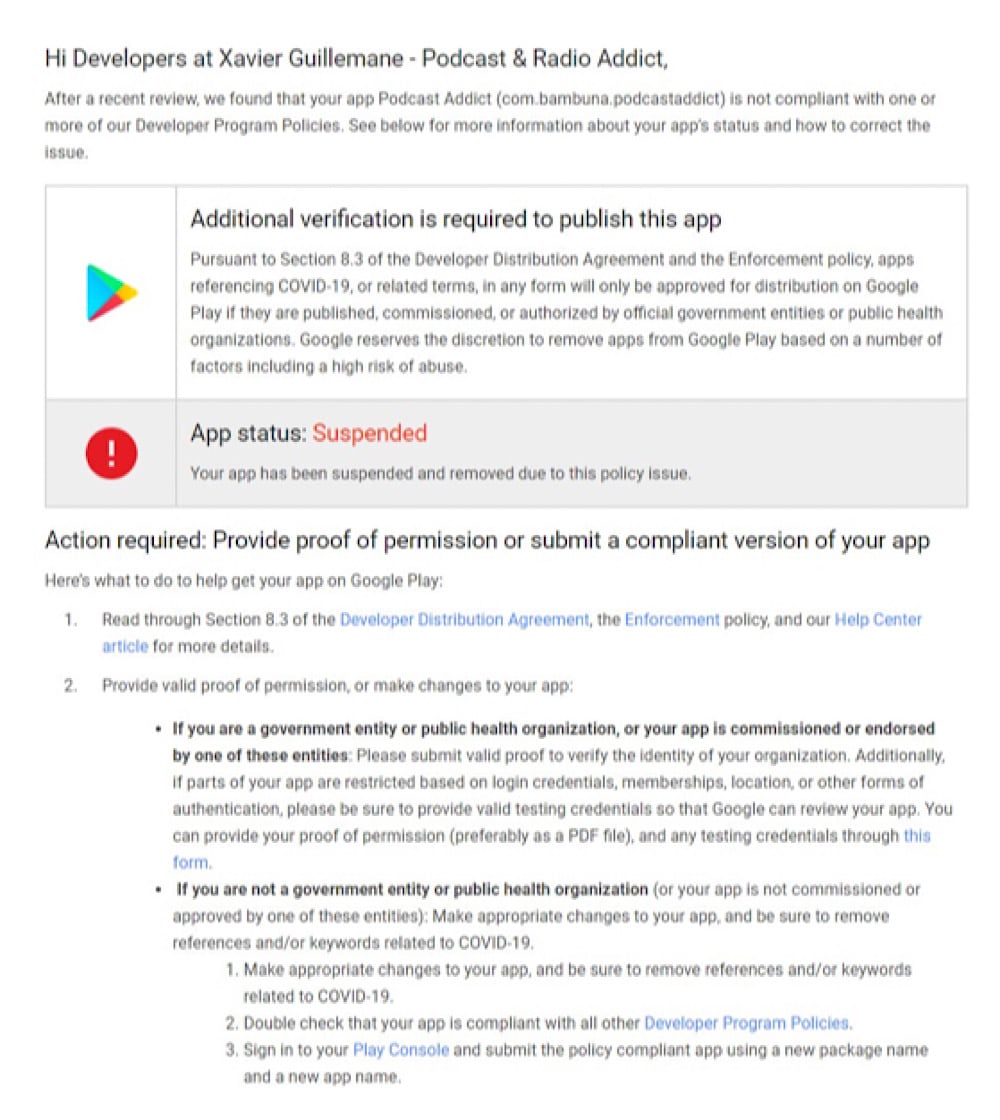
The notice: banned under Section 8.3 for third-party content
Podcast Addict does not host podcasts. It catalogs third-party RSS feeds — some 750,000 shows at the time. In spring 2020, Google Play adopted what its spokesperson later called an “intentionally cautious approach” to pandemic content: under Section 8.3 of the Developer Distribution Agreement, any app “referencing COVID-19, or related terms, in any form” could be distributed only if published, commissioned, or authorized by an official government entity or public-health organization. A podcast catalog run by one developer in Lyon could never qualify — and the policy, as the April 2020 developer guidance made plain, also barred monetization for referencing apps entirely.
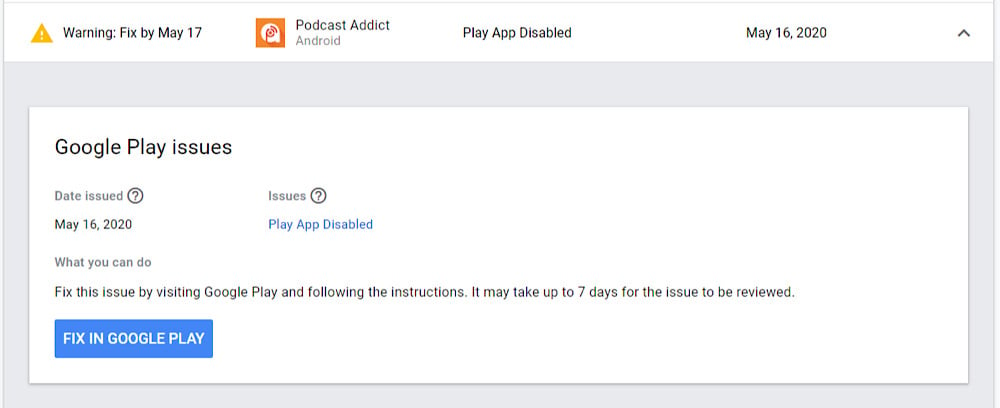
On Saturday, May 16, 2020, the suspension landed. The Play page returned “Not found.” AdMob stopped serving. Installed copies kept playing, but there were no new installs, and anyone who changed phones could not re-download the app they used every day. Guillemane posted the suspension notice publicly the same day, noting that Google’s own podcast app and YouTube carried the same shows, and wrote that once the listing is gone, an Android app “basically doesn’t exist.” He filed the formal appeal immediately; Google quoted up to seven days for a decision. He privately estimated the best case at 21 days.
The 72 hours: an APK, a falsifiable claim, and a public escalation
Sunday, May 17, he published the official APK on his own site, signed with the official key — so sideloaded installs would update seamlessly from Play if the app returned. APKMirror mirrored it; the tech press linked to it. His users had a working channel within 24 hours, whatever happened next.
Monday, May 18, he published the fact that broke Google’s stated reason: the flagged keyword, he wrote, “never did appear on the Play Store app page nor does it appear in the app source code. The app gives access to 3rd party content…” The official @GooglePlayDev account replied in public, asked for his appeal ID, and said the case was escalated. The Verge, Techdirt and The Register ran the story the same day; to Podnews he sharpened the parity argument — by this logic, the policy “should also apply to all web browsers, news apps and social networks.”
Tuesday, May 19, Hiroshi Lockheimer, Google’s SVP for Android, Chrome OS and Play, apologized publicly: the team was “still sorting out kinks in our process as we combat Covid misinformation, but this app should not have been removed.” A Google spokesperson confirmed the reinstatement to press. Total time off the store: roughly three days, against a quoted appeal wait of up to seven.
Reinstated unchanged — the trailing-space resubmission
Read the acceptance email closely, because it reveals how the machine works. The appeal was accepted — but the email did not say “our mistake.” It told Guillemane to fix the issue and resubmit. There was nothing in his app or listing to fix, so he added a trailing space to the end of a store listing field, resubmitted the app unchanged, and it went live the same day. The system required a diff; he gave it a space.
“Apologies to Podcast Addict fans today. We are still sorting out kinks in our process as we combat Covid misinformation, but this app should not have been removed. Carry on with your podcasts, folks!” — Hiroshi Lockheimer (@lockheimer), May 19, 2020
Why a Catalog App Was Structurally Exposed
One listing is the whole business
Podcast Addict began as a hobby in 2011, built by a bank software engineer in California; Guillemane quit to run it full-time in 2014 and has done everything since — development, support, releases — alone. Distribution, discovery, updates, and ratings accumulated since 2012 all lived on a single store listing. When that listing was deleted, none of those assets moved with him. That is the first structural fact of this case: for a store-native app, the listing is the business’s address, and the platform owns the street. (The mirror-image case in our platform risk case library — Sarafan — shows the same dependency arriving slowly, through terms tightening over years, rather than in one Saturday email.)
What happens to ad revenue when your app is suspended
The second structural fact is that both of his Google switches flipped at once. The app was free; income came from one small AdMob banner — chosen, he wrote, as the least intrusive format — plus a one-time purchase to remove it, and a Patreon. A suspension does not pause that income politely: the listing disappears and ad serving stops in the same act, so new-user revenue and existing-user revenue go to zero together.
The model was fragile even on good days. A podcast app plays in the background — by Guillemane’s own count, over 98% of usage — so the banner that pays for everything is almost never visible; banner prices fall year after year while servers and support grow with the user base. Podnews, working from impression counts visible in 2019 (roughly 210 million impressions a month) and an assumed $0.15 banner CPM, estimated on the order of $32,000 a month in ad revenue. That is a third-party estimate Guillemane never confirmed — useful as an order of magnitude for what a suspension puts at risk, not as a damage figure.
Not Once: The Enforcement Record, 2016–2024
May 2020 reads differently once you see it was the fourth strike, not the first:
- January 2016 — Play suspends Podcast Addict (then past 4 million downloads) under the sexually-explicit-content policy — for third-party podcasts it merely linked to. Reinstated quickly; the exact duration was never documented.
- September–October 2019 — AdMob blocks nearly all ads on the same explicit-content rationale; the app loses 99.9% of its ad impressions and revenue overnight. After Android Police covers the story, Google contacts him within about an hour and concedes there was no violation.
- April 2020 — AdMob stops ads again, citing “unauthorized filesharing” over downloadable podcasts. Cleared on appeal in about a day.
- October 2024 — the app is taken down again, briefly, over an alleged violent-extremism violation; the notice, once more, does not say what triggered it, and the app returns quickly.
A catalog app’s content is definitionally other people’s content. Every automated sweep — for explicit material, for file-sharing, for pandemic terms, for extremism — lands on the cataloger. Guillemane summarized it himself in November 2020: “Google can choose to stop the monetization whenever they want to, which happened 3 times already since the beginning of the year.”
Can Google Suspend Your App for Third-Party Content?
Yes — and this case is the documented proof, with the mechanism in writing. Google’s suspension notice did not claim Guillemane had created or uploaded anything. It cited Section 8.3: an app referencing COVID-19 “in any form” required government or public-health authorization. An aggregator references whatever its sources publish; a podcast catalog with 750,000 feeds references everything. Guillemane’s rebuttal — the keyword appears nowhere in his listing or code — was factually correct and procedurally irrelevant until a human with authority read it, because the enforcement was automated and the policy made no exception for catalogs, browsers, or news readers. If your app surfaces user-generated or third-party content, your policy exposure is the union of everything your sources publish, enforced at machine speed. That is the generalizable fact; Podcast Addict is simply where it left a paper trail.
The Aftermath: A $0.99 Subscription as a Platform-Risk Hedge
Most coverage ends at the apology. The business story doesn’t. In November 2020 — six months after the suspension, in a year when Google had stopped his monetization three times — Guillemane launched Podcast Addict Premium: $0.99 a month or $9.99 a year, still the price today. His announcement is the most candid document in this case: nine years of free and ad-supported was not sustainable; banner revenue fell yearly even as users grew; the one-time ad-removal purchase paid once for updates that last forever; and Google could stop the rest whenever it chose. Premium — cross-device sync, casting, no ads, no upsells — would, he promised, leave “99.99% of the app” free forever.
Read that launch for what it is: not a growth tactic but a hedge, priced at a dollar a month, against the next Saturday email. It also carries a visible cost — recent reviews include long-time users angry that subscription replaced the one-time purchase and that free-tier ads grew fuller. A hedge bought under pressure is still a product decision your users will judge. Both halves of that sentence are the lesson.
The Google Play Appeal in 2026: How Long, and What Changed
The 2020 path: one form, a seven-day quote, one tweet
In 2020 the formal route was a single appeal through a web form, a quoted wait of up to seven days, and no intermediate status. What actually resolved Guillemane’s case was parallel and public: press coverage within 48 hours, the platform’s own support account escalating in the open, and an SVP’s apology on day three. His apology thread then filled with developers for whom none of that happened — the standing reminder that his timeline is the exception that documents the rule.
The 2026 path: Policy Status, one appeal, a 180-day deadline
Today’s system is more documented and no less automated. Google’s 2025 safety reporting says over 1.75 million policy-violating apps were prevented from publishing and more than 80,000 developer accounts banned in a single year. Appeals now start from a Policy Status page in Play Console — still one appeal per enforcement action — and the outcomes are tiered in writing: a rejection costs an update, a removal costs visibility, a suspension costs your users, stats and ratings and can never reuse the package name, and an account termination ends the business. Under policy announced in October 2025, terminations carry a hard 180-day appeal window for terminations from January 28, 2026; after that, the matter is closed. So “how long does a Google Play appeal take” now has two answers: the documented process, measured in forms and windows — and the undocumented one, which in the only fully public case we have took three days and a headline. Developers checking their own exposure can pair this with the Google Search Console signals our library tracks on the search side; enforcement risk rarely announces which surface it will arrive on.
So the 2026 version of Guillemane’s playbook is narrower than the 2020 one. Going public still shortens clocks — twice in his record, coverage moved Google faster than the queue (an hour in 2019; three days against a seven-day quote in 2020). A sideload channel you control still buys survival time. But the move that does not depend on a journalist or an executive is the November 2020 one: a revenue line the platform doesn’t switch. If your income stops the day your listing does, you don’t have a distribution channel. You have a landlord with an off switch.
What This Case Cannot Prove
Three limits, plainly. The cost: no figure for Podcast Addict’s suspension losses exists in the record; the mechanism is documented, the amount is not, and any article quoting one is estimating silently. Transferability: the escalation worked for a developer with almost ten million downloads and press reach; the counter-evidence sits in the same apology thread. Category blame: the spring-2020 sweep hit many app types; this case documents one false positive in detail, not the sweep’s overall accuracy.
Oddig Verification — Podcast Addict Today (Nov 2, 2026)
Checked for this case: the app is live on Google Play under the same developer account (“Xavier Guillemane — Podcast & Radio Addict”), install bracket 10M+, 4.59 stars across ~596K ratings, version 2026.13 shipped October 22, 2026; AppBrain estimates ~13M cumulative installs and ~890 installs a day over the last 30 days. In-app purchases run $0.99–$9.99; Premium remains $0.99/month or $9.99/year. We also checked a claim circulating on content-farm sites that Podcast Addict was acquired by Acast in 2024: Acast is a listed company that discloses every acquisition, no disclosure or trade coverage exists, and the developer account has never changed — we treat the claim as false. A trade brief’s reference to a further suspension “in 2022” is likewise uncorroborated and appears to be a date error for 2020.

Sources (all external links nofollow): Guillemane’s @PodcastAddict posts, May 16–18, 2020; Podcast Addict changelog, November 2020 (podcastaddict.com); Google’s suspension notice as reproduced by 9to5Google, May 19, 2020; Google spokesperson statement, May 19, 2020; H. Lockheimer on X, May 19, 2020. Coverage: The Verge; The Register; Techdirt; Podnews (2019–2020); Android Police (2019–2020); PocketNow (2016); Podcast News Daily (2024). Policy comparison: Google Play Console Help; Google policy update, October 2025. Current state: Google Play listing and AppBrain, checked Nov 2, 2026. Research cutoff: Nov 2, 2026.