

Cal AI is often told as a story about young founders and a large exit. The more useful question is why a new calorie tracker could grow in a crowded category—and which parts of that result a new team can actually test.
In an August 2026 Starter Story interview, Zach Yadegari and Blake Anderson revisited the growth and sale of Cal AI, a mobile app that lets people log food by taking a picture. They were joined remotely by Jake Castillo, who described a marketing and operations role, and Henry, who described leading the technical team. This was a four-person founder story about one product, not four independent “millionaire app” case studies. The interview briefly discusses other projects the people had built or planned; those projects are not Cal AI revenue and should not be combined with its numbers.
Zach said Cal AI generated about $30,000 in its first month, more than $100,000 in the second, and reached roughly $1 million in a month within eight months. He and Blake discussed a roughly $50 million annual revenue run rate or expectation at the time of filming. These are founder-reported figures and projections, not an audited income statement. Separately, MyFitnessPal announced on March 2, 2026 that it acquired Cal AI and would keep it operating as a standalone product. The official announcement confirms the acquisition but does not disclose a price. The interview says the sale was for millions without revealing the final consideration; neither source supports an exact sale price.
Start around 2:24 for founder-reported numbers, 2:48 for the team's roles, and 3:59 for how the co-founders handled acquisition offers. Compare those claims with MyFitnessPal's official acquisition announcement rather than treating the interview as audited financial reporting.
A familiar need with a different first action
n
n
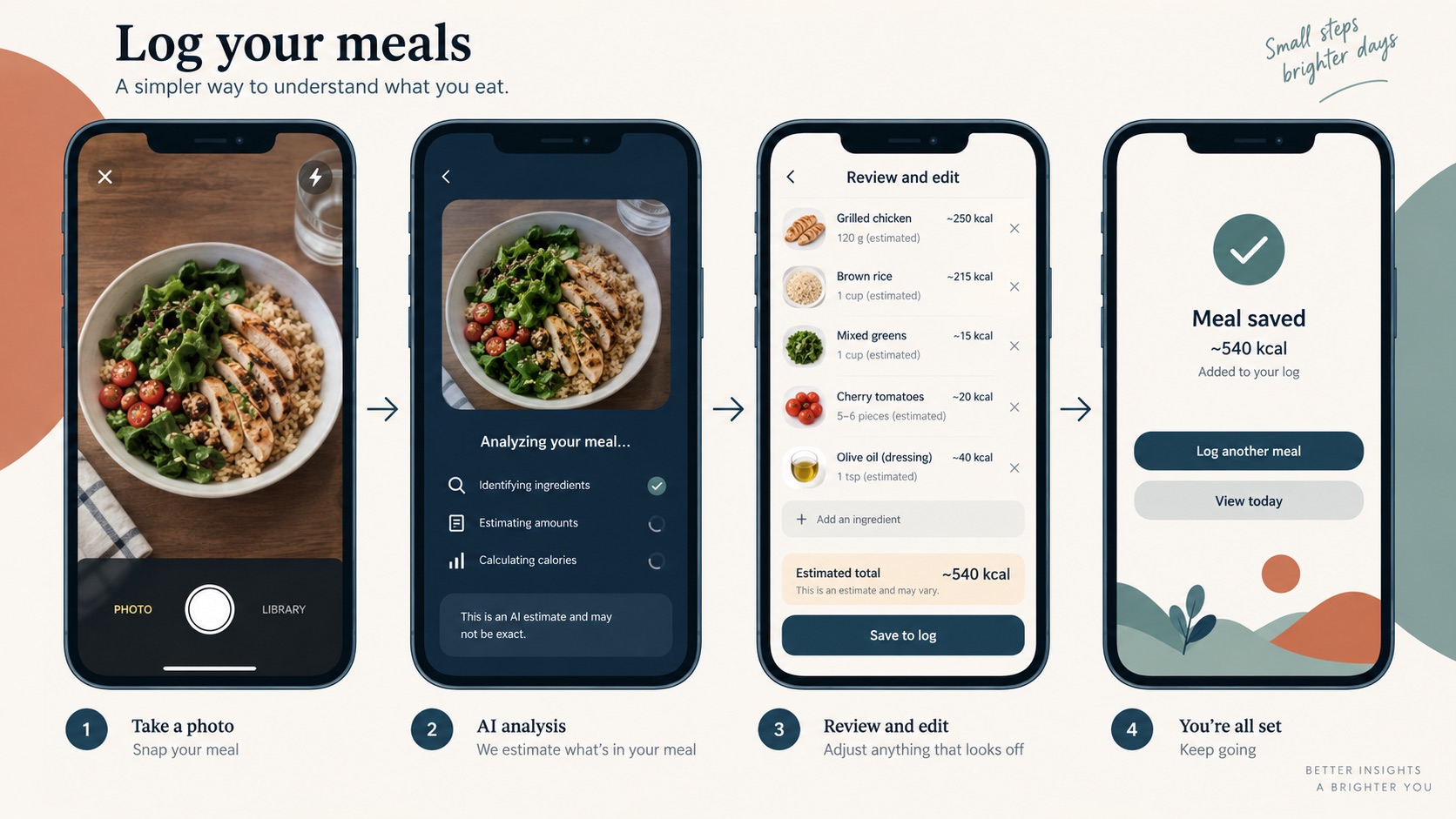
Most calorie trackers ask users to search for a food, choose a serving size, and enter the meal. That can be accurate when the user is diligent, but it creates friction several times a day. Cal AI made the first action a photo. Its official site now describes photo, barcode, and text input and displays estimates for calories, protein, carbohydrates, and fat. The product did not invent the desire to track nutrition. It changed the work required to begin.
That distinction explains why the opportunity was bigger than “AI can recognize food.” A model alone does not give a person a usable habit. The product has to show a plausible result quickly, let the person correct mistakes, retain the record, and provide enough trust to be used again tomorrow. The first scan is a demonstration; the fifth and fiftieth scans are the business. If food recognition is occasionally wrong—and Cal AI's own FAQ says its estimates are not perfect—the experience must allow correction without turning into the manual logging chore it promised to remove.
The official site's claim that the app is “about 80% accurate” should be treated as a vendor statement with an unspecified testing method. It is not a clinical-grade validation study. Mixed dishes, hidden oils, portion sizes, sauces, and incomplete images can all make photo-based estimates uncertain. A founder copying the visual workflow in another domain should be explicit about what is estimated and what must be verified by the user.
The real product insight is therefore a workflow insight: identify a useful activity people abandon because the first step takes too much effort, then compress that first step. The AI component matters only if it delivers a result accurate enough for the user's purpose and easy to inspect or amend. This is a narrower and more transferable lesson than “build an AI app.”
How to read the famous growth numbers
The Starter Story interview compresses several kinds of numbers into a short segment. Keeping them separate changes the business analysis.
| Reported item | Source and meaning | Important limit |
|---|---|---|
| $30K first month; $100K-plus second month | Zach's account in the interview | No audited revenue definition, refund data, or channel split shown |
| Roughly $1M in a month within eight months | Founder's growth narrative | A peak or milestone month is not a stable annual average |
| Around $50M annual revenue pace or expectation | Interview discussion in 2026 | A run rate/projection is not recognized full-year revenue |
| Millions of users/downloads | Interview description; Cal AI site says “5M users” | Installs, registered accounts, active users, and paying users differ |
| Acquired by MyFitnessPal | MyFitnessPal's official March 2026 announcement | Purchase price and founder proceeds were not disclosed there |
Even if the headline revenue is accurate, the economics remain unknown to readers. Subscription apps pay for creator deals or ads, app-store commissions, cloud and model calls, support, refunds, analytics, and employees or contractors. A high gross revenue figure can coexist with a much smaller profit figure. The episode does not give enough data to calculate contribution margin, lifetime value, or customer-acquisition cost. It would be misleading to imply that the founders “kept” a $50 million annual run rate or that the acquisition price can be derived from it.
The reported progression is still meaningful evidence of demand. It suggests that some users were willing to pay to reduce logging friction at scale. But the decision that matters to a new team is smaller: can this audience complete a useful first session, return for a week, and pay enough to cover acquisition and service costs? A celebrity-sized monthly revenue number cannot answer that for a different product.
The team was not four interchangeable app builders
The interview identifies complementary responsibilities. Zach describes being CEO and having prior experience with apps. Blake describes co-founding, investing, and advising. Jake says he handled marketing, operations, and business operations as CMO/COO. Henry says he managed technology and product smoothness as CTO. Those labels do not tell us every decision each person made, but they do show the venture was not simply one teen prompting an AI model and collecting subscriptions.
They also describe a relationship history. Zach and Henry met at a coding camp as children and had built things together. Zach contacted Blake. Jake joined after other work in apps. In the interview, the founders say clear areas of responsibility and trust helped them make decisions. One example concerned whether to accept offers around the end of 2024; according to their account, they received low-eight-figure offers and decided together to keep building. That is their account of an earlier negotiation, not the disclosed price of the eventual MyFitnessPal sale.
For readers, the operational lesson is to assign ownership of the hard functions early: product quality, acquisition, economics, and coordination. If everyone is “working on growth,” nobody may own payback. If everyone is “working on product,” bugs at the point of payment can be ignored. A small team can be effective when responsibilities are concrete and decisions have an explicit owner. Trust matters because the team may face a choice between a real offer and an uncertain larger outcome; the interview provides a vivid example, not a universal rule to reject an acquisition.
What the buyer acquired—and what remains inference
MyFitnessPal's announcement provides an unusually clear statement of intent. It said Cal AI brought an AI-native nutrition experience and a distinct, performance-oriented audience; Cal AI would remain a standalone product, while MyFitnessPal would invest in development and marketing. Those are the buyer's words, so they are stronger evidence than speculative posts about a purchase price. They also imply that the value was not just source code for photo recognition. Audience, brand, product experience, and growth capability all mattered to the buyer's stated strategy.
It is reasonable to infer that reduced logging friction and access to a differentiated user segment made Cal AI strategically interesting. It is not possible from these sources to apportion the acquisition value among brand, team, user base, technology, and future revenue. Any article claiming the exact multiple paid would need the transaction documents or a reliable disclosure. Oddig should not repeat unsourced nine-figure rumors as fact.
Acquisition is also not an inevitable end point for a successful app. Many useful products will remain independent. A founder should aim for a healthy business first; the sale is an option, not the business model. The presence of an acquirer can raise the upside of solving a strategic pain, but it cannot validate a thin product that users do not retain.
A practical way to study the opportunity
Suppose you want to build an app that uses an image to replace a tedious manual step. The sensible first project is not “Cal AI for everything.” Pick a specific task and user group, then test the full workflow.
- Document the current friction. Watch people complete the task without your product. Record each search, field, correction, and moment they give up. Do not rely on a general complaint such as “logging is hard.”
- Test the one-action promise. Put a prototype in front of five to ten relevant users. Ask them to complete the task from start to finish while you observe. Measure seconds to a usable first result, not just whether the model returns something.
- Show uncertainty honestly. If the input is ambiguous, present a range, a confidence cue, or an edit step. A smooth wrong answer is worse than an honest estimate for decisions that affect health or money.
- Measure return behavior. Instrument day-one completion, seven-day reuse, corrections per task, and why users stop. The value proposition is a repeated habit, not a single photogenic demo.
- Test willingness to pay in context. A user saying “cool” is not a subscription. Offer a clear price after they experience the workflow, observe trial-to-paid conversion, and track cancellation and refunds.
- Check the economics. For each paid cohort, compare receipts after platform fees and refunds with acquisition cost, model calls, storage, support, and ongoing product work. Acquisition is scalable only if the margin and retention support it.
This is an experiment plan, not a seven-day ritual. The time required depends on the task, reliability threshold, user access, and platform review. A prototype that handles a health-related estimate responsibly may require considerably more testing than a low-stakes organizational tool.
Risks that make a copycat thesis weak
The founders discuss whether copying existing apps still works. Their view in the interview is that copying can make some money but tends to have a lower ceiling than a differentiated product or distribution approach. That is an opinion from experienced founders, not a measured law. What the Cal AI case supports more concretely is that a crowded category can still contain a meaningful friction point. The opportunity is not “calorie apps are easy money”; it is “the same job can be redesigned around a simpler first action.”
A new entrant also faces stronger incumbents. MyFitnessPal can invest in Cal AI and its own products. App stores control discovery, subscriptions, and policy enforcement. Cal AI itself publicly explains that subscribers may need to restore purchases and that uninstalling the app does not cancel a subscription—ordinary but real user-support problems. Third-party reporting in April 2026 described a temporary App Store removal over payment-policy concerns. Such events show why a founder must design payment flows and claims for platform compliance, not just conversion rate.
There are ethical and accuracy questions too. Nutrition estimates can influence people's behavior. An app should avoid implying that a photo offers exact information, give users a way to correct the result, and direct high-stakes medical decisions to qualified professionals. The product's own FAQ acknowledges limitations. A case study that celebrates “frictionless” logging without mentioning these constraints would hide part of the actual work.
What to take away
Cal AI demonstrates a powerful pattern: a large existing market can still reward a radically easier workflow, especially when a team can ship, distribute, and improve the product quickly. The four-founder structure helped make that possible; it should not be erased to tell a cleaner solo-maker story. The acquisition confirms strategic value, but its price is not public in the official source. And the eye-catching monthly numbers are self-reported milestones, not a substitute for cohort economics.
If you are searching for a comparable opportunity, choose a task that users repeat often and dislike doing manually. Prove that your version saves real effort without hiding error. Then test whether users return and pay after the novelty of the demo wears off. That is a far more useful target than trying to reproduce someone else's headline.
Sources & further reading
- Starter Story's August 2026 interview with the Cal AI team — founder-reported growth figures, responsibilities, acquisition-offer discussion, and future-project remarks.
- MyFitnessPal's official Cal AI acquisition announcement, March 2026 — confirms acquisition and standalone-product intent; no price disclosed.
- Cal AI official product site and FAQ — first-party feature description and limitations of meal estimates.
- YouTube original video — embedded above.