

The obvious version of this story is that a simple website widget makes more than $50,000 a month. The more useful version asks why customers still have to call a local service business to buy, and what it took to turn that friction into a product people would pay for.
Tom Holliday and his brother built Avenue, a booking and inquiry system for service businesses, with an early focus on Australian trades and automotive shops. In a September 2026 Starter Story interview, Tom said the company was doing A$85,000 a month in revenue. The video headline translates the order of magnitude into “$50K/month,” but that headline does not label the currency. This article uses the founder's Australian-dollar figure to avoid implying that A$85,000 and US$85,000 are the same. The figure is founder-reported revenue, not independently audited profit.
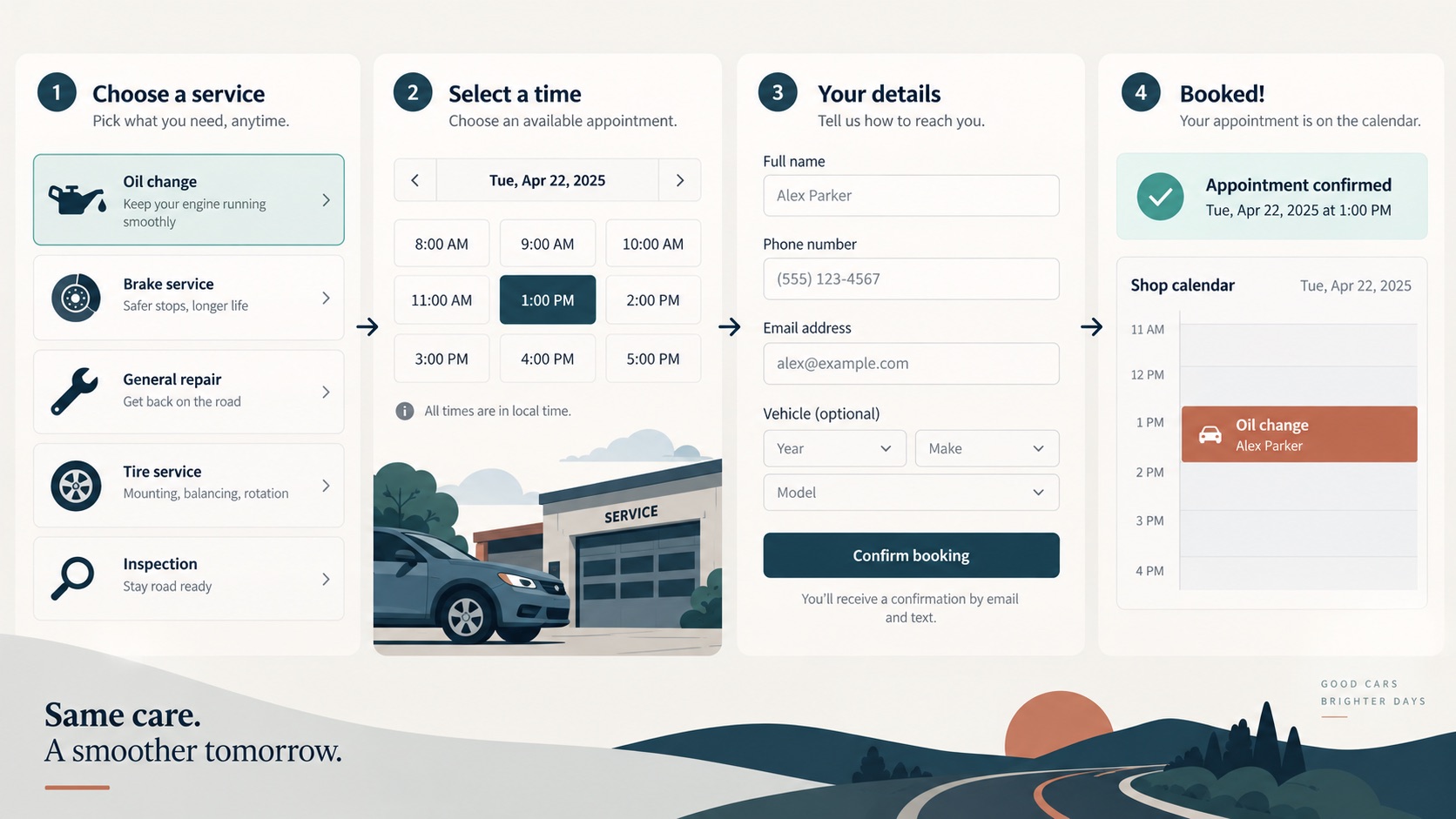
The product is more than a floating button. Its core path starts on a service company's website or Google business profile, lets a customer choose a service through a visual form, and moves that intent toward a booking or inquiry. The official Avenue site currently describes branded forms, calendar booking, confirmations and reminders, SMS conversations, review requests, and an AI call agent. Those are current site claims and do not establish that every feature existed when the company began. The case is valuable precisely because the visible entry point was simple while the delivery and selling work was not.
Watch from about 1:28 for the product explanation, 2:29 for the founder's revenue discussion, 6:18 for early sales, and 9:51 for the product demonstration. The interview is the primary source for business claims; Avenue's own site corroborates the customer workflow and present feature set.
The demand: people are ready to buy, but the business is not ready to receive them
A local customer can discover a mechanic, electrician, or other service provider outside working hours. They may know what they need and want to choose a time. Yet many service businesses still require a phone call, voicemail, or email before the customer can act. From the customer's point of view, that creates a gap between intent and commitment. From the business owner's point of view, the gap can mean missed jobs, repeated administration, and a queue of inquiries to follow up later.
The key question is not whether the shop has a website. It is whether a visitor can make meaningful progress toward a booking at the moment they are motivated. A generic contact form records interest but often pushes the real work back to the business. Avenue's visual path tries to capture service type, timing, and details before staff intervene. Its site describes confirmations and reminders that can reduce missed appointments, plus a floating button offering call, text, quote, or book options. These functions sit around a familiar customer job: “I have a problem; can you help, and when?”
That job explains why an apparently small widget can be valuable. The interface can be only a few screens, while the outcome is a booked service that the business would otherwise struggle to capture. For a mechanic with a healthy job value, one or two additional bookings may matter more than many cosmetic website improvements. This is an inference from the business model, not a published attribution study of Avenue clients. To prove value for a particular customer, the operator should measure completed bookings and show-up rates against a baseline.
The market boundary also matters. Avenue's site says it serves businesses broadly, but the interview says trades responded most strongly during early door-to-door selling. Direct feedback from these operators helped the team narrow the product. A different vertical might need different calendars, quotes, dispatch workflows, safety questions, or payment terms. “A booking widget for every business” is a broad positioning line; “a better way for mechanics to capture after-hours bookings” is a testable use case.
What actually made the product work
n
n
Tom describes Avenue as an embedded website experience that can also connect to Google's booking surface. The customer sees service options visually and can proceed to a purchase path or inquiry. Tom says the backend automation is fundamentally different from a simple appointment-button widget. The official website gives a more concrete current picture: branded booking forms, calendar availability, SMS and email confirmations, reminders, two-way SMS on a higher plan, service add-ons, payments, and reporting. The site also offers an AI after-hours phone agent as a separate priced product.
The product therefore has at least three layers:
| Layer | Customer-visible job | Operational work underneath |
|---|---|---|
| Entry point | Find a Book Online option from Google or the business website | Integration, placement, branding, mobile usability |
| Guided choice | Select a service, add-on, location, or time | Service catalog, eligibility questions, calendar rules |
| Follow-through | Receive confirmation and show up | SMS/email delivery, reminders, owner notifications, reporting |
The value is not the button alone. If the booking ends in a disconnected inbox that nobody monitors, the sale is still lost. The integration and follow-through make the promise credible. This is why copying a floating contact control is unlikely to reproduce Avenue's business. A useful test must cover the entire customer journey from intent through attended appointment.
The website today also lists Standard at A$199/month, Premium at A$395/month, an enterprise tier by quote, and an AI Agent at A$399/month. These are public list prices when researched, not proof of Avenue's historical average contract value or plan mix. The interview does not publish customer count, churn, gross margin, or how many accounts use each tier. Dividing reported revenue by one advertised price would therefore manufacture a customer count.
The $50K headline and the economics below it
Tom says Avenue reached A$85,000 monthly revenue. He also discusses a Stripe view and growth over the prior year, but the spoken transcript of one August comparison is garbled enough that it should not be used as a precise year-over-year figure. The safer facts are the founder's current monthly claim and the public product/pricing information. Even those do not prove net revenue after discounts, tax, or refunds.
It is tempting to call this a “high-margin widget.” The interview argues against that shortcut. Tom explains that he hired a lead designer, a backend lead, and a frontend developer before revenue. He funded the early build with income from a pre-existing marketing agency and roughly 70 hosting clients. This was a bootstrapped product in the sense that it was not presented as venture-backed, but it was not a zero-cost solo side project. A previous business supplied cash and relationships, and a team created the product.
He also lists recurring tools and service costs, including AWS hosting, SMS through Twilio, and AI voice credits. He mentions roughly A$4,000 for Twilio in the interview; the context suggests substantial SMS usage, but it does not provide a complete expense statement. Labor, sales travel, onboarding, support, telecommunications, and payment fees would all affect margin. A feature that requires reminders and two-way messages has variable costs, unlike a static embed. An honest unit-economics model should consider message volume per location, booking value created, staff time saved, churn, and customer support load.
Here is a simple decision model for a potential customer, not an assertion about Avenue's accounts. If a shop pays A$199 monthly, earns A$150 in contribution margin from an incremental attended job, and the system reliably produces two such jobs that would otherwise be lost, the value is A$300 before staff-time savings. That could justify the subscription. But if those bookings would have arrived by phone anyway, attribution is weaker. The right customer metric is incremental attended appointments, not total form submissions.
Why door-to-door sales mattered
The early acquisition channel is the most unusual part of this case. Tom says the team visited local businesses in person and showed the product. At first they demonstrated it on an iPhone. Prospects misunderstood it as a standalone app rather than something embedded in their own website. An employee suggested switching to an iPad, which made the website context and branding visible. They added brochures. The sales process improved because prospects could finally see the outcome in their own terms.
This is not a story about a clever pitch line. It is a story about reducing the cost of understanding a new product. If a buyer cannot picture how a tool fits into their existing website and working day, the feature list will not help. The iPad demonstration crossed that gap. It also created a way to ask better questions: what happens to inquiries after closing time, who confirms a booking, which service choices confuse customers, and what a completed job is worth.
Tom says the team initially entered many kinds of local businesses, from studios to repair shops, rather than choosing trades from a spreadsheet. The trades answered more directly and seemed more interested in a measurable return. Avenue adapted to those needs. This is a different path from deciding the ideal customer entirely in advance. It is a search process in which sales conversations help identify the right market.
That process is not free or universally scalable. Door-to-door selling costs founder time, travel, staff salaries, and repeated demos. Yet for a relatively high-value local service, a face-to-face sale may be rational if the account lasts long enough. The interview does not give acquisition cost or payback period, so we cannot say whether this channel is more efficient than online ads. What it did reveal is that showing the workflow made the offer legible to people who were not already searching for booking software.
A practical experiment for another local niche
The most useful way to apply this case is to select one service workflow and measure the leak before building a broad platform. A founder might choose an auto shop, dental practice, home cleaning service, or specialized repair business, but those examples require their own validation; Avenue's traction with mechanics does not prove demand elsewhere.
- Observe the current booking journey. Search for five to ten local providers on a phone after hours. Count the steps to request a real appointment. Note whether the site offers a form, a call-only number, or an actual available time. This is a discovery exercise, not evidence of sales by itself.
- Interview both sides. Ask prospective customers when they last abandoned an inquiry and ask owners what happened to after-hours calls, missed calls, and no-shows. A business owner may value fewer interruptions more than extra form completions; find out before designing the pitch.
- Prototype one complete path. Build a branded service choice, time request, and confirmation for one vertical. You may simulate back-office routing manually at first, but tell the pilot customer what is manual. The result must be an attended appointment, not a nice-looking button.
- Show the product in context. Put the prototype on the shop's actual website or a realistic staging page and demonstrate it on a tablet as well as a phone. Avenue's experience suggests that the frame changes buyer comprehension.
- Measure outcomes. Record eligible visitors, starts, completed requests, confirmed bookings, attended jobs, booking value, and messages sent. Compare with a comparable baseline period and account for seasonality where possible.
- Offer a paid pilot with explicit success criteria. Define what the customer will pay, what setup is included, and how the value will be judged. A verbal “sounds useful” is weaker than a willingness to pay for an observed improvement.
The timeline should follow the complexity of the service. A simple appointment path may be testable quickly; a workflow involving emergency dispatch or complex quoting may take longer. The sequence matters more than an arbitrary seven-day plan.
Where the model can fail
First, the product depends on the business's operations. A booking system cannot create capacity where none exists, and it cannot fix a shop that never responds to follow-up. Second, integration claims need verification. Avenue says its product works through Google and websites, but a founder building something similar must check the current rules for Google booking surfaces, calendars, customer data, SMS consent, and local privacy law rather than assuming universal access.
Third, the model can be service-heavy. Custom branded forms, onboarding, sales visits, and exception handling may raise costs even when the interface appears simple. Fourth, attribution is easy to overstate. A booking that moved from a phone call to a form is not necessarily an incremental booking. A convincing customer case should compare lost leads, time saved, conversion, and show-up rate—not merely form traffic.
Finally, a new product must win trust from owners and their customers. Customers are sharing contact and sometimes payment data. Owners need confidence that reminders are correct, calendars do not double-book, and calls or messages do not disappear into a vendor dashboard. The strongest sales demonstration therefore includes what happens when the booking succeeds and when something goes wrong.
The transferable lesson
Avenue did not find a secret new category. It translated a stubborn offline buying problem into a short online path and sold it to owners face to face until the best-fitting niche became clear. The founder's A$85,000 monthly figure suggests a meaningful business, but the path involved a pre-existing agency income stream, early employees, on-the-ground sales, and operational integrations. Calling it “just a widget” erases the hard part.
For a builder, the next step is to pick one local buying journey and ask where motivated customers get stuck. Make that step visibly easier, then measure whether the business receives more attended, valuable work. If the answer is yes, the product may be worth paying for. If the answer is only “the button looks better,” you have not yet reproduced the mechanism that made this case interesting.
Sources & further reading
- Starter Story interview with Avenue co-founder Tom Holliday, September 2026 — primary source for founder-reported revenue, build financing, door-to-door sales, and product demonstration.
- Avenue official website — current first-party product features, published plan prices, and customer-facing positioning.
- YouTube original interview — embedded above.