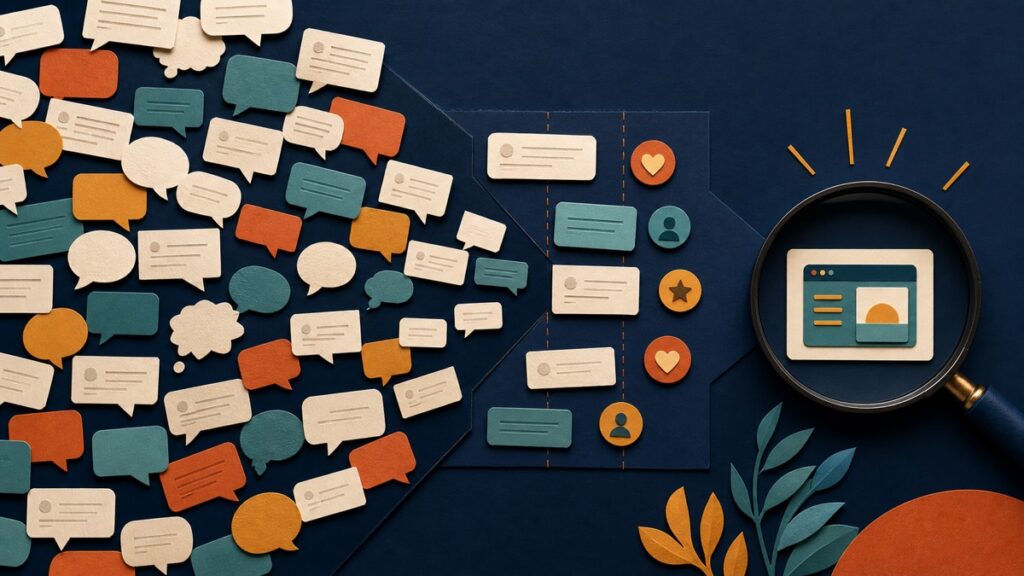

A waitlist is easy to mistake for a marketing widget. At an early stage, it is more useful as a learning system: a way to find the people who care enough to explain their problem, test the product with you, and tell you why they might pay.
A solo founder recently described reaching $2,000 in monthly recurring revenue with 28 paying subscribers after four months. The revealing part was not the revenue. The first version had interest and traffic, but no way to hold on to it. The founder had launched without a waitlist, then rebuilt the launch around beta testers, a simple capture path, and live onboarding calls.
This is a single founder’s self-reported case, not a recipe that guarantees revenue. But the sequence is useful: do not treat interested visitors as anonymous traffic; turn early attention into conversations that change the product.
The costly gap between interest and learning
When someone sees a new product but cannot act, you lose more than an email address. You lose the chance to ask what they expected, what stopped them, and what they would try next. A bare “coming soon” page makes this worse because it gives the visitor no reason to answer.
A strong early waitlist makes a small promise: you will get a useful first look, and the founder will use your feedback to make the product less frustrating. That promise sets up a relationship, not a lead magnet.
The 4-part waitlist that earns its place
1. A concrete problem statement
State the repeated, expensive moment your product addresses. Avoid a broad category label. “A faster CRM” is vague. “A way for a two-person sales team to prepare a follow-up from a call in five minutes” lets the right reader recognise themselves.
2. One qualifying question
Ask a question that changes what you build or whom you invite first: “What are you using now?” “How often does this problem happen?” or “Would you test it on a real project this week?” Do not turn the form into a survey. One useful answer is enough.
3. A specific next step
Say what happens after signup: a short demo, a beta invite, a reply to their answer, or a guided setup. An early product does not need automation. A founder response is often the advantage.
4. A place to learn from use
The founder in the case used short live calls to help people apply the product to their own situation. That makes the call both a demo and the first onboarding moment. It exposes confusing language, missing steps, and false assumptions before churn turns them into silent departures.
Turn a waitlist into a 7-day learning loop
| Day | Action | What you learn |
|---|---|---|
| 1 | Invite five people with the sharpest problem fit. | Whether the promise is clear enough to earn a reply. |
| 2–3 | Run 15-minute calls; ask them to use one real example. | Where onboarding and value language break. |
| 4 | Group objections by pattern, not by loudness. | Which issue affects more than one person. |
| 5 | Make one small fix to the path or product. | Whether the highest-friction step improves. |
| 6–7 | Invite the next five people with the improved version. | Whether the same objection returns. |
Keep notes in three columns: what a person was trying to do, where they paused, and the words they used to describe success. Those words are often better homepage copy than anything a founder invents alone.
Why live onboarding can outperform a polished demo
A recorded demo shows your preferred workflow. A live session shows the customer’s workflow. At the start, that difference is everything. The founder behind the $2K MRR example described offering a short call, helping people use the platform on their actual problem, then making the pre-launch offer. The call created a direct line between claimed value and experienced value.
It will not scale forever. It does not need to. Before product-market fit, scale is not the primary constraint. Repeated confusion is.
Metrics that keep you honest
- Reply rate: how many signups answer the qualifying question?
- Show-up rate: do people make time for a short session?
- Activation: can they reach one meaningful outcome during or after the call?
- Objection recurrence: does the same barrier appear three times?
- Paid conversion after use: do people buy after they have experienced the core job?
Do not optimise the raw list size first. One hundred vague signups can create more work than ten people who can describe the job they want done.
A practical pre-launch checklist
- Put one clear outcome above the email field.
- Ask one question that informs product or segment choice.
- Offer a real next step within a stated time window.
- Invite early people to test a real workflow, not a staged demo.
- Review objections weekly and change only one thing at a time.
- Keep a path for people who are interested but not ready.
Early traction is not a number sitting in an analytics dashboard. It is a growing record of people who had a problem, understood your promise, tried the product, and came back. A good waitlist makes that record possible.
Source note
This article expands on a founder’s self-reported launch and onboarding breakdown. Its numbers are presented as a case, not a benchmark.